
Art
Genalguacil, the Malaga village whose memories are preserved in works of art
The nameless child, the cup from the pantry, the bedtime story and the hopes of the local people have inspired a new edition of an initiative that combats depopulation in the Genal Valley through art
-U00350526487vGv-1200x840@Diario%20Sur.jpg)

The winding road leading to Genalguacil is a warning. “To get to this place, you have to take your time, because it’s going to ... take you somewhere different.”
Pablo Bellot says this three weeks after first crossing the mountains of the Serranía de Ronda, now more aware of the place he has been living in, having got to know its people, and having experienced being greeted in the street as if he were just another local.
And it turns out that this simple gesture - a ‘good morning’ as they walk up the street - is one of the things this current group of visitors appreciate most.
For nearly two weeks now, Pablo, Isabel, Julia, Sara and Wo have been part of the local community in Genalguacil, a village where contemporary art is present on every corner and which, in even-numbered years – such as this one – gains a first-hand experience.
The Genalguacil Art Festival, held every two years, comes of age with its 18th edition. It has been 32 years since this little corner of the Genal Valley decided to combat the neglect and depopulation of the rural world with an artistic initiative that would put it on the map.
And it worked. Today, the population stands at over 500 and the exodus has been halted. But this initiative also had a side effect – something they perhaps did not expect and which surprises those who visit the village every two years: the locals, from the six-year-old boy to the lady in her nineties, have come to regard contemporary art as a natural part of their lives.
They have grown accustomed to their faces, their memories and their belongings being transformed into works of art, just like those currently being created in the workshops - in the form of tapestries, murals, installations or photographs that preserve their memories. And that is by no means common.
-U68733302243dmG-680x476@Diario%20Sur.jpg)
It’s a culture shock for everyone, but for some it’s much more so. “It’s something quite unique,” admit Leung Chi Wo and Sara Wong. They’re from Hong Kong but live in London. They ended up in this white village on the recommendation of a friend in the art world: on a trip to Malaga last winter, they fell in love with the area, “the food, the people”, and wanted to return.
They don’t speak Spanish, but they get on with everyone. “Everyone is very open and welcoming. In a way, we’re learning to communicate beyond words,” says Wo. And when they need to, they always have Google Translate to hand. Because part of their project involved communicating with the village.
Leung Chi Wo and Sara Wong have been searching through the family albums of ordinary people for that person whose name nobody remembers any more - forgotten or unidentified figures whom they wish to honour by bringing them into the spotlight.
In Genalguacil, they found it in a book compiling old photographs of the village. The photograph was taken in Plaza de la Constitución, with several women in the foreground, but it was a boy with his back to the camera, appearing in the background, who caught their attention.
“Do you know that boy or anyone who looks like him? Please contact us via WhatsApp.” They handed out posters bearing that message and the photo, and walked the streets chatting to locals to see if anyone recognised him.
No luck. But then Julián turned up - a six-year-old boy willing to be that faceless little boy from 1968, giving him his rightful place several decades later. Using this updated photograph, a banner will be designed to welcome visitors at the entrance to the municipal car park - the final result of their One’s Own Stranger project.
-U73451365436pkn-680x476@Diario%20Sur.jpg)
For these Asian artists, memory is hidden in those photo albums. For Isabel Bonafé, on the other hand, it lies in those objects passed down from generation to generation and kept in cupboards.
It is "an architectural feature that is lost in modern homes" but which still endures in Grandma’s house as a sort of cabinet of curiosities, with plates, cups and teapots "encapsulated" in time that are no longer used.
The Seville-born artist has visited homes in Genalguacil so that local women can show her their treasures, convinced that these objects hold the oral stories and confidences that women shared with one another over coffee.
An 89-year-old woman showed her an aluminium coffee pot that had belonged to her grandmother; another, aged over 90, brought out the bowl from which women two generations ago used to eat. Isabel Bonafé has collected these and other items and created a negative image of them on napkin paper, “because grandmothers always have one in their hands”.
With all the pieces she has collected, she will create an installation bearing her signature style, featuring light and shadow that play on trompe-l’œil and optical illusions. It is entitled ‘My Oldest Memories are a Hundred Years Old, or Perhaps a Little More’.
That domestic world is also what interests Julia Llerena. She speaks softly, almost in a whisper. It is siesta time on a summer’s afternoon in Genalguacil and her little ones are resting. And that moment of calm has a great deal to do with her work.
The Seville-born artist explores the rituals of protection and affection that mothers and grandmothers practise towards their children and grandchildren; those prayers and stories repeated night after night before bedtime. To this end, she collects small objects found in the bedrooms of Genalguacil - an excuse for their owners to tell her their stories as Night-Time Storytellers (the project’s title).
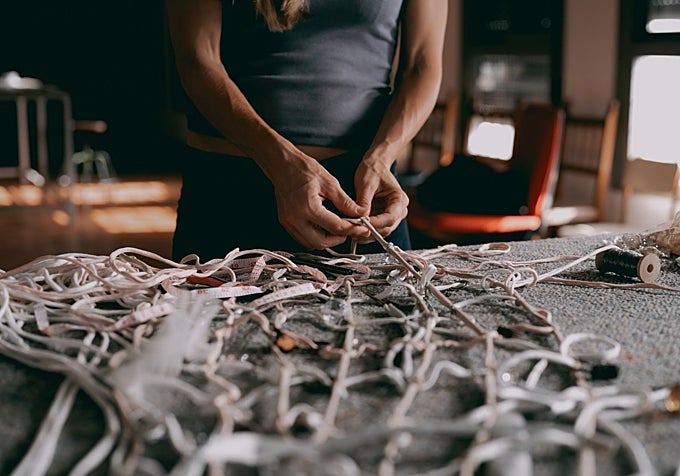
Hairpins, lockets, necklaces, buttons… with all of these, Julia Llerena weaves a tapestry in which she brings all those voices together through "the object, the stitch and the thread".
It is a kind of "woven memory", a way of connecting all that wisdom, "all that presence and that absence too, because some of those people are no longer with us, but those stories live on in our memory". The result will be exhibited at the municipal museum.
What Pablo Bellot is preparing, on the other hand, is intended for the outdoors, to adorn one of the village’s white façades. It will feature what his neighbours think, want, desire or demand.
The Alicante-born artist explains that throwing a stone is a basic and primal act of communication; it is about bringing out something you carry inside.
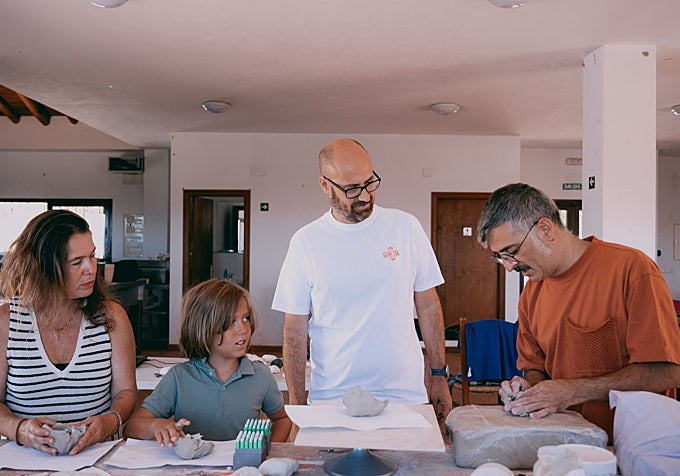
Building on this idea, Bellot invites the locals to create their own ceramic stone and write a message on it. “I hope it reflects everything that the people here have inside them; it’s a poetic way of saying things,” he explains about The Stone as a Message.
His aim was to reach a hundred, a figure that, in a village of just over 500 people, was an ambitious goal. That is why he asked participants as they arrived to make more than one, just in case. But halfway through the project, he already had 101 ceramic messages featuring three recurring words: family, future, dream. “Well, it seems that’s the case - it’s true that contemporary art is part of who they are,” says the Alicante-born artist.
This is the first time in three decades that artists have spent so much time in the village. Traditionally, the residencies lasted two weeks – Genalguacil’s ‘big fortnight’ – during which creative work takes place alongside workshops for children, talks and music in the main square (until 15 August).
But contemporary practices have changed the way art is created. Projects are no longer simply pieces sculpted in the studio, but works rooted in the village that require prior research and a presence on the ground. This year, the residency has been extended to a month and the organisers have opted for just four projects, rather than the six or more of previous editions.
“In this way, the artists get to know a Genalguacil that is closer to what we find at any time of year: a quiet village, with fewer people on the streets, a leisurely pace and more opportunities to have a chat with the locals,” explains Arturo Comas, coordinator of the artists in residence at the Encuentros de Arte in Genalguacil.
They are used to working in fast-paced cities, surrounded by cars and tarmac. “Now I see an eagle perched on the pine tree opposite for hours on end, and I can hardly believe my eyes,” says Pablo Bellot as he describes the workshop he shares with Isabel Bonafé in a building that used to house the old chestnut cooperative.
Julia Llerena is in the village school’s gym, just a stone’s throw from the house where she’s staying at the moment. “Everything’s so close by and so easy!” she exclaims.
Leung Chi Wo and Sara Wong laugh as they admit that the experience is proving “unusual and intense”, like a “summer camp”. They’re focusing on art in contact with nature like never before, but they’ve also made new friends with whom they eat, cook and even swim together. “I’d say I feel younger here,” exclaims Leung Chi Wo.
![[]](http://static.vocstatic.com/voc26/latest/assets/images/favicon/surinenglish/apple-touch-icon-57x57.png)