
Education
'The situation in the Social Sciences and Humanities is horrible, but I didn't come to Granada because of Trump'
US anthropologist Arpan Roy has been awarded the Ramón y Cajal scholarship and has chosen to study in Granada for its history and quality of life
I. Gallastegui
Granada
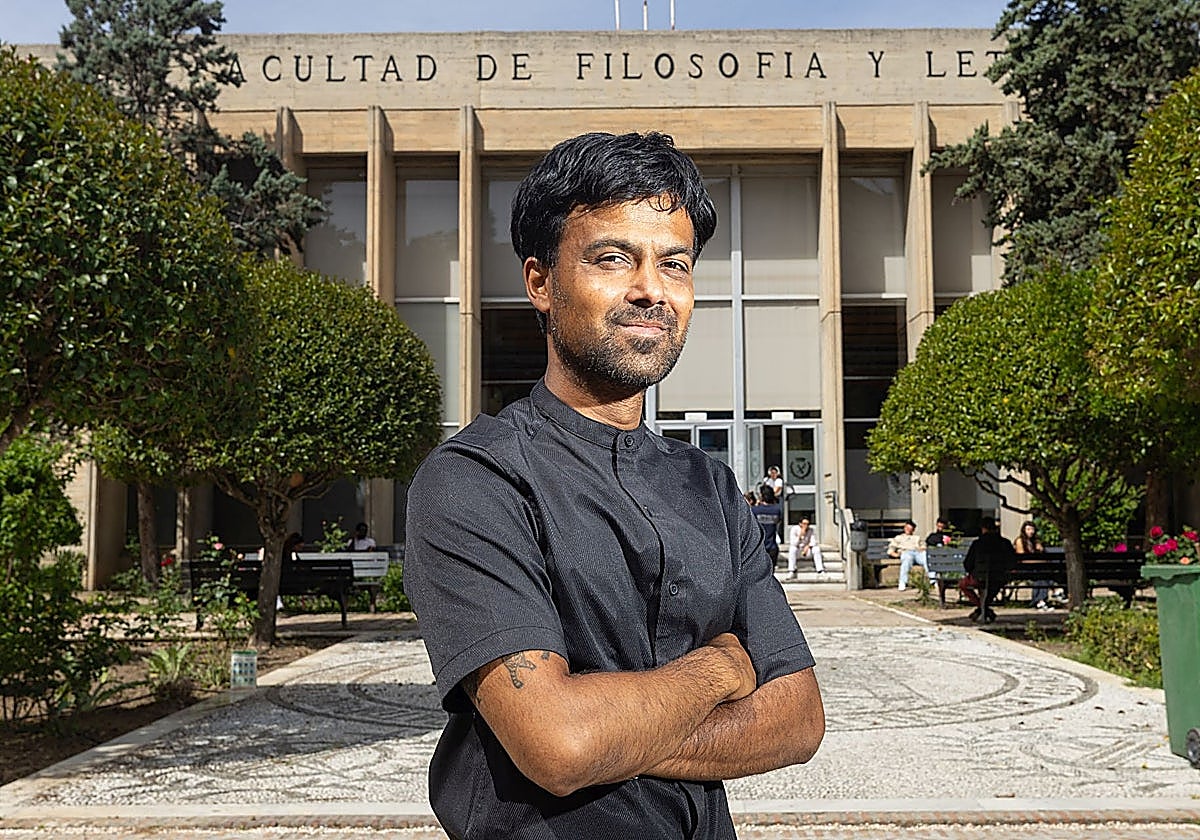
Arpan Roy (Calcutta, 1983) has been awarded the Ramón y Cajal scholarship to study at the University of Granada, having completed his PhD in Anthropology at Johns Hopkins University (Baltimore, Maryland), where he stayed for a year as an assistant professor.
A researcher on the relations between religions and cultures in the Middle East - Christians, Muslims and Roma - in 2023 his family moved to the USA when he was just eight years old and Arpan has US citizenship. He has chosen a life of academia and as well as the PhD, he was awarded a postdoctoral contract by the American government with a US research centre in Jordan and in 2024 another, with European funding, in Berlin.
Roy's most recent scolarship, which has brought him to Andalucía, "had nothing to do with Trump", he says, because by January 2025, when he began his second term, he already had his mind "on the other side of the pond".
However, he does not deny that the situation in science has worsened in the USA and is "horrible" in the humanities and social sciences. "When I finished my PhD in 2021, the job market had already gotten much worse: job availability in my area has fallen by 40 per cent, while in the so-called hard sciences it has grown by 13 or 14 per cent. This is a trend that has been going on for years and has been accelerated by the Trump administration," he explains.
Funding from the National Science Foundation, one of the main agencies for funding social science research and from the Wenner Gren Foundation, which specialises in anthropological studies, has been cut by almost half.
"Job opportunities in my area have fallen by 40 per cent. It is a trend that has been going on for years and the new government has accelerated it".
"In the United States, elite private universities are very closely linked to the market, they function like companies, they have their investments and they respond to the demands of the government, which is closely linked to the arms industry. For example, my anthropology faculty is next to a centre that researches the science of the drones that are being sent to Afghanistan," he says. Social science research does not enjoy that status because it has no industrial application, he reasons.
"Life took me to Europe and my relationship with Spain goes back a long way. I have many friends, I have come here many times and I wanted to live here," he explains. Of the few Spanish universities with a Social Anthropology department, the University of Granada was one of the best, with outstanding names such as the professors José Antonio González Alcantud and Juan Gamella and he believes that in this institution he has room to grow professionally.
Roy was also attracted by the history of Granada, which is closely related to his lines of research and by the quality of life in a medium-sized city that he could not find in Madrid or Barcelona with the same salary as the Ramón y Cajal scholarship. Not forgetting his love of the flamenco guitar, which he intends to continue to cultivate. Just a month ago he moved to Granada with his wife. "It's practically permanent because after five years you have a teaching post at the university", he highlights.
He admits that the difference in salary compared to the United States, where a teacher can start with a salary of 60,000 or 70,000 dollars, is significant, "but so are the costs: there, rent alone costs 2,000 euros a month".
![[]](http://static.vocstatic.com/voc26/latest/assets/images/favicon/surinenglish/apple-touch-icon-57x57.png)