
History
Analysis dispells doubts over authenticity of poems written by Federico García Lorca
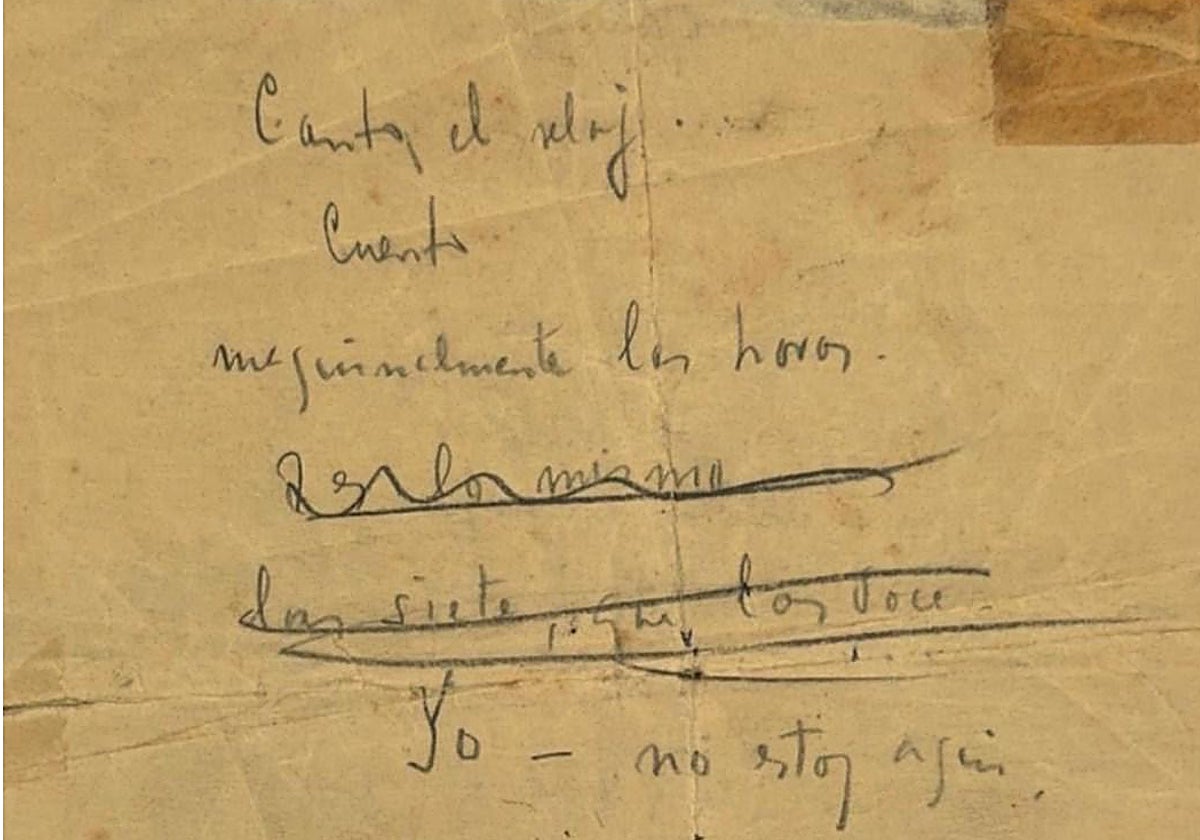
A handwriting study has confirmed that the writing in the Lorca manuscript Canta el Reloj, discovered by the singer Miguel Poveda at an auction in Germany, is that of the Granada poet

Jorge Pastor
Granada
Everything about Federico García Lorca arouses fascination. His life, his work, his symbolic universe, his love affairs, his death…
That is why the discovery of ... a text by the poet from Fuente Vaqueros in Granada province has had such international significance.
And that is precisely what happened on 16 April 2026 when the news broke that the singer Miguel Poveda, who has Lorca tattooed on his own skin, had discovered that on the reverse of the manuscript of La Gacela de la Raíz Amarga, which he had bought from a German antiquarian, there were some verses written by poet. In fact the story made the front pages of newspapers and dominated the television news.
However, there were also researchers, such as Andrew A. Anderson, Professor Emeritus of Spanish Literature at the University of Virginia, and other colleagues, who denied from the outset that the handwriting was Lorca’s.
From that moment on, Miguel Poveda chose to remain silent and await the results of an expert report, which covered document and handwriting analysis that he commissioned from the experts Begoña González and Rocío Martín from Tintaverum, a company that works for institutions such as the Prado Museum. The conclusions of this study prove Miguel Poveda right, as well as Pepa Merlo, the Lorca specialist who stated, beyond any doubt, that those words were written by the Granada poet.

In that document, dated 1933 (although Pepa Merlo theorises that it may be earlier) there was a poem entitled Canta el Reloj (The Clock Sings). “I count the hours mechanically. Seven o’clock is just the same as twelve,” reads the first stanza. “And I am not here,” it continues. “It is the physical marker I left behind, when I set off, so that I might know my place upon my return.”
In their conclusions, González and Martín explain that "no evidence of forgery, tampering or alteration has been found in the document in question, either in its constituent or physical elements or in those that make up its content".
From a handwriting analysis perspective, the experts conclude that, following a thorough comparison, "sufficient and significant correspondences have been found in its graphic, structural and gestural characteristics." Based on all these findings, González and Martín conclude that this copy of Poveda’s Canta el Reloj was written in Federico García Lorca’s own hand.
Merlo laments the "recklessness" of those who concluded that the document was not authentic "based solely on a two-second television clip". He simply urges them to admit their mistake, "something that is part and parcel of investigative practice".
The discovery came about when Miguel Poveda purchased, at an auction in Germany, a handwritten page of La Gacela de la Raíz Amarga, a poem that Lorca dedicated to his friend Julio Casal for publication in the magazine Alfar. Poveda sent a photograph via WhatsApp to Pepa Merlo, who has spent thirty years studying Lorca’s literary output and is the author of the critical edition of El Diván del Tamarit.
On the reverse side
On examining the image, Merlo noticed writing on the reverse side alluding to time and a clock. After comparing the handwriting of the letter ‘q’, the ‘s’s in open endings, the way lines were crossed out and certain conceptual patterns – such as the way ‘yo’ was written or the phrase ‘I am not here’, which matched notes in the García Lorca Archive – Merlo confirmed that it was an original work by Lorca.
With regard to Lorca’s handwriting, from his literary beginnings in the 1910s until he finished La Casa de Bernarda Alba on 19 June 1936, Pepa Merlo asserts that it underwent a remarkable evolution. This variability depended on factors such as the ‘tool’ he used to write (pencil or pen), the thickness of the nib or the speed of the stroke – notes jotted down hurriedly on the go are not the same as those written while sitting calmly at his desk. Lorca’s handwriting was particularly variable in his early years, between 1910 and 1920, although by the 1930s, having reached intellectual and personal maturity, greater stability can be observed from a formal point of view.
The lines of Canta el Reloj resonate with the same mystery that runs through Lorca’s universal works. The lyricism of transience, the desolation of hours that pass irrevocably, and the anguish of a spirit that suspects its own absence. Knowing that these words in Poveda’s document sprang from García's pen allows readers to glimpse once more into the mind of one of the key figures of the Generation of ’27 at the height of its creativity.
![[]](http://static.vocstatic.com/voc26/latest/assets/images/favicon/surinenglish/apple-touch-icon-57x57.png)