
Health
Twice-daily fumigation to curb spread of West Nile mosquito on Costa Tropical
Following the alert pest control company Sanisur is carrying out operations in high-rish areas around Salobreña until 20 August

MJ Arrebola
Granada
Salobreña on Granada province's Costa Tropical has been on alert due to the presence of mosquitoes carrying the West Nile virus since Thursday 23 ... July. The alert was triggered after the Andalusian regional government detected, in one of its monitoring traps, a mosquito that had tested positive for the virus, meaning that this mosquito had, at some point, bitten an animal or bird carrying the disease.
Although no cases in humans have been detected, Salobreña town hall has taken immediate action and contracted Sanisur, a company based in Almuñécar which specialises in pest control, to implement a work plan that will run until 20 August.
Related story
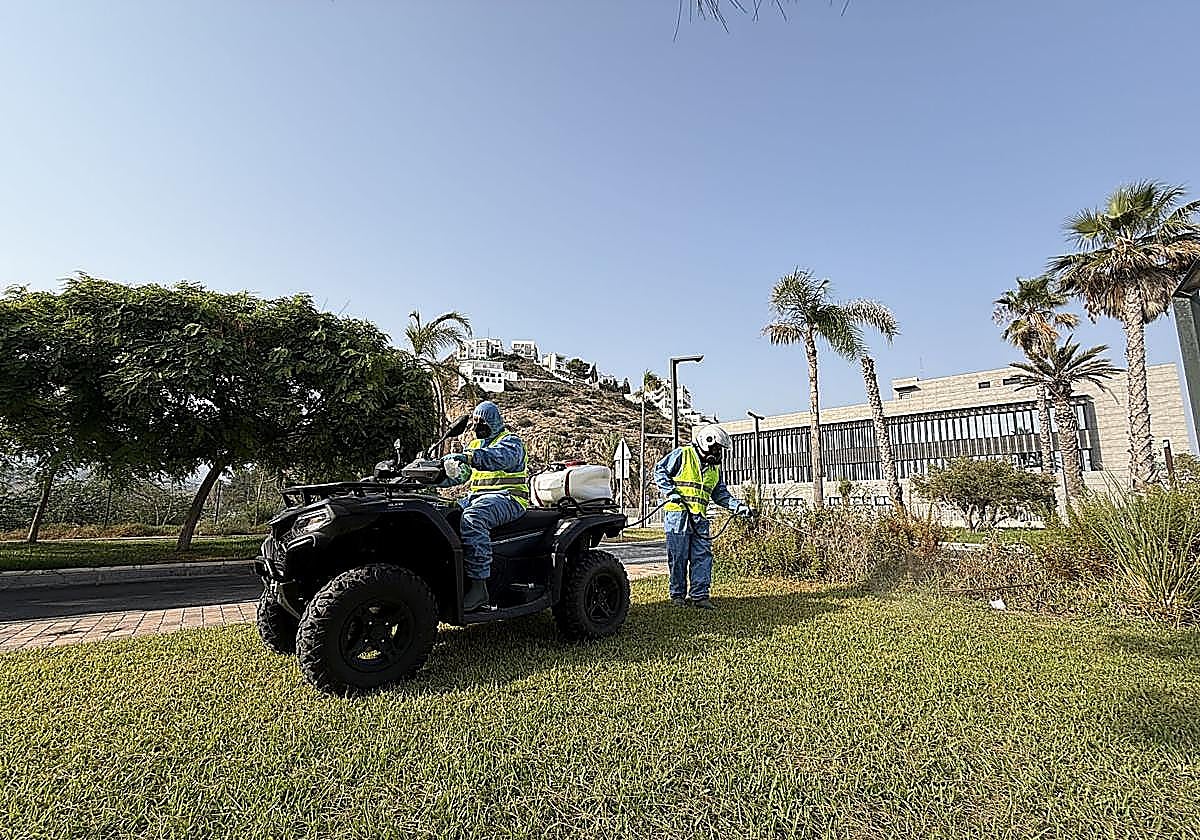
José Francisco del Carpio, the company’s technical director, explained that a total of twelve operatives are working intensively in the area. While one team is "combing" the town’s streets in two shifts – morning and night – three other people are focusing on the administrative side to gather information.
Most active
Treatment operations on the town's streets are concentrated during the times when the mosquito is "most active": in the morning, between five and nine, and in the late afternoon and evening, from six to eleven. The plan involves carrying out a preventative treatment applied directly to the water to stop the larvae from developing, as well as a "mass" treatment against adult mosquitoes.
Del Carpio pointed out that all the products used for fumigation "are authorised by the Ministry’" For the larvae, a biological product is used: Bacillus thuringiensis’ a living organism that works by eliminating the mosquito larvae naturally. For adult mosquitoes, a natural pyrethroid is used, a product with a rapid effect that kills the insect as soon as it is applied.
The protocol they are following requires them to treat the entire wetland area within a radius of one and a half kilometres of any settlement. With spray bottles in hand and wearing personal protective equipment, the workers are carrying out operations along the entire riverbed, in irrigation channels, in areas of reed beds where moisture may have accumulated and also at points near the beach where fresh water mixes with salt water. Furthermore, as a precaution, work is being carried out in all gardens and public spaces that have fountains, irrigation systems or any accumulation of water.
Heavy rainfall
In a message aimed at reassuring the public, the company has clarified that the pond in La Fuente park, one of the most popular spots in the town, “poses no risk, as its water is changed every week, which prevents the larvae from developing”. The message went on to say, “The ducks that live in the pond themselves, along with fish, frogs and turtles found in other bodies of water in the municipality, act as natural predators of the larvae."
This year’s heavy rainfall has caused vegetation to grow rampantly and expanded the wetland areas, and many of these areas, such as the wetlands, are now practically inaccessible due to the large amount of reeds. In those areas where neither a lorry nor a car can get to, the team will be using drones this week to locate all those hard-to-reach areas that may require treatment.
Furthermore, according to information obtained by IDEAL, the company is organising meetings with local irrigators to ask them to close or cover any open water tanks on their properties, as these serve as breeding grounds for mosquitoes. They will also be asking for the cooperation of residents’ associations with lawns, swimming pools or landscaped areas to arrange their own pest control treatments with specialist companies, as, as Del Carpio points out, “this is in everyone’s best interests”.
Website
Sanisur has launched a website (www.sanisur.com) so that any local resident can report standing water or any mosquito-related issue. The company’s technicians review each report and, if it is confirmed to be genuine, mark it on a map on the website itself; if not, it is simply dismissed.
Another feature of the website is that it allows any user to upload a photograph of a bite so that an automated system can determine whether it was caused by a mosquito or another type of insect. As Del Carpio explains, this is one of the most common queries from local residents, who are often unable to identify the source of their bites.
According to the technical director, the aim of these four weeks of intensive work is “to ensure that Salobreña’s risk level falls again and returns to the medium category, the same as that of the other municipalities on the Costa Tropical”.
![[]](http://static.vocstatic.com/voc26/latest/assets/images/favicon/surinenglish/apple-touch-icon-57x57.png)