
Sealife
An 'army' of clones explains the rapid invasion of Asian seaweed on Andalusian coast
Researchers from Granada and Malaga prove that 'Rugulopteryx okamurae' spreads asexually in invaded territories including the Cambriles cove
I. Gallastegui
Granada
A team of researchers from the universities of Granada and Malaga has confirmed that the Asian seaweed reproduces asexually, from clones, which would explain the explosive invasion of this species along the Andalusian coastline, where it was first detected in 2015. It is already causing serious environmental and economic problems from Cadiz to Almeria.
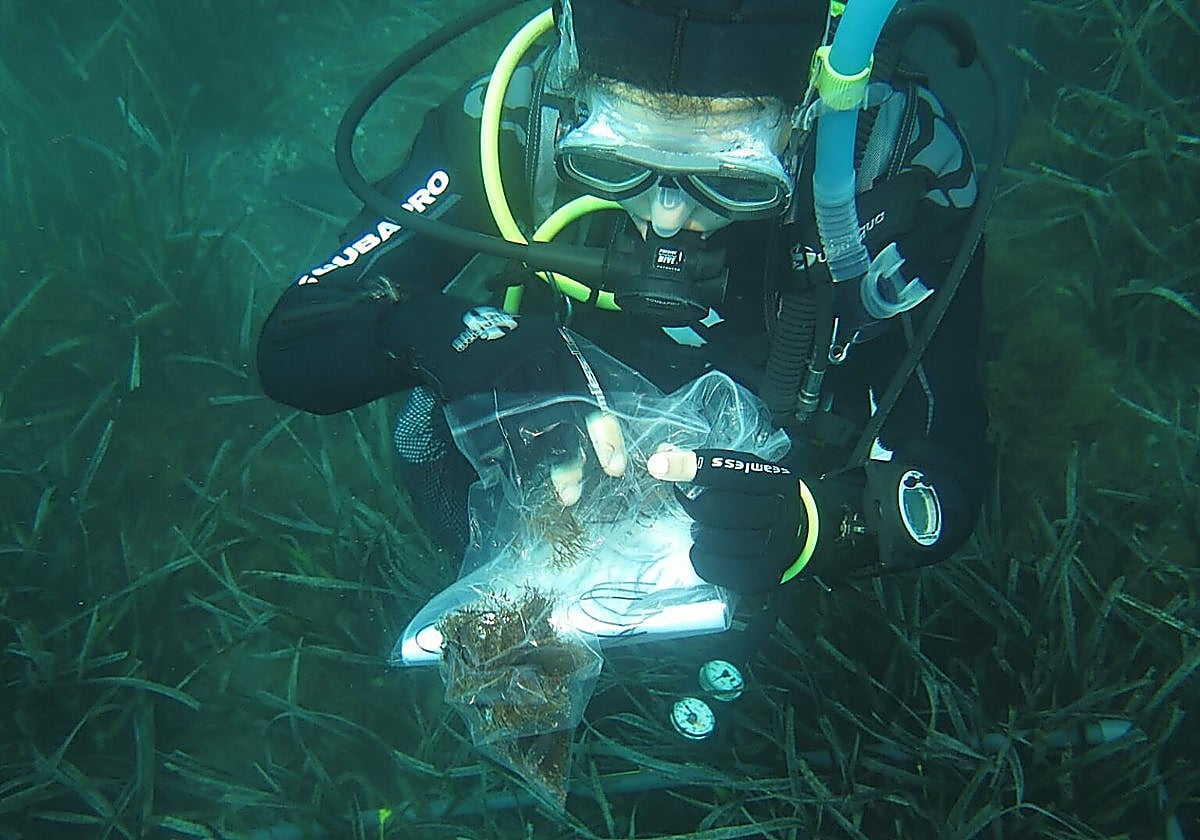
The study, published in the journal 'Marine Pollution Bulletin', reports on the monitoring carried out by scientists over the course of a year in the 'Posidonia oceanica' area of Cala de Cambriles in Lújar, an ecosystem protected for the great biodiversity it harbours.
As the scientists explained through the Descubre foundation, they removed samples of the algae every two months and once in the laboratory, they analysed how many of them had reproductive structures and in what quantity, to calculate their capacity for propagation.
According to this study, whose main author is María Altamirano, who first detected this invasive species in Ceuta in 2015, each of these individuals can generate more than half a million potential specimens per square metre over the course of a year, and their maximum reproductive capacity occurs in spring and summer.
The results of this study help to understand the rapid proliferation of the algae and could contribute to the design of effective control strategies. "Although eradication is only successful with early detection and rapid and sustained action over time, we could try with population controls, applying selective elimination strategies at the most appropriate times, to give native species a chance to develop," Jesús Rosas-Guerrero, researcher at the University of Málaga and co-author of the article, explained to the Descubre Foundation.
Previous research had discovered that 'Ruguloterix okamurae' can reproduce both sexually, by means of gametes and tetraspores, which provide genetic variability in populations, and asexually, i.e. with a single progenitor individual, through clones - propagules, small stalks capable of detaching and growing to form a new specimen - or spores, cells which, when germinating, generate an individual.
However, the Andalusian researchers' analysis has concluded that, outside its original habitat, in an invaded territory, the predominant form of reproduction is asexual: propagules were detected practically all year round and asexual spores, especially in spring and summer.
In view of these results, the researchers believe that, with this explosive reproductive capacity, part of these specimens remain in the water column, living and travelling in it to new areas, without needing to settle in a territory, which would explain their rapid expansion and the presence of large floating masses on the coast.
Environmental and economic crisis
The invasive algae originating from the coasts of Japan, China, Korea and the Philippines first appeared in the area of the Strait of Gibraltar eleven years ago, apparently brought by merchant ships, and on the Atlantic coast of Andalucía it has become a very serious problem.
In Granada province, although less abundant, it was detected in nets by fishermen in 2019 and has been gaining ground underwater ever since especially in Maro-Cerro Gordo, La Herradura, El Tesorillo de Salobreña, Castell de Ferro and La Mamola.
This invasive species grows in shallow waters - between 0.5 and 15 metres - and on rocky bottoms, has a thallus of between 10 and 20 centimetres with fan-shaped branches, and outside its original habitat grows uncontrolled because in this area, unlike its original habitat, it doesn't have predators.
As well as affecting native species, decomposition reduces oxygen and light in the environment, which worsens the survival of other species, from invertebrates that live in symbiosis with native algae to orange corals and gorgonians, as well as posidonia meadows, a highly vulnerable plant endemic to the Mediterranean and valuable for its ability to filter the water and the great biodiversity it attracts around it.
In addition to the environmental damage it causes, 'Rugulopteryx okamurae' ruins fishing gear and reduces fishermen's catches. It also means a great economic cost for local councils, which have to remove it from beaches to avoid the inconvenience it causes to tourists: bad smell, insects and difficulty in bathing in the sea.
The study was financed by the Biodiversity Foundation, part of the Ministry for Ecological Transition and the Demographic Challenge, and the Andalusian Regional Government's Department of University, Research and Innovation through Feder funds.
![[]](http://static.vocstatic.com/voc26/latest/assets/images/favicon/surinenglish/apple-touch-icon-57x57.png)