
Wildlife
The curious sea animals that live off the coast of Almeria
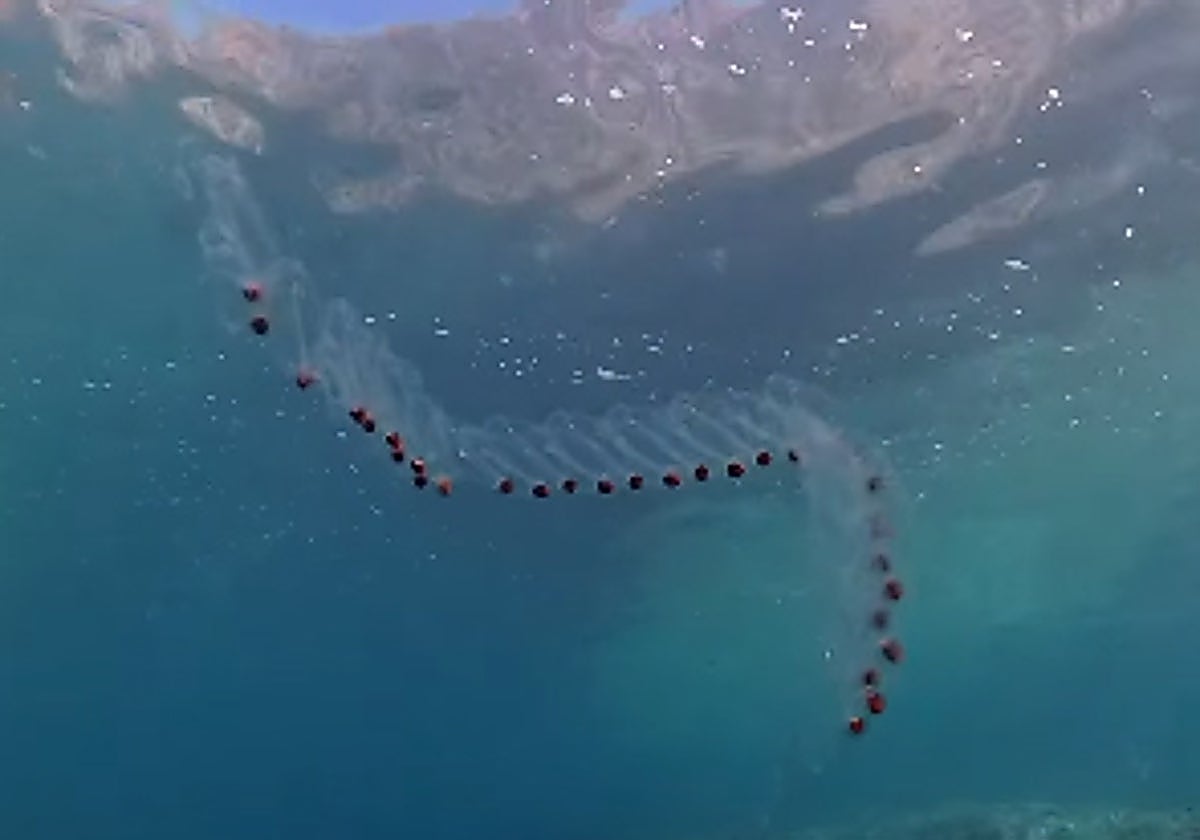
Diver David Chaquete has posted videos on his social media accounts showing some of the most unusual creatures that inhabit the depths of the province's coastline
E. Gabriel Llaneras
Almería
There is a world off the coast of Almeria province that most swimmers are oblivious to. Only a few, like diver David Chaquete, can reach ... these depths and capture images of the most unusual species and he has just posted a video on his social media in which he shows some of what is lurking under the sea.
One of these species is the Forskalia edwardsii, an unusual name that describes a floating colony formed by a multitude of translucent zooids which together can reach two metres in length. It is common on the eastern coast of Spain and usually lives in shallow open waters, drifting with the currents, although after strong storms it can appear in areas closer to the coast.
The salp, transparent and inoffensive
Another species featured in this publication is a salp, an organism with a transparent, cylindrical body that looks more like a barrel pumping water to get around and is often mistaken for jellyfish or even pieces of plastic.
They are absolutely harmless and do not sting. They can join with others like them to form rows more than a kilometre long, known as the Venus belt. They play a key role in the health of the oceans, feeding on phytoplankton, absorbing carbon and transporting it to the deep sea and helping to reduce CO2 in the atmosphere.
Glowing creatures
Pyrosomes are also seen in the video. These free-floating, glowing colonies of hundreds to thousands of tiny marine organisms called zooids produce a very bright bioluminescence that provides the perfect snapshot for any diver who comes across them. In fact, they are the brightest luminous planktonic organisms in existence and it is estimated that their light can be seen, in clear water, up to 100 metres away.
Jellyfish dupes
Most of the species that appear in this curious video look at first sight like jellyfish, although none of them are: beroe ovata, or comb jelly, which has an elongated body which can grow up to 16 centimetres long, is flat and is completely transparent, with a very dilated pharynx that occupies almost the entire volume of the animal and with which it is capable of ingesting relatively large prey.
The most striking thing about this species is its diet. It feeds almost exclusively on other ctenophores, which makes it a specialised predator within its own animal group and this means that swimmers in the seas off Almeria province who do come across it have nothing to worry about.
![[]](http://static.vocstatic.com/voc26/latest/assets/images/favicon/surinenglish/apple-touch-icon-57x57.png)