
Environment
Almería’s El Algarrobico hotel licence overturned by Andalucía’s advisory council after 20-year deadlock
Binding ruling forces Carboneras council to annul 2003 permit, bringing demolition of the illegal beach resort in Spain closer

Sevilla
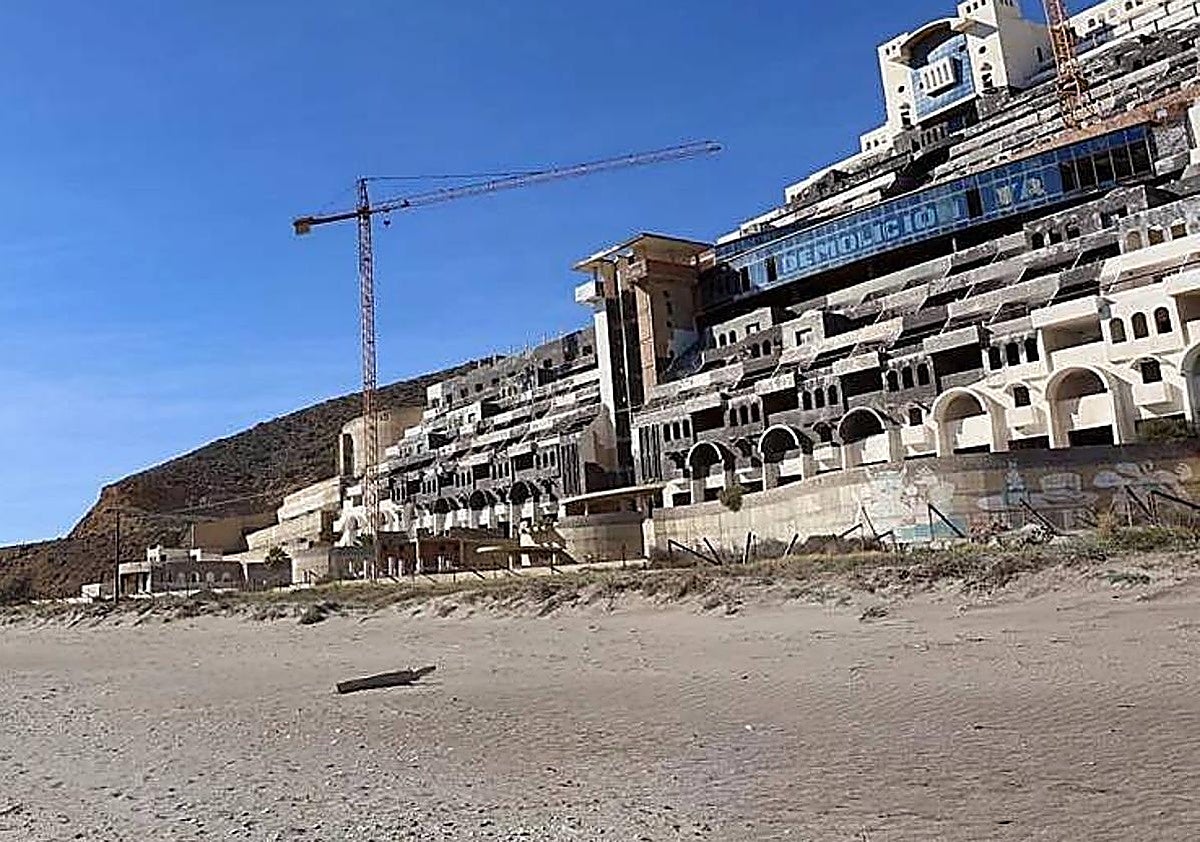
The illegal 21-storey El Algarrobico hotel may finally be demolished after a decisive ruling cleared a 20-year administrative gridlock over Carboneras beach.
The ... Permanent Commission of the Consultative Council of Andalucía has ruled unanimously that the planning permission granted in January 2003 to build the hotel is null and void.
This mandatory and binding ruling forces Carboneras Town Council to officially ratify the permanent invalidation of the planning permit in an upcoming plenary session.
The decision dismantles the legal framework that has kept the 411-room complex standing. The hotel was built by developer Azata del Sol in the Cabo de Gata-Níjar Natural Park, completely changing the image of a pristine beach on Almería's Levant coast.
Related story
-

Environment
Europa Press
The ruling validates the local council’s proposed resolution, which aimed to comply with judicial mandates issued by the High Court of Justice of Andalucía in 2021 and the Supreme Court in 2022.
Both judicial bodies had previously ordered the Almería municipality to open an official review procedure due to the accumulation of irregularities detected in the original permit.
The primary argument in the advisory council’s text rests on the blatant encroachment onto a protected natural area. Legal experts rejected the thesis maintained by the local administration for years, which claimed that a 1994 zoning plan classified the affected sector as buildable land.
A meticulous inspection of the original mapping from the Natural Resources Management Plan, published in the regional official gazette, proved that the plot enjoyed C1 protection. This status corresponds to natural areas of general interest.
This classification disqualified the land from any residential or hotel development. The municipal permit violated a higher-ranking environmental regulation that took precedence over local powers.
Added to this argument is the clear violation of the 1988 Coastal Law, which established a 100-metre protection zone from the shoreline. The hotel project had taken refuge under a partial zoning plan approved shortly before the state law came into force, which had reduced that margin to just 20 metres.
Sectoral plan
Sectoral plan
The Consultative Council determined that Carboneras town council should have adapted its sectoral plan to state requirements before approving the project. Failure to follow this directive resulted in the unlawful occupation of public maritime-terrestrial domain.
The body dismissed the arguments of the construction company, which claimed that the passage of more than 20 years prevented the annulment. Legal experts clarified that expiry deadlines do not apply in this case, as the delay was caused by the dense litigation that kept both parties occupied over the last two decades.
The text validates the report issued in March by the town clerk and leaves the calculation of any potential compensation claims by the private firm to a later procedure, arguing that the local authority currently lacks the means to carry out that assessment.
The resolution weakens the developer’s position regarding future claims for financial compensation, as the nullity from the outset deprives the builder of holding any grandfathered rights.
Azata del Sol had previously demanded €70 million in past lawsuits, a figure that environmental groups now consider nullified following this ruling.
Environmental organisation Greenpeace reacted to the decision by urging the local council to execute the mandate swiftly so that the demolition machinery can move in.
The group pointed out that there are no longer any bureaucratic hurdles left to delay the tearing down of a building they define as the ultimate symbol of coastal overdevelopment.
Unfulfilled commitment
The current situation contrasts sharply with the outlook in February 2025, when the First Deputy Prime Minister of Spain, María Jesús Montero, visited the area to announce a declaration of public utility that would allow for the partial expropriation of the state-owned plots.
That announcement, which coincided with a political offensive by the Regional Government of Andalucía regarding the expansion of protected spaces in Doñana, sought to challenge Andalucía's environmental management dominance.
The regional government criticised the initiative at the time, viewing it as a unilateral move outside the agreements of the joint monitoring commission.
The regional executive argued that the expropriation route threatened to drag the conflict through the courts indefinitely, and that the most efficient path required the town council to annul the licence - an option the advisory council has now endorsed.
The acting Regional Minister for Public Works, Rocío Díaz, described the ruling as a "decisive milestone" and called on the Mayor of Carboneras, Salvador Hernández, to act with maximum agility to convene the plenary session to officialise the legal death of the 2003 permit.
This validates the Andalusian judicial strategy over the central government's expropriation route, which remains stalled in the courts over compensation disputes.
The Carboneras mayor accepted the challenge, confirming that the local council will debate the measure shortly, though he pointedly noted that a municipality of 8,000 residents operates with limited resources.
Hernández appealed for institutional loyalty from other tiers of government to ensure the town does not become the sole victim of a legacy mess.
Simultaneously, the central government delegate, Pedro Fernández, defined the concrete skeleton as the "ultimate example of wild overdevelopment" and claimed that the expropriation work started in 2025 was the true catalyst for speeding up the process.
From the Ministry for the Ecological Transition and the Demographic Challenge, officials defend that the central executive’s resolve has been decisive in forcing the revival of a procedure stalled by the inaction of other institutional spheres.
The same ministry sources stressed that the nullity of the licence was always the position backed by the state, in harmony with judicial rulings that had long been ignored, meaning they view the advisory opinion as a definitive step forward against what they term an aggression on the natural environment.
Following the ruling, the government has urged an immediate meeting of the monitoring commission for the agreement signed with the regional administration to coordinate the demolition of the structure and the environmental restoration of the plot.
This formal reactivation of the 2011 protocol commits the central government to fully funding the demolition of the 411-room behemoth.
For its part, the Regional Government of Andalucía will take on the tasks of clearing the rubble, waste management, and the landscape restoration of the coastal natural environment.
The joint plan of both administrations adds a social component through the design of a green employment scheme and the establishment of a workshop school in the Natural Park.
This initiative will focus training for local youth on the recovery of coastal ecosystems and the development of the future adjacent marine protected area, attempting to turn the remnants of the conflict into an engine for job creation in the region.
![[]](http://static.vocstatic.com/voc26/latest/assets/images/favicon/surinenglish/apple-touch-icon-57x57.png)