
Art
The Museo Casa Natal Picasso rescues Marisol Escobar, the forgotten queen of pop art
The exhibition Neither Muses Nor Models vindicates the Venezuelan artist alongside other creators such as Dorothea Tanning and Helen Frankenthaler
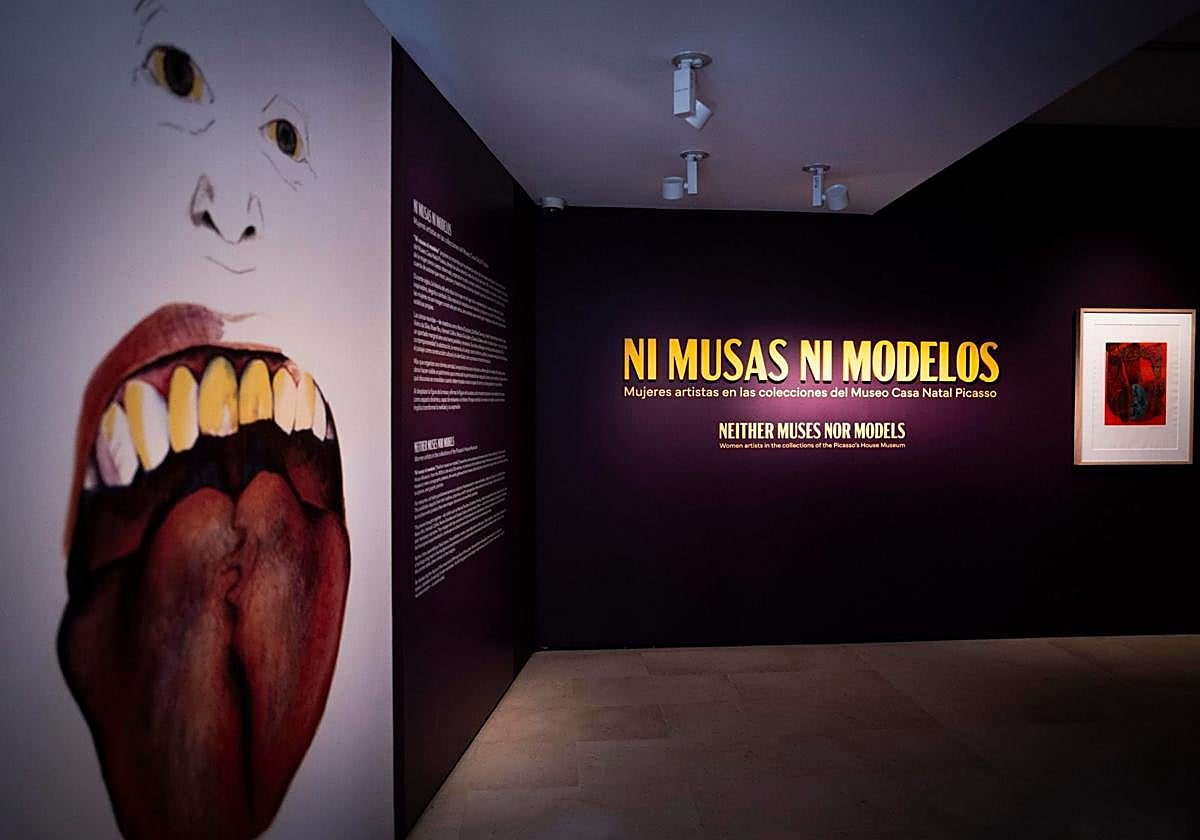

She was a mysterious woman, often hidden behind sunglasses and long silences. But Marisol Escobar became one of the most famous artists of the 1960s. ... She was on the cover of Vogue and Harper's Bazaar and one of the few women to participate in 1968 in the fourth documenta in Kassel, one of the most prestigious contemporary art exhibitions in the world, held every four years in Germany.
The Museo Casa Natal Picasso now presents the exhibition Ni Musas Ni Modelos (Neither Muses Nor Models), which vindicates Escobar, whose work Saco La Lengua (I Stick Out My Tongue) is the image of the exhibition, and another thirty artists such as Dorothea Tanning and Helen Frankenthaler. But let's return to Escobar.
Her mother's suicide when Marisol was barely eleven years old created a wall between her and the world that she never fully broke down. Her reaction to the tragedy was silence. Literally: she barely spoke until she was in her twenties. That drama and her subsequent condition as a mute child and adolescent forged a peculiar way of observing reality, of looking at the world.
Her unhappy family history contrasted with her economic privilege. Born into a wealthy Venezuelan family, she grew up in Paris and lived between Caracas, the United States and Europe, which also allowed her to train at the Otis Art Institute and the Jepson Art Institute in Los Angeles, to study painting at the École des Beaux-Arts and to receive private lessons at various public schools in New York from instructors such as Hans Hofmann, himself a teacher of Jackson Pollock and Lee Krasner.
Her American adventure, after a dangerous flirtation with drugs that went on for several years, led her to meet Andy Warhol in the early 1960s. She was then much more famous than he was, the queen of pop art. She had exhibited at MoMA and was frequently featured in publications such as Time, Life and the New York Times. Warhol, dazzled by her magnetism and enigmatic halo, called her "the Latin Garbo", the first artist "with glamour".
Paradoxically, the passage of time has often reduced her to Warhol's muse, she who always tried to demolish the patriarchal construction of history. That is why her inclusion in the exhibition at the Casa Natal, under a title that combats the classic stereotype of muses and models, redresses in a way that old injustice.
Even then she was attracted to science fiction and sculpture, a fascination transferred to her unique combinations of drawn and carved surfaces, body casts and other objects that were soon praised by critics and collectors. Then came the portraits, always satirical, provocative and she became a celebrity: thousands of people queued to see her exhibitions. But her art was not inoffensive. Criticism of convention and gender roles was a constant in her work, which challenged gender and sexuality norms, police repression, Cold War politics and the treatment of immigrants.
Escobar became a celebrity: thousands queued to see his exhibitions
She continued to travel, visited India and different parts of Southeast Asia, learned to dive until she found underwater her greatest refuge beyond art, far from a world that always seemed too constricting, a corset that was too tight. On her return, things had changed. The market and the official narrative of pop art, dominated by men, did not sit well with her feminist and critical gaze. She didn't mind too much.
Far from striving to maintain her status, she became obsessed with pre-Columbian art. Her popularity waned until she fell into obscurity, into the silence that gave rise to it all. She died ten years ago, well into her eighties and a prey to Alzheimer's disease. The Guardian defined her as "the forgotten star of pop art", the woman who could have been everything but preferred silence.
More than forty works and four months of duration
In addition to Escobar's work, Neither Muses Nor Models brings together artists such as Dorothea Tanning, Helen Frankenthaler, María Elena Vieira da Silva, Roser Bru, Hannah Collins, Marisa González, Elena Laverón, Teté Vargas-Machuca and Susana Solano. Their works dialogue with the great debates of contemporaneity: abstraction, memory, the body as a political territory, technological experimentation, landscape as a cultural construction and identity as a process in transformation. The more than 40 pieces that make up Neither Muses Nor Models, an exhibition in which the Fundación La Caixa is collaborating, come in their entirety from the collections of the Museo Casa Natal Picasso, in some cases from donations by artists and collectors. The exhibition, curated by Mario Virgilio Montañez, head of Cultural Promotion at the Museo Casa Natal Picasso, was inaugurated last week by Luis Lafuente, director of the Public Agency for the management of theCasa Natal and other museum and cultural facilities; Juan Carlos Barroso, territorial manager in Andalucía, Ceuta and Melilla of Fundación La Caixa and Enrique Sánchez, director of the Business Area of CaixaBank in Malaga. The exhibition can be visited until 13 September.
![[]](http://static.vocstatic.com/voc26/latest/assets/images/favicon/surinenglish/apple-touch-icon-57x57.png)