
Art exhibition
Almodóvar sneaks into the Thyssen Museum to prove that ‘Spain is different’
From Goya to Barceló, ‘¡Olé!’ traces two centuries of Andalusian stereotypes that came to define Spain around the world, from the Romantic travellers to the ironic and avant-garde perspective of contemporary art
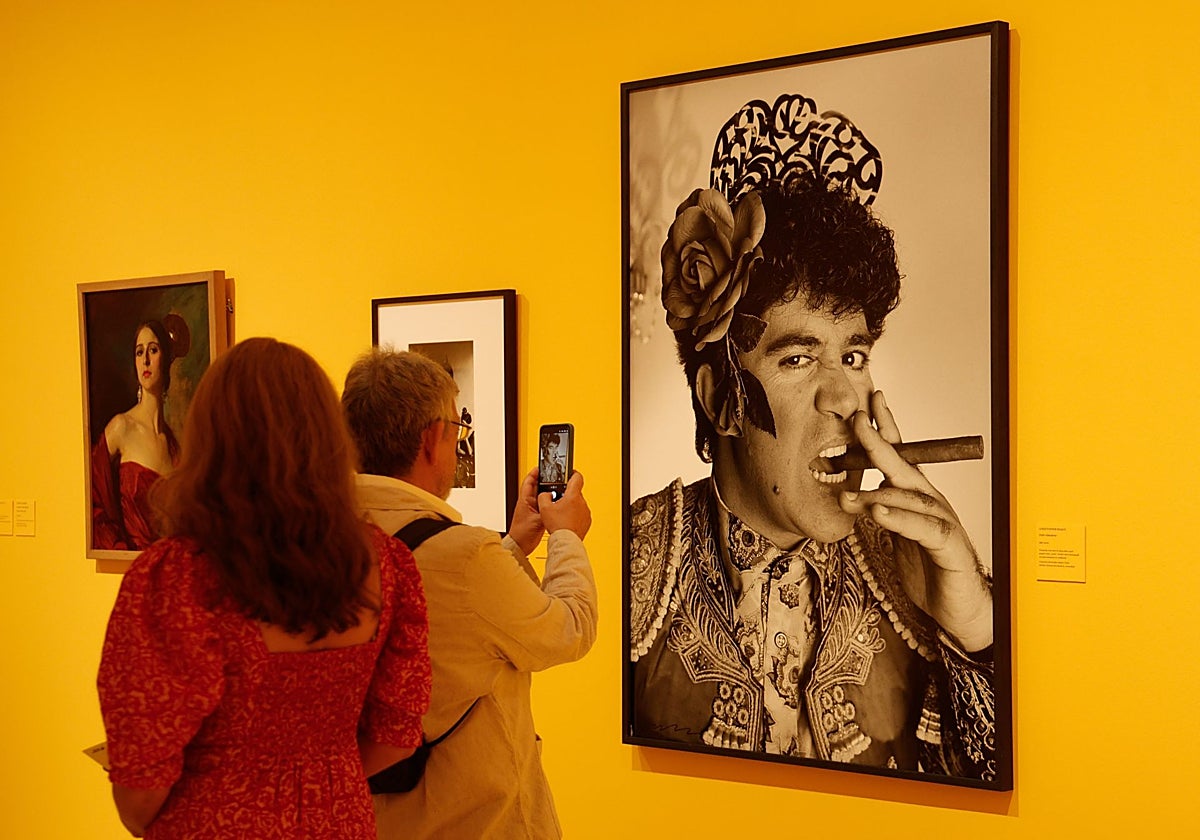

Pedro Almodóvar looks into Christopher Makos’s camera in 1985 with a flower in his hair, a cigar between his fingers and dressed as a ... bullfighter. The legendary director from La Mancha plays with clichés: it couldn’t be more Spanish. Or could it? A few steps away, Camarón opens his mouth for Alberto García-Alix’s lens. A bullfighter by Manolo Prieto raises his arms in the middle of a bullring whilst an Iberia aeroplane flies overhead. Juan Barjola takes bullfighting into far more violent territory, whilst Miquel Barceló reduces it almost to pure geometry: a huge circle of sand, with the bull and the bullfighter, tiny figures, at its centre. And on an old television screen, the slogan with which Spain learnt to sell its uniqueness abroad reappears: ‘Spain is different’.
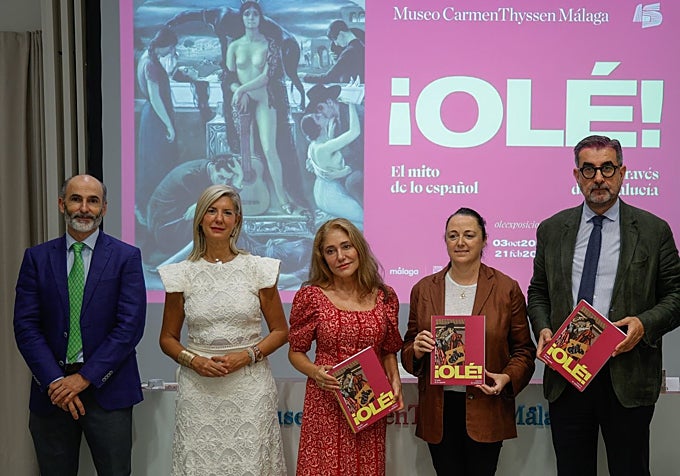
All of this - from Goya to Cristina García Rodero, from Picasso to Sonia Delaunay - is covered in ¡Olé! El Mito de lo Español a Través de Andalucía¡ (Olé! The Myth of Spanishness through Andalucía), the temporary exhibition with which the Carmen Thyssen Museum in Malaga is celebrating its fifteenth anniversary by posing an uncomfortable question: how much of it is true, how much is fiction and how much is commercialisation in that image of Spain - with its flamenco, bullfighting, mantillas, guitars and gypsy women - which the world came to recognise even before visiting the country.
The exhibition spans the walls of the museum’s third floor, featuring more than seventy works by some fifty artists, with nearly two centuries separating one artistic vision from the next. Zuloaga, Romero de Torres, Sorolla, Saura, Equipo Crónica and Pilar Albarracín also form part of a narrative that deliberately blends eras and artistic languages. The aim is not to compile a collection of Spanish images, but to consider how a handful of symbols - almost all of them Andalusian, incidentally - came to shape, both within and beyond our borders, a recognisable image of an entire country.
“Many of these stereotypes are still alive and well 200 years on: they can be found in souvenir shops and in the minds of many tourists,” says curator Bárbara García
The story began a long time ago. Romantic travellers of the 19th century found here a land that seemed to them far removed from industrialised Europe, and exotic enough to be worth writing about. Andalucía ended up providing many of the characters and settings for that image of Spain as imagined from abroad. Lourdes Moreno, artistic director of the Thyssen, recalled during the presentation the accounts of travellers such as Richard Ford and George Borrow. Then came ‘Carmen’. Bizet’s opera, which premiered in Paris in 1875, transformed a free-spirited and rebellious Sevillian gypsy woman into one of the most universally recognised Spanish characters - paradoxically, even though its composer had never set foot in Spain.
Andalusian art thus came to occupy a large part of the ‘Spanish’ artistic landscape. And it did not always take the same form. Sorolla found light, colour and festivity; Zuloaga, Gutiérrez Solana and Romero de Torres, on the other hand, looked towards a considerably darker, less welcoming Spain. In the galleries of the Thyssen, the two coexist: the one that fascinated with its joy and exoticism, and the other, harsher side, which also came to form part of the country’s portrait. The exhibition, explains Moreno, aims precisely to go beyond a "complacent" interpretation: alongside "costumbrismo", there is "criticism, irony and an avant-garde perspective that differs" from that of 19th-century painting.
Because Spain ended up doing something rather amusing with that imagery: selling it. Tourism turned flamenco, bullfighting, sunshine and partying into selling points, right down to the ‘Spain is different’ slogan that Juan Rabascall revisits in the exhibition, now imbued with a different meaning. Manolo Prieto’s poster for Iberia tells the story almost without needing any explanation: an aeroplane flies over the bullring whilst the bullfighter raises his banderillas. The cliché also served to fill aeroplanes.
But ‘¡Olé!’ goes beyond simply examining how that image was constructed. “We have images that are parodic, critical and even subversive or defiant in the face of stereotypes,” explains Bárbara García, curator of the exhibition alongside Alberto Gil. And therein lies one of the exhibition’s greatest successes: a bullfighter, a guitar or a flamenco dancer may remain, but the perspective is no longer that of the traveller who arrived in Andalucía in search of the exotic. The museum’s own press release speaks of a journey where tradition and the avant-garde, "officialdom and subversion", clash continually. This is where the visions of Picasso, Saura and Barceló come into play.
Photography takes this interplay even further. In Toros en Ronda, Cristina García Rodero draws on a tradition that has so often been used to construct the ‘Spanish image’, but she does so by getting close to those who live it, thereby humanising the cliché. And in Camarón, García-Alix dispenses with the guitar, the stage and practically every other element needed to identify flamenco. Nor does he need them. "Within that myth there are myths with their own names, as is the case here," noted García.
Almodóvar dressed as a bullfighter, García-Alix’s Camarón and García Rodero’s Toros en Ronda sit alongside Goya, Picasso and Sorolla
Because, after all, those codes are still at work. “Many of these stereotypes are still alive 200 years on,” acknowledges the curator. “They’re in the souvenir shops, they’re in the minds of many of the tourists who visit us, and we use them too to promote ourselves.” This persistence ultimately gives meaning to an exhibition that does not seek to determine how much was true or false about that Spain, but rather to show what we have done with its image over the past two centuries. We have painted it, photographed it, exaggerated it, sold it, criticised it and even parodied it. And, despite all that manipulation, we still recognise it.
¡Olé! El Mito de lo Español a Través de Andalucía will be on display until 21 February 2027 and brings together loans from nearly forty collections and institutions, including the Prado, the Reina Sofía, the IVAM, the Sorolla Museum and the Fine Arts Museums of Granada, Seville and Bilbao.
![[]](http://static.vocstatic.com/voc26/latest/assets/images/favicon/surinenglish/apple-touch-icon-57x57.png)