
Art
One of Murillo’s most iconic works is returning to Spain after almost a decade to be exhibited in Malaga
La Virgen de la Faja will be featured in the new exhibition organised by the Unicaja Foundation, which is due to open next week
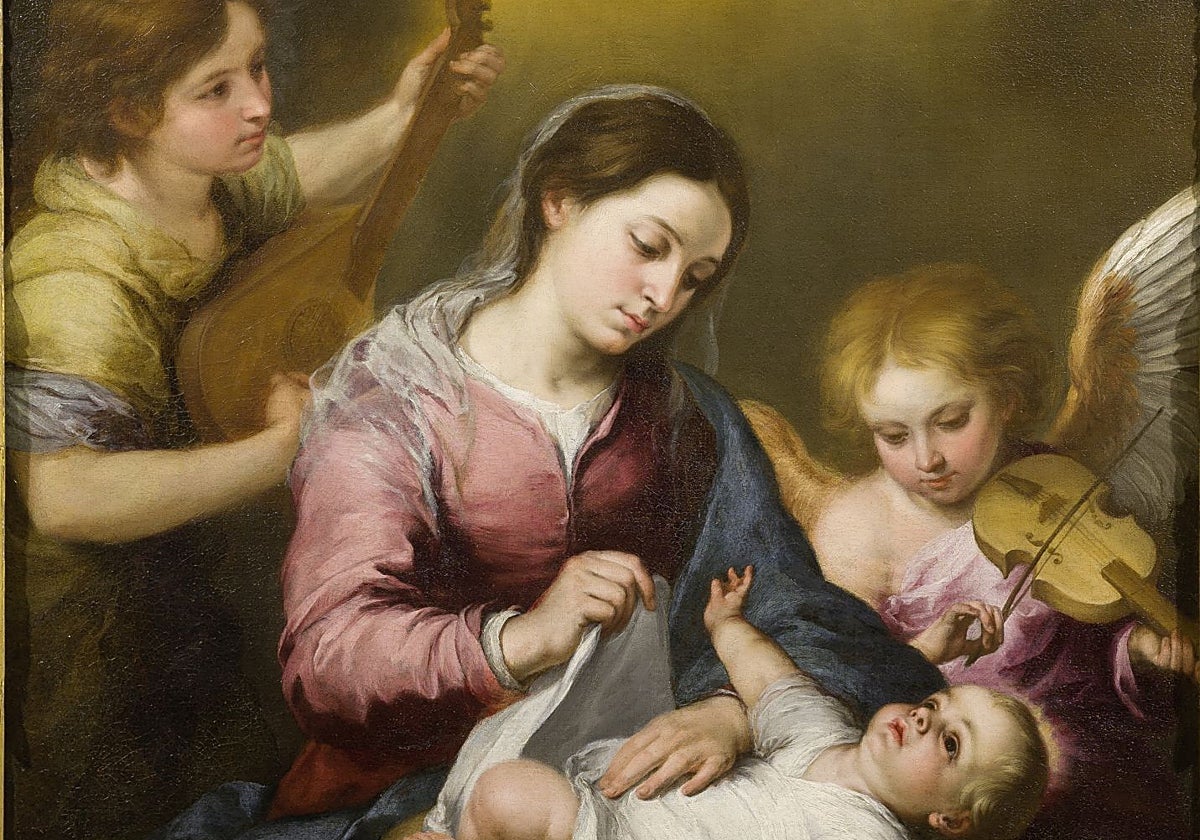

After almost a decade away, La Virgen de la Faja, one of Murillo’s most unique and intimate works, is returning to Spain. The painting, ... whose last Spanish owner was the Duke of Montpensier, began an international journey in the midst of the Civil War, passing through private collections across half the globe, from Japan to Switzerland, drawn by one of the Sevillian master’s most celebrated religious compositions: the Virgin leaning over the Infant Jesus as she wraps him in the linen cloth (faja) traditionally used to swaddle newborns, both surrounded by angelic musicians and cherubs.
The Unicaja Foundation has now recovered the painting, which combines a domestic scene with the Sevillian master’s celestial vision, rendered with his characteristic delicacy and treatment of light, as the centrepiece of its forthcoming exhibition in Malaga. The exhibition, which will explore musical iconography in art and is entitled Y Sonó la Música (And the Music Played), will open next week at the Cultural Centre named after the Malaga-based organisation, the former Episcopal Palace, and will bring together around a hundred works that explore the pictorial world of music between the 16th and 19th centuries.
The return of La Virgen de la Faja has a symbolic significance. It is one of Murillo’s best-known religious works, an image that was widely circulated as early as the late 17th century. The known history of the painting begins in Seville. Its first documented owner was Juan Federigui Fantoni, a canon of the cathedral and archdeacon of Carmona, who, in his will of 1673, bequeathed the painting to his nephew Luis Federigui. In that document, he wrote a sentence that sums up the appreciation the work already inspired at that time: he asked that it be held ‘in high esteem, as it is an object of my devotion and the work of Bartolomé Murillo’.
The Federigui family
The painting remained in the Federigui family for generations before entering the art market in the early 19th century. Around 1819, it was acquired by the Count of Águila and, barely two decades later, passed into the hands of Baron Isidore Taylor, one of the great promoters of Spanish painting in France, who bought it for Louis-Philippe d’Orléans, the future King of the French.
Following the fall of Louis-Philippe’s monarchy, the collection was dispersed and La Virgen de la Faja was put up for auction at Christie’s in London in 1853. It was acquired by the prestigious Colnaghi gallery on behalf of Antonio María de Orleans, Duke of Montpensier, who added it to his residences in Seville and Sanlúcar de Barrameda. It remained there until one of his descendants decided to sell it in Paris in 1937. Since then, it has embarked on a long journey through various private collections in France, Germany, the UK, Japan and Switzerland, where it is currently held. It returned to Spain in 2017 for the exhibition Murillo y su Estela en Sevilla (Murillo and his legacy in Seville) at the Espacio Santa Clara, and will now be on display in Malaga.
But the significance of the painting extends beyond its history. The composition had a notable influence on Andalusian Baroque painting and was copied on numerous occasions. Among the best-known versions are the one attributed to Alonso Miguel de Tovar, held at the Museo de Cádiz, and another attributed to Bernardo Lorente Germán, which belongs to a private collection in Madrid.
The work, in fact, circulated widely throughout Europe thanks to the graphic reproductions that began to be produced in the 19th century. Among these is a lithograph now held at the Prado Museum, created by the French artist Louis Stanislas Marin-Lavigne and printed by Lemercier & Cie. from the Sevillian painter’s original. Reproductions of this kind played a decisive role in the international dissemination of great works of art, enabling compositions such as this one by Murillo to be known and admired far beyond the places where the originals were located.
![[]](http://static.vocstatic.com/voc26/latest/assets/images/favicon/surinenglish/apple-touch-icon-57x57.png)