
Art exhibition
From Murillo to Picasso: how the great masters painted music
An exhibition at the Unicaja Foundation Cultural Centre celebrates musical iconography through around a hundred works spanning five centuries of art history
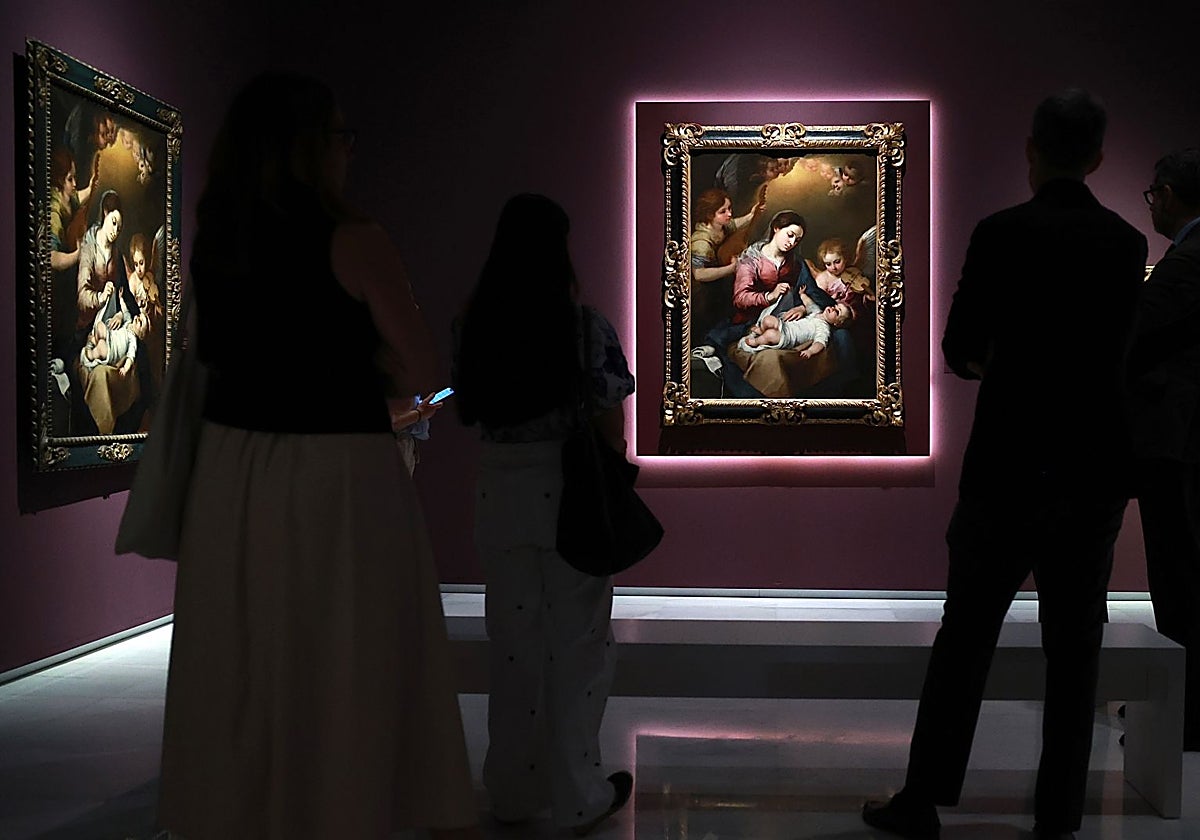

Music is ‘the art of organising sounds and silences’ based on the principles of harmony, melody and rhythm. Like visual artists, musicians have always sought ... to create beauty and convey emotions. And perhaps that is why it is not unusual to find painters who also play musical instruments. An exhibition at the Unicaja Foundation Cultural Centre breaks down the barrier between music and painting, showcasing how the great masters of all time depicted it. From Picasso to Murillo, via Julio Romero de Torres, Alonso Cano, José de Ribera, Guido Reni, Enrique Simonet, Bernardo Ferrándiz and Denis Belgrano, amongst others.
'Y Sonó la Música. Iconografía Musical en el Arte' (And the Music Played: Musical Iconography in Art) occupies all the rooms of the former Episcopal Palace (Plaza del Obispo, 6), including its garden - the least well-known corner of this building, where various musical scenes can be seen on the 18th-century plinths. Curated by José Luis Romero, the exhibition holds many other curiosities amongst the hundred or so pieces it has managed to bring together from some thirty lenders. Among them is what was once the painting that adorned the ceiling of a bourgeois house in Malaga, and a painting from the Cathedral whose restoration has revealed the bare chest of a woman who, at some point in history, had been painted over (Alegoría de la Templanza o de los Sentidos’, Miguel Manrique, 1640–1650).
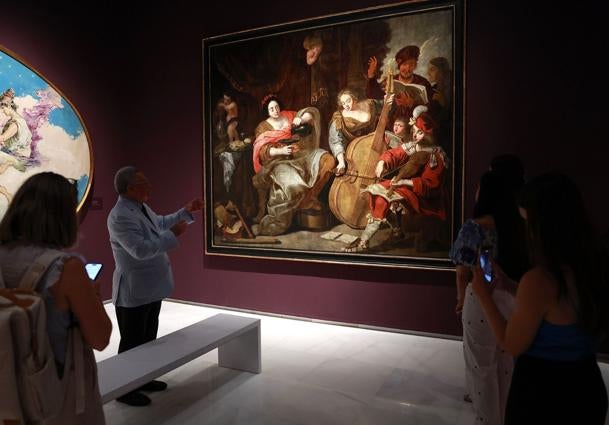
A restoration reveals a censored breast in a Malaga Cathedral painting
It is a scene often depicted in the Baroque period: an allegory in which figures and objects symbolise the five senses. Miguel Manrique, a Flemish artist settled in Malaga, painted the work around 1640, a few years before his death, and it has formed part of the heritage of Malaga Cathedral for centuries. But it had been some time since the "Allegory of Temperance or the Senses" could be seen as Manrique created it. The restoration of the canvas, carried out by Fundación Unicaja for its exhibition outside the cathedral, revealed that overpainting had covered the chest of the woman playing the viola da gamba (a string instrument from the Renaissance and Baroque periods, held upright) on the right of the scene. It now appears in its original form.
The painting forms part of the exhibition "Y Sonó la Música. Iconografía Musical en el Arte", which can be seen until 2 November at the Centro Cultural Fundación Unicaja. Manrique's large-format work is one of the standout pieces in the room dedicated to musical figures. On the left of the image, a woman delicately pours wine into a glass as a symbol of temperance, one of the cardinal virtues, and paradoxically also as a representation of the sensory pleasure of taste. On the other side, music takes over: there is a young violinist, a group of singers and a woman playing the viola da gamba. At some point in history, it was considered indecorous or inappropriate for the instrumentalist to show her chest, and it was censored.
José Luis Romero, curator of the exhibition, explains that overpainting was common practice within the Church and recalls how, in Michelangelo's "The Last Judgement" in the Vatican, figures originally depicted nude were covered up. A modesty that contradicts part of religious iconography, in which the Virgin appears with her chest uncovered, as in the "Virgen de Belén" or the "Lactation of Saint Bernard". "At the time there weren't the prejudices we have today," notes Romero. For this exhibition, Fundación Unicaja has driven the restoration of this and many other works from different sources, a process that has taken more than a year of work.
The "Allegory of Temperance or the Senses" arrives at the cultural centre from Málaga Cathedral, where more pieces by the same artist are kept, and it will return there once the exhibition ends, now exactly as the Flemish painter conceived it.
Related story
The link with Malaga is ever-present: there are the musical scores by Iribarne and Eduardo Ocón from the Cathedral’s archives; a painting by Simonet depicting the altar boys of the Malaga cathedral choir; a painting by Ferrándiz entitled ‘Un Día de Juerga en Málaga' (A Day of Revelry in Malaga); clay figurines of musicians that were once sold as souvenirs; and a section dedicated to Picasso as ‘the painter who most frequently depicted musical imagery in art’. The ‘Malaga-related’ items come from the Cathedral, the Unicaja Foundation’s Museum of Popular Arts and Customs, the foundation’s own collection, the Museo de Málaga, the Carmen Thyssen Museum and the Museo Interactivo de la Música, which has loaned antique instruments that are on display here alongside the paintings depicting them.
It all begins with ‘El Silencio’, the first of the exhibition’s five sections, the place where the instruments rest. Highlights include a still life by Moreno Villa, which plays with the shape of the guitar, and a highly distinctive work that Rafael Alberti dedicated to Picasso a year after his death: ‘Picasso, Guitarra, Paloma, España’. After passing through a curtain, visitors enter ‘Los Escenarios de la Música’: from temples to pilgrimages, with a stop at the Teatro Cervantes, whose stage curtain by Bernardo Ferrándiz is displayed as a full-scale photographic reproduction.
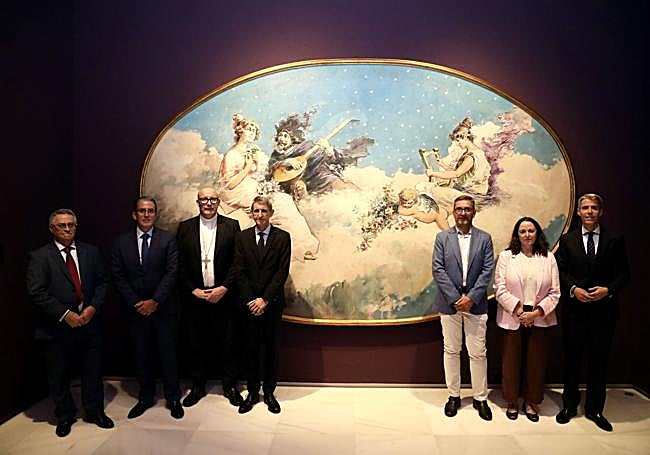
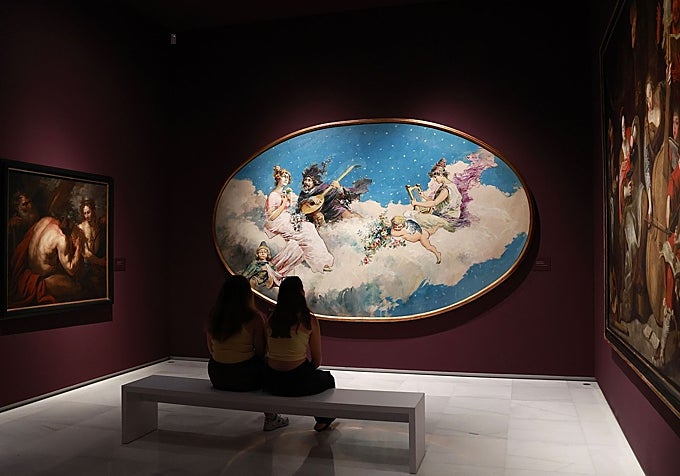
The exhibition then moves on to ‘Los Protagonistas’, beginning with the mythological figures. Here, the monumental piece by José Denis Belgrano entitled ‘Personajes de Comedia: Alegoría de la Música’, a four-metre-long work - in which the goddess Athena can be recognised playing the lyre - which, as the curator noted, once adorned the grand hall of a 19th or early 20th-century house in Malaga. Women also play a leading role, representing two social extremes: young ladies from good families who learnt to play the piano, and those who earned a living in cafés singing copla. Among the former, a painting by Francisco Domingo Marqués stands out, depicting a woman giving a recital inside Muñoz Degrain’s workshop in Valencia. In the background, a composition by Eduardo Ocón can be heard, which seems to emanate from a piano on display there, from the first piano factory in Malaga, the Montargón workshop. Among the latter, Julio Romero de Torres’s ‘La Copla’ is particularly striking: a woman looks directly at the viewer, with a guitar in one hand and a knife hidden on her leg, symbolising the harsh reality of the song.
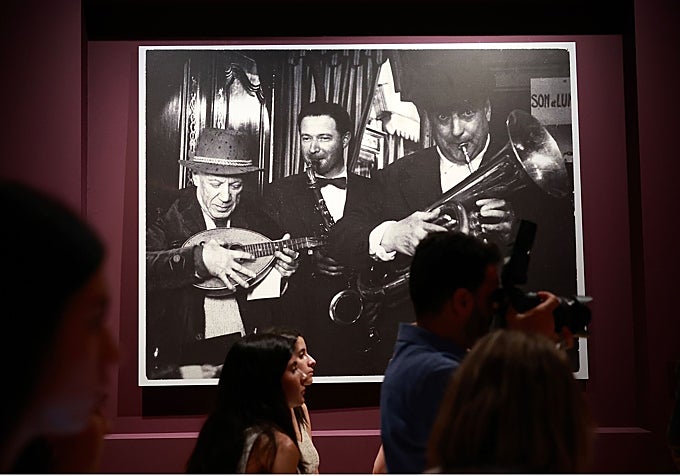
Other figures featured include King David with his harp, a blind musician palying the hurdy-gurdy (shown here in a painting by Ramón Bayeu at the Prado Museum), Saint Cecilia, the patron saint of music (with a stunning ivory reliquary), and Picasso. The Malaga-born artist had his portrait taken in Arles in 1959 alongside two friends and with a mandolin he had bought as a model for his works, in a nod to the painting 'Los Tres Músicos' which he had painted three decades earlier. Among his works is a tambourine painted with two Andalusian figures and a small painting in the style of synthetic cubism in which he completely breaks down an instrument.
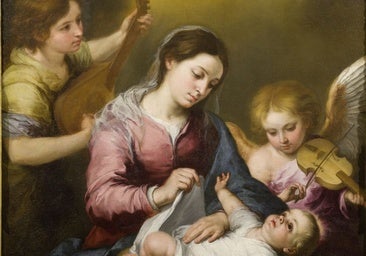
A 16th-century panel by Pedro de Campaña, on loan from the Prado, depicting six musical instruments, introduces the theme of celestial music, in which angelic musicians accompany visions of saints and Marian scenes. This section features one of the exhibition’s highlights: Murillo’s painting ‘La Virgen de la Faja’, which has been exhibited in Spain only once and is now returning after a tour of galleries and private collections in Paris, Germany, London, Japan and Switzerland. The composition - a scene depicting the Virgin changing the child’s swaddling clothes whilst two angels play the lute and the violin - was so admired in its day that it inspired numerous copies, such as those shown here by Alonso Miguel de Tovar and Bernardo Lorente Germán. Nearby, ‘Las Tentaciones de San Jerónimo’ by Juan de Valdés Leal catches the eye: these 'temptations' are women making music.
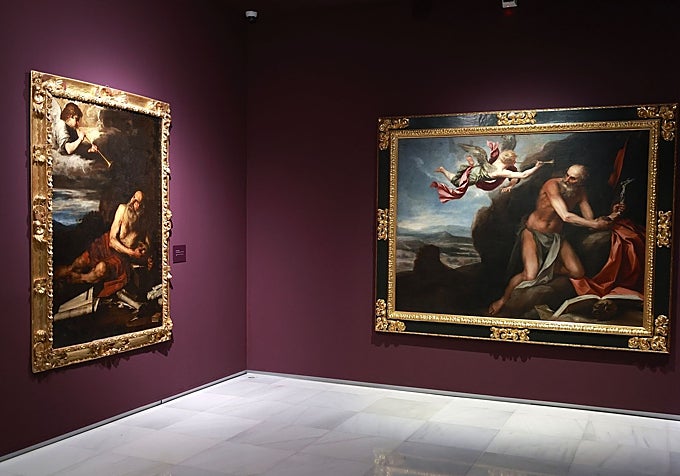
It all concludes – as is fitting in the Judeo-Christian tradition – with ‘El Juicio Final y la Gloria’, two powerful works that symbolise the evolution of the Spanish Baroque: from darkness to the exaltation of beauty. José de Ribera and Alonso Cano both depict the trumpeting angel announcing the Last Judgement to St Jerome; however, whilst the former shows the saint as decrepit and sombre (1617-1618), the latter portrays him as strong and vibrant (1660).
Five centuries of music in the history of art are on display at the Unicaja Foundation Cultural Centre until 2 November, Monday to Saturday from 10am to 2pm and from 5pm to 8pm (from 1 September, the afternoon opening hours will be from 4pm to 7pm). Sundays and public holidays from 10am am to 2pm. Admission is a charitable donation of three euros, which will be donated in full to the Casa del Sagrado Corazón ‘Cotolengo’ in Malaga and to the ‘Chavorrillos’ Association for the Equality of Roma Children.
![[]](http://static.vocstatic.com/voc26/latest/assets/images/favicon/surinenglish/apple-touch-icon-57x57.png)