
Art exhibition
Chema Lumbreras paints Gamel Woolsey’s Middle-earth
The artist reinterprets the poetic world of the author of Málaga en Llamas in an exhibition held at the house where she lived with Gerald Brenan in Churriana
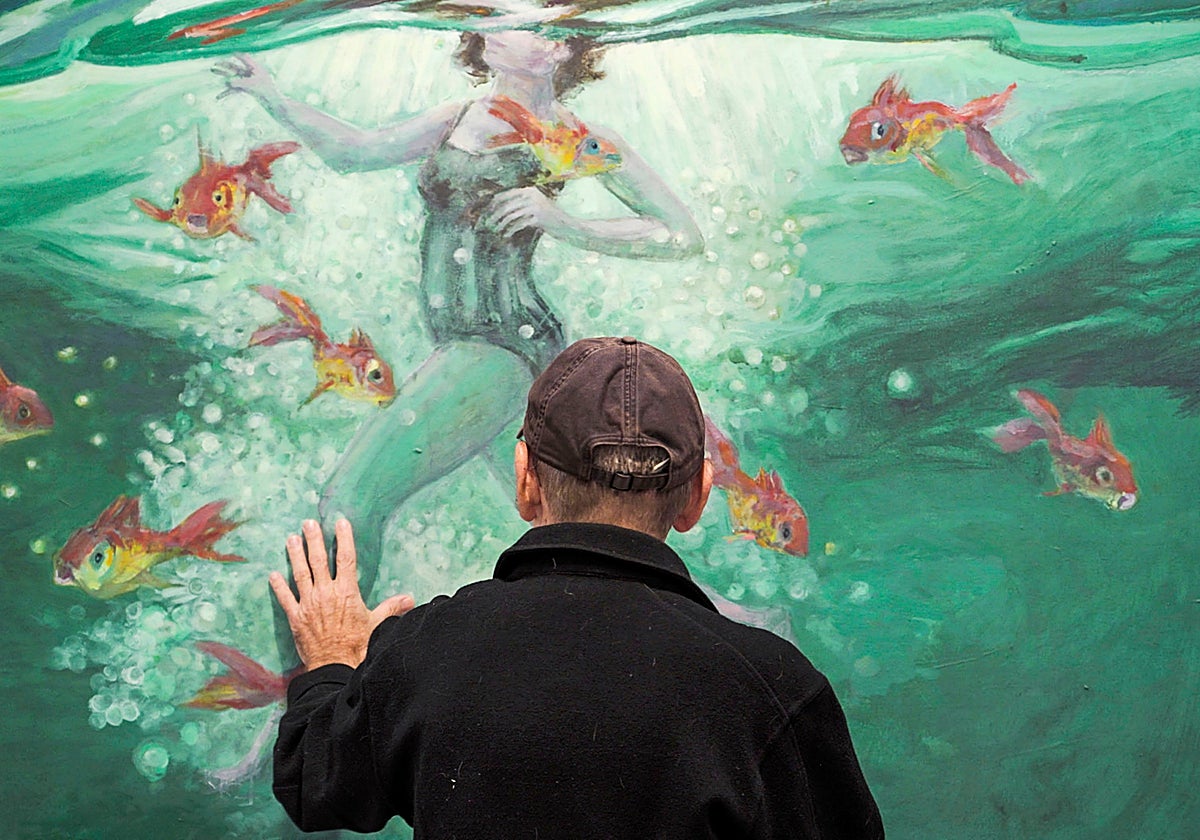

Between reality and dreams, there existed for Gamel Woolsey a liminal space from which she viewed the world. "It is neither Heaven nor Hell / this ... intermediate universe where I dwell. / With secret sorrow, with open joy, / I follow my path through Middle-earth," wrote the American author in a poem published shortly before she settled in Churriana with Gerald Brenan. Chema Lumbreras slips into this undefined space with oil paintings, sculptures and drawings that reinterpret Gamel’s life and work. These works will be on display until 4 April at what was once her home, the Gerald Brenan House in Churriana, in the exhibition La Última Hoja.
In one of the most powerful pieces in the exhibition, Chema Lumbreras imagines Woolsey in the swimming pool at her home – which still stands today – surrounded by goldfish. She is not swimming: she is submerging herself to the point where she can still breathe. It is his way of placing her on that blurred plane that served as her mental and creative refuge, the gateway to a poetic universe that speaks of love, the passage of time and death.
Like Woolsey’s, Lumbreras’s work occupies a space somewhere between reality and fantasy
These are also the major themes in the work of the Malaga-born artist. “These are subjects that interest me immensely. Her poetry has been a real revelation,” says Lumbreras. Exiled from her own exile in Spain, “she embodies the expatriate; she lives in an abyssal world, in that Middle-earth where a poetic personality was forged,” adds Alfredo Taján, director of Casa Brenan.
Like Woolsey’s, Lumbreras’s work occupies a space halfway between reality and fantasy, playing with scales and strange beings that are half-human, half-animal. This surreal world permeates various rooms in the house, not just the exhibition spaces, with his papier-mâché figures popping up in the most unexpected places, as curator Helena Juncosa explains.
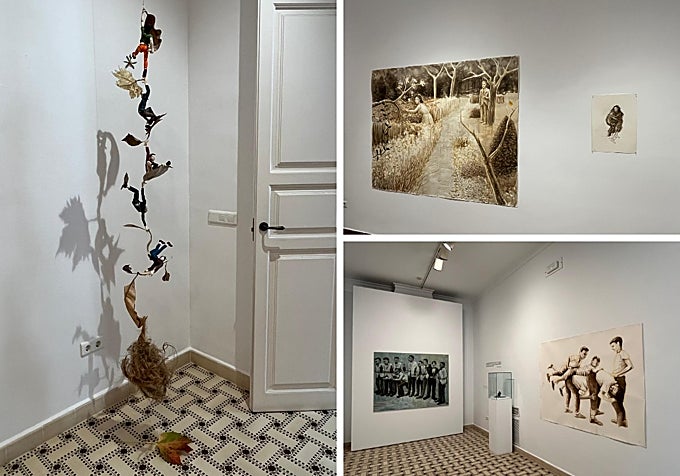
In one of her most delicate installations, Gamel Woolsey is suspended from a giant leaf. It is La Última Hoja (The Last Leaf), the piece that gives the exhibition its title and which takes its name from the collection of poems The Last Leaf Falls. A leaf that reappears in another sculpture and in several watercolours inspired by verses by the American poet, which allude to the changing of the seasons as a reflection of the inexorable passage of time and of nature.
The garden, in fact, features prominently in the works - both as a botanical setting and a metaphorical one - that "place of relaxation and refuge, but also of the decline of Gamel’s artistic life," notes Juncosa. A garden that Lumbreras paints in a yellowish hue in a watercolour measuring up to two metres wide. With this decontextualised colour, Lumbreras lends the scene an unsettling, even sinister atmosphere - a feeling that pervades many other works in this exhibition. "I usually work with humour, but faced with Gamel’s poetry, it didn’t come naturally to me, or I felt it wasn’t appropriate," reflects Lumbreras.
His first piece of pottery
In that physical garden, by the pool, Lumbreras displays one of his latest experiments: his first ceramic work, created in collaboration with Helena Juncosa and Alfredo Taján for this exhibition. “The three of us added this and that; and in the end, instead of a frog, we ended up with a shark. Whilst a frog eats insects, this one eats goldfish,” says Lumbreras with a smile.
In total, there are around thirty works, all of them recently created, inspired by the writer’s life and the era in which she lived. In one painting, Lumbreras gives a nod to the surprising number of waiters that Brenan recounts were working at a hotel in Madrid where they stayed in 1949; and in a large-scale watercolour, he recreates a typical children’s game of the era, with some children climbing on top of others.
The impact of the war
But if anything shaped the lives of Brenan and Woolsey, it was the Spanish Civil War, a conflict that drove them into exile out of fear of both sides and kept them away from Churriana for 17 years. A watercolour depicts Malaga in Flames, the title of Gamel Woolsey’s most famous and striking work. In La Busqueda (The Search), Lumbreras draws on an episode recounted by Brenan in The Face of Spain, when the two of them, on their return to Spain, went to Granada “with the naïve hope of finding Lorca’s remains in some niche, but his name is not there, as everyone knows,” explains the artist. And with Pa Negre, he symbolises the hunger of the post-war period.
Imagination, the symbolic world and the liminal connect Woolsey and Lumbreras in this exhibition (open to the public on Wednesdays and Thursdays from 4pm to 9pm, and on Fridays from 11am to 2pm and from 5pm to 9pm). And whilst she inhabited an undefined space in poetic creation, he does so in art. "Style is something I’m not interested in seeking. And indeed, I have no style," says the artist with conviction and pride. He, too, prefers to live in his own particular middle ground.
