
Astronomy
Spanish astronomers discover solar system with habitable planet and 'world of lava'
Twice the size of Earth and with a temperature of around 18C, TOI-1752 c could have liquid water and an atmosphere, according to the Andalusian institute of astrophysics

Madrid
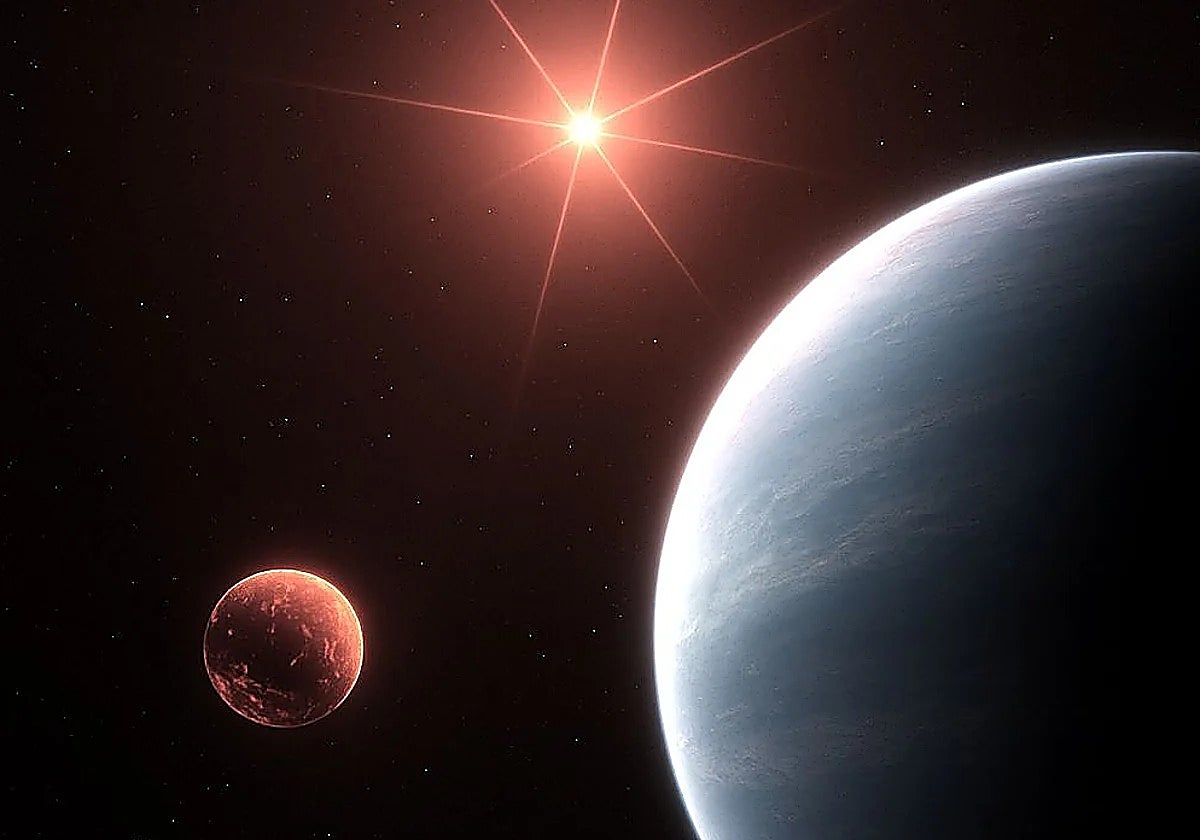
Two very different planets orbit a red dwarf star. One is "potentially habitable" and the other "a world of lava", according to the Andalusian institute ... of astrophysics (IAA), which confirmed that the system known as TOI-1752 c is "planetary in nature".
This star, which is smaller and cooler than the Sun, is 337 light years from Earth. It was identified by the TESS satellite, a Nasa mission in which Spanish astronomers are seeking to detect nearby worlds.
The satellite detects "small, periodic dips in a star's brightness that occur when a planet passes in front of it from our perspective", the IAA explains. Using this data, the Granada-based team confirmed that, indeed, there were two planets behind these signals.
The planet on which life could "potentially" exist is larger than Mars and smaller than Neptune, perhaps twice the size of Earth. Named TOI-1752 c, it lies within what scientists call the "optimistic habitable zone", because, under certain conditions, liquid water could exist there.
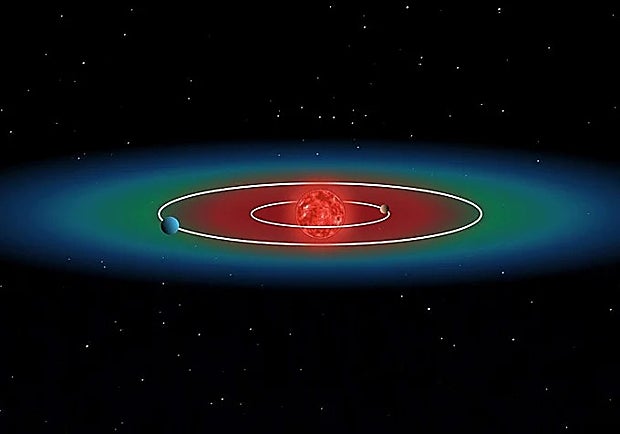
Furthermore, given its distance from its star, it might even have liquid water on its surface, although the presence of liquid water does not in itself imply that the planet is habitable. Furthermore, astronomers found that TOI–1752 c "may retain a larger proportion of its atmosphere" following an analysis of its composition, which "suggests that it is dominated by gases".
TOI–1752 c has a "moderate" temperature of around 18C (291K), an orbital period of 32 days and a size smaller than Neptune. These three characteristics lead scientists to regard it as a "twin" of the planet K2-18 b.
Discovered a decade ago, K2-18 b is considered the "most promising" of the candidates for supporting Earth-like life, as it contains carbon molecules. Both lie within their star's "habitable zone", have a "relatively long" orbital period of just over 30 days and their star is a dwarf for both.
Although the composition and habitability of this exoplanet are still a matter of debate, "given the similarity in its physical parameters and atmospheric properties", researchers "expect TOI–1752 c to prove just as scientifically compelling as K2-18 b in the coming years".
When assessing the potential habitability of the one-star, two-planet system, the authors found that "in the context of small planets, both are large enough to likely harbour atmospheres".
The second planet is very different from the first. It is "extremely hot, consistent with a lava-world environment", and may have a rocky composition. Named TOI-1752 b, the planet closest to its star completes its orbit in less than a day and receives an intense amount of radiation, to the extent that its surface could reach temperatures high enough to keep rock molten on the hemisphere facing the star, the article explains. "This could favour the formation of a secondary atmosphere, generated from materials released by the planet's own surface."
![[]](http://static.vocstatic.com/voc26/latest/assets/images/favicon/surinenglish/apple-touch-icon-57x57.png)