
Nature
New arrival at Madrid Zoo Aquarium: birth of a Bornean orangutan
The new baby, a 1.5-kilo male, represents a boost for the conservation of these great apes that are critically endangered in the wild
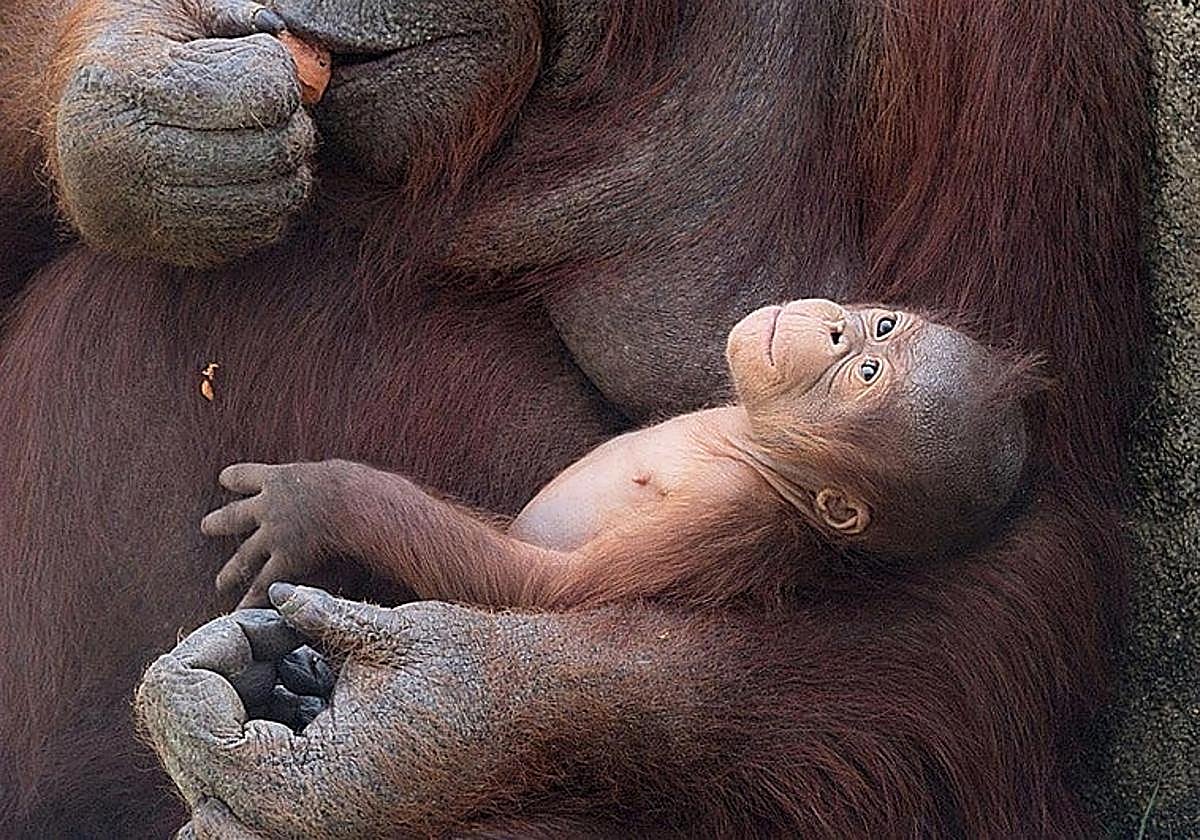

The Madrid Zoo Aquarium is celebrating the birth of a new Bornean orangutan (Pongo pygmaeus) baby, one of the most endangered species on the planet, classified as Critically Endangered according to the Red List of the International Union for the Conservation of Nature (IUCN).
The infant was born in the early hours of 2 April, after 8.5 months of gestation, which is the norm for this species, and, according to experts, is progressing favourably.
During these first weeks of life, his activity is limited to eating and sleeping, constantly clinging to his mother, Surya. She has previously given birth to three more babies and is proving to be a "true mother", as stated by the zoo's orangutan keeper, Maica Esponinosa. Surya is demonstrating exemplary maternal behaviour, devoting all her attention to the care and grooming of the little one.
Voting for his name
As is tradition at Madrid Zoo, the newborn's name must begin with the letter 'S', the same initial as his mother. In the coming days, the park will invite the public to participate in choosing the final name through its official channels.
Related story
Together with his mother, his two brothers Sabah and Sinar, his father Dahi and a curious pair of long-handed gibbons (Sandra and Adam), the family completes a vital nucleus for the survival of these "men of the forest", the literal meaning of the Malayan name for this species.
A slow and fascinating development
During this first trimester, the newborn's activity is mainly limited to eating and sleeping, clinging to its mother's fur. Only by the age of three to five months will it begin to taste its first fruits and vegetables, coinciding with the appearance of its incisors. This diet reinforces its herbivorous nature that, in adulthood, will be based almost exclusively on plant buds, grasses, bark and a wide variety of wild fruits.
The team of keepers has observed that the little one already displays very strong grasping reflexes, something instinctive and vital in a species that spends most of its life high above the ground. This trait will allow the baby to move safely in its natural environment from a very early age.
The Bornean orangutan is a totally arboreal and diurnal species that moves with great agility between branches by brachiation (swinging through trees), descending to the ground on very rare occasions. For this, it has extraordinarily long arms, much longer than its legs. It also builds nests with branches and leaves high up in the trees to rest, a skill that the youngster will learn from its mother over a prolonged learning period that can last up to eight years.
The challenge of saving the red "man of the forest"
The birth of this orangutan is a hopeful sign in the face of a harsh reality: the Bornean orangutan is classified as Critically Endangered by the IUCN. The forests where the species originates are disappearing at a rate of 2.5 million hectares per year.
The population of these primates has fallen drastically in the last century - specifically by 60 per cent of its total in just the last 40 to 60 years - due to massive deforestation for palm oil plantations, poaching and the illegal wildlife trade. With a very slow reproduction rate of one baby every six to eight years, each new birth in captivity under conservation programmes is vital to ensure the future of their lineage.
A commitment to survival
The birth in Madrid is not just a social event, but part of the European Endangered Species Programme (EEP). "Every birth is a genetic success," say the Madrid Zoo, which collaborates with international organisations like Hutan to protect the species' refuges in the northern part of Borneo island. The goal is to maintain a healthy and genetically diverse reserve population that can ensure the future of these animals if their situation in Asia continues to worsen.
The arrival of this baby has also positively altered the social dynamics of the group at the zoo. The dominant male Dahi and the young brothers Sabah and Sinar curiously observe the new member to their clan, under the watchful eyes of their enclosure neighbours, a pair of long-handed gibbons.
![[]](http://static.vocstatic.com/voc26/latest/assets/images/favicon/surinenglish/apple-touch-icon-57x57.png)