
High stakes and highland heifers: why Spain’s Picos de Europa are (officially) the world’s most beautiful region
Time Out has crowned this rugged national park in Asturias as the top destination for 2026, where dramatic peaks meet ancient pilgrimage trails and very stubborn cows
Dilip Kuner
It is a brave thing for a travel authority to declare one single patch of earth the "most beautiful in the world”.
Usually, such titles are reserved for the polished coastlines of the Amalfi or the manicured peaks of the Swiss Alps. The problem with such places - beautiful as they undoubtedly are - is that at times the scenery feels like it was designed by a concierge, so perfect is it.
But when Time Out handed the 2026 crown to the Picos de Europa, it felt like a win for the rugged underdogs. This jagged limestone national park in Northern Spain doesn't do "manicured". It is a landscape of dramatic contradictions: lush Atlantic meadows that look like Ireland on steroids, pressed against vertical grey spires that feel like the backdrop for a high-fantasy epic. And a break here is all put together with a distinctly Spanish flavour - as if chaos could erupt at any moment but never actually does.
The Paco factor and pilgrim paths
Last summer, my wife Sandra and I decided to enjoy the cooler climes of the Picos (compared to the scorching Costa del Sol - it was 40C in Marbella compared to a refreshing 23C in Asturias). We quickly discovered that the "world-class beauty" in the principality comes with a side of logistical gymnastics. The crown jewel of the park is the Lagos de Covadonga - two glacial pools, Enol and Ercina, tucked high in the Western Massif.
To get there, you must board a fleet of Alsa coaches in the busy-with-pilgrims-and-tourists town of Cangas de Onís. This town isn't just a bus hub; it was the first capital of the Kingdom of Asturias and is a vital gateway for those on the Camino de Santiago. Specifically, it serves the Camino Primitivo and the Camino de la Costa networks, where modern pilgrims swap their walking sticks for bus tickets to witness the mountain "miracles".
Our driver - let's call him Paco - navigated hairpin turns with the casual indifference of a man buying milk. At one point, we swung our back end over a thousand-foot drop to let a descending bus pass with about three inches of clearance. Sandra was unconcerned, but I spent the ascent practicing "yogic breathing," which is a polite way of saying I was white-knuckling my armrest.
Our alpine overlords
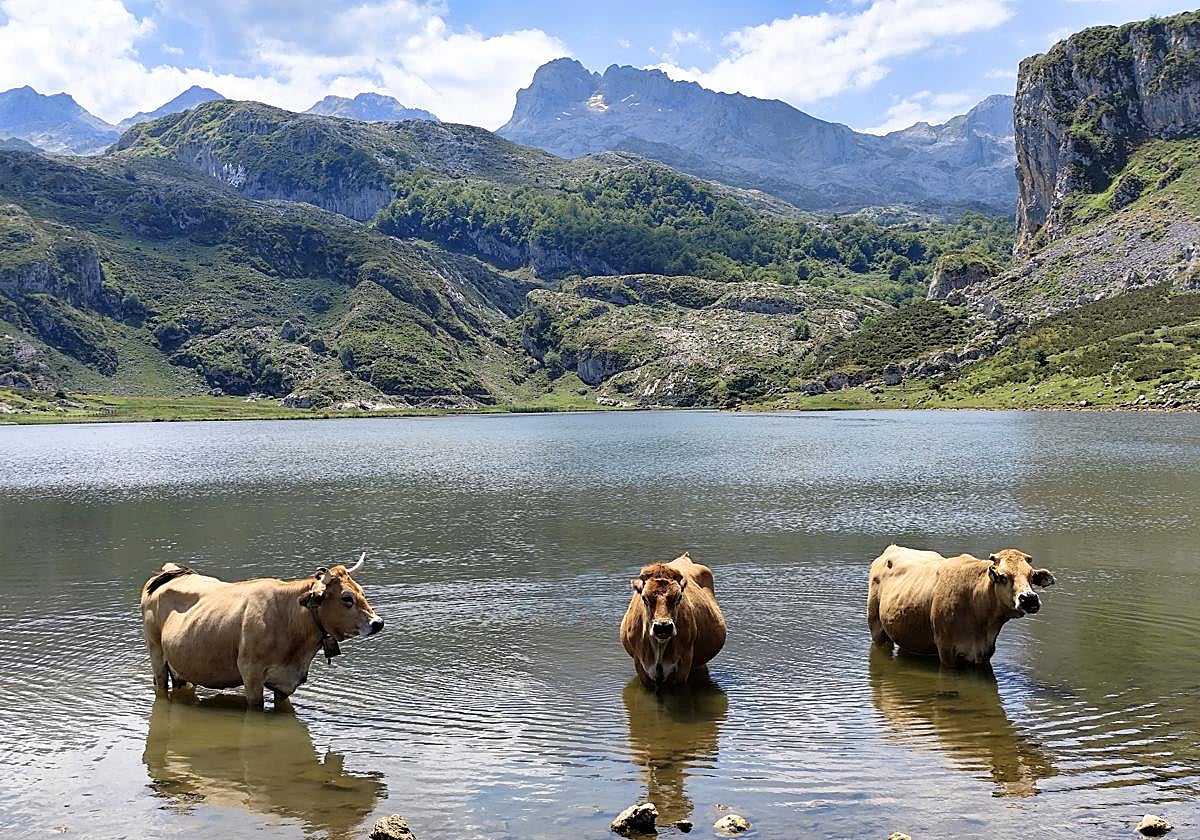
Once you reach the top, you realise the humans aren't actually in charge. That honour belongs to the Asturian Mountain cattle. These aren’t your average, bored pasture cows; they are elite, high-altitude sovereigns.
In the Picos, you don't hike the trails; you negotiate them. If a cow decides to take a nap in the middle of a gate, you don’t move her - you find another route. It’s a level of confidence I can only aspire to, especially when being stared down by a ginger heifer who clearly knows she is the centrepiece of a Unesco Biosphere Reserve.
Related story
The lakes are fantastically beautiful, framed as they are by the peaks that give this region their name. Taking the route from bus stop to lakes is a relatively easy stroll (cows permitting - they really are everywhere). More serious hikers can ‘wander’ off into the wilderness. For myself and Sandra, the bus stop beckoned.
Marriage, miracles, and the 'Divine Gorge'
The descent leads you back to Covadonga, a site that manages to be both deeply spiritual and slightly surreal. It is a cornerstone of the Camino Covadonga pilgrimage, featuring a giant pink limestone basilica and the Santa Cueva, a chapel wedged into a cliffside above a thundering waterfall.
Sandra and I watched as tourists engaged in the local "extreme sport" at the Fountain of Seven Spouts. Legend says drinking from all seven in one breath ensures marriage within a year. Seeing grown adults desperately chugging lukewarm water while their partners look on with concern is, frankly, the best free entertainment in Spain.
If you want to avoid the "marriage water," the rest of the park offers plenty of ways to test your hamstrings:
-
- Ruta del Cares: A 12km cliff-edge hike nicknamed the "Divine Gorge."
-
- Fuente Dé cable car: A vertical ascent of 753 metres in just four minutes near Potes.
-
- Bulnes funicular: A tunnel ride into a misty hamlet where the only "traffic" is a local carrying a wheel of Cabrales (the world’s strongest blue cheese).
The Picos playbook: how to survive the beauty
Getting there
Fly into Asturias (OVD) or Santander (SDR). You’ll need a rental car for the valley roads or to explore the coastline, but remember the Lakes Access Plan: between 8am and 8pm in summer, it’s bus-only. Seats are limited, so best to book online in advance.
Where to bed down
The luxury hub: Parador de Cangas de Onís. A 12th-century monastery where the stone walls are thick enough to drown out your memories of the bus ride.
The hiker’s base: Potes. A medieval maze of stone bridges and a crucial stop on the Camino Lebaniego, which leads to the Monastery of Santo Toribio - home to the largest surviving piece of the True Cross. It’s the best place to eat Cocido Lebaniego, a chickpea stew that is essentially a hug in a bowl.
Further afield: We stayed in Oviedo, which provided an excellent base for exploring not just the Picos de Europa, but also the Asturian coastline. (PS. while in Oviedo, try to eat at the Gato Negro, which sells traditional local dishes, and the freshest seafood).
A final warning
You will be tempted to buy Cabrales cheese. It is delicious. It is also chemically powerful. Do not leave it in a warm rental car while you go for a "quick" three-hour hike. The scent does not "air out" - it colonises.
Is it the most beautiful region in the world? Well, it can certainly make a strong claim. Just remember that you are, at best, third in the local hierarchy - somewhere behind the Virgin Mary and a very stubborn cow.
![[]](http://static.vocstatic.com/voc26/latest/assets/images/favicon/surinenglish/apple-touch-icon-57x57.png)