
Spain
World media shines global spotlight on Russian "nuclear" wreck first revealed by local press
New investigation validates early reports by SUR in English sister news site La Verdad that the Ursa Major was a covert transport for North Korean submarine reactors

Gregorio Mármol
Murcia
The world’s attention has returned to the depths of the Mediterranean following a major CNN investigation released this week, which provides a detailed look ... into the December 2024 sinking of the Russian vessel Ursa Major.
The documentary sheds new light on the "unprecedented military operation" that may have sent the ship to the bottom to prevent a breach of international nuclear sanctions. While the story is now making global headlines, it was first uncovered in March 2026 by the Murcia-based newspaper La Verdad - a sister publication of SUR in English.
La Verdad’s original reporting was the first to reveal the ship's secret cargo and the suspicious circumstances surrounding its final moments. The Ursa Major was never meant to be a ghost, but by the time it reached the deep basin of the Alboran Sea, it was already a phantom. Here we reprint the original story.
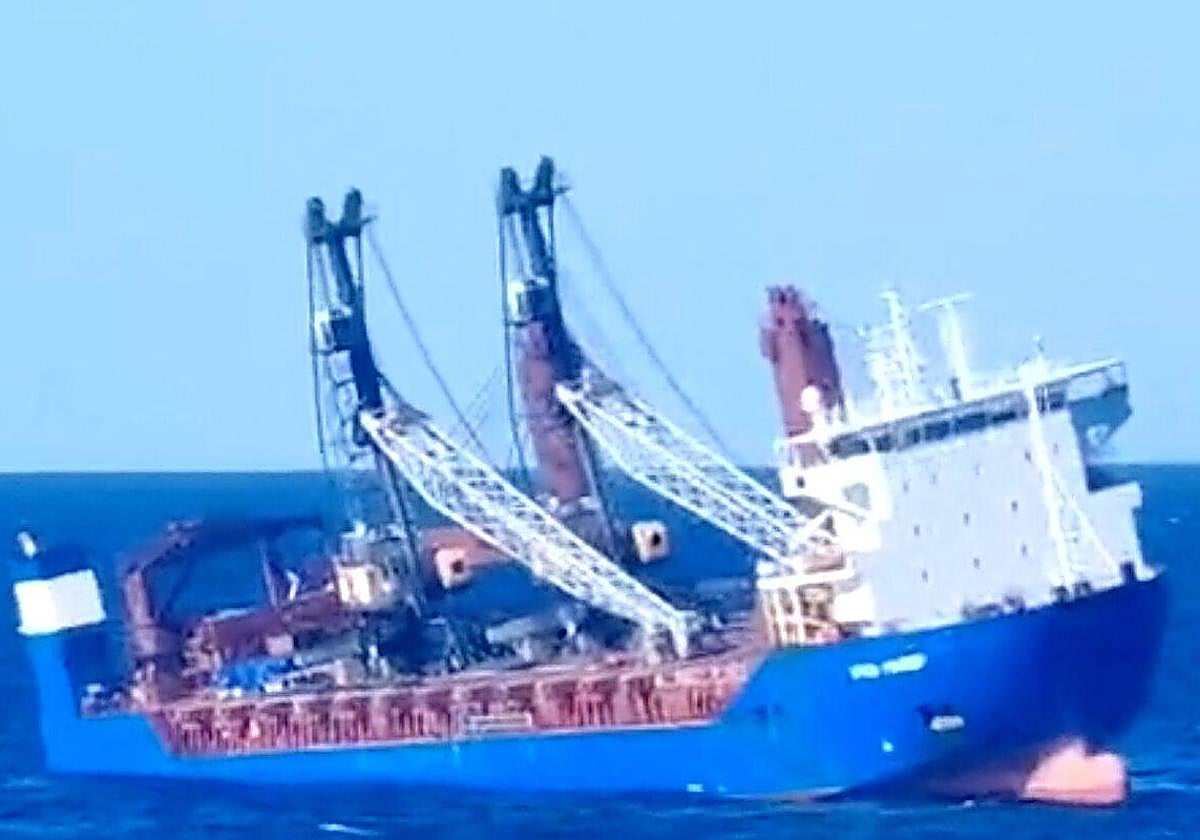
The Spanish government has ruled out inspecting the wreckage of the merchant ship Ursa Major, which sank on December 23, 2024, 62 miles south of Cartagena. The vessel was clandestinely transporting two nuclear reactors between the Russian ports of St Petersburg and Vladivostok.
"The remains of the ship currently rest at a depth of 2,500 metres. Although it is technically possible to access it, the significant risks involved make it unfeasible," acknowledged the Secretary of State for Defense, Amparo Valcarce, during a Joint Commission for National Security hearing in response to questions from the Popular Party.
Valcarce appeared before the commission on February 19, but her testimony has only now come to light following its publication in the official Journal of Sessions. In her appearance, Valcarce confirmed details first revealed exclusively by LA VERDAD on December 28, which have since gained international significance.
However, in the official information provided by the government, the only allusion to the cargo was that there were "no dangerous goods." Valcarce avoided any reference to the statement made by Captain Igor Vladimirovich Anisimov, recorded in the official maritime report (8059/24-Escora). In that report, drafted by the Maritime Captain of Cartagena, Óscar Villar, the captain admitted to the undeclared transport of components for two VM-4SG nuclear reactors - destined, according to investigators, for North Korea.
A captain's admission ignored
On December 23, 2024, the Ursa Major - a member of the Russian "ghost fleet" typically used for transporting military hardware - became the centre of a maritime mystery while sailing 62 miles south of Cartagena and 39 miles off the Algerian coast. After three explosions were recorded in its engine room, the 142-metre vessel sank to a depth of 2,500 metres. While 14 crew members were rescued by Spanish Maritime Rescue, two sailors - a second engineer and an oiler - disappeared in the disaster.
A year after the incident, La Verdad revealed details that elevated the case to a geopolitical scandal, drawing intense interest from media in the US, France, and Great Britain. The official report from the Maritime Captaincy records a second statement from the captain, revealing that the ship was not merely carrying port cranes and empty containers, but nuclear reactor components for North Korea. The shipment was allegedly part of a covert military technology exchange agreement.
The sabotage theory
Evidence gathered by national authorities suggests the sinking was not accidental, but rather the result of international sabotage executed with a state-of-the-art torpedo to prevent the nuclear technology from reaching its destination.
Suspicion was further fueled by the actions of the Russian government, which invoked the UNCLOS Convention to take charge of the rescue and conduct its own official investigation. Putin’s government went so far as to reproach Spain for having "inspected" the vessel.
On the night of the sinking, the Russian landing ship Ivan Gren arrived at the scene and demanded that Spanish vessels - including the Clara Campoamor and the patrol boat Serviola - withdraw at least two miles. At 10pm, as the Ursa Major sat listing in the dark, the Ivan Gren launched a barrage of red flares to blind the infrared sensors of intelligence satellites monitoring the area. Minutes later, the ship sank. Simultaneously, the National Geographic Institute recorded three distinct explosions at that exact position.
Days later, the Russian spy ship Yantar was detected in the area. It is suspected of deploying submersibles capable of reaching 6,000 metres to ensure no trace of the sensitive cargo remained. Spain, meanwhile, officially ruled out using its own unmanned underwater vehicles (ROVs) to verify the theory, despite having the capability.
Radiation detection from the air
The Ursa Major case has been presented by analysts as a paradigm of "hybrid warfare," combining conventional transport with unconventional methods like sabotage. This theory is bolstered by the movements of international military forces following the sinking.
LA VERDAD verified that the only aircraft in the world capable of detecting radioactive particles in the air - the USAF's WC-135R "Constant Phoenix" - was mobilised from Nebraska to fly multiple passes over the sinking zone last summer. At that time, the Spanish version of the nuclear cargo had not yet been made public. A second "Nuke Sniffer" returned to the same area this past February, flying repeated patterns over the Mediterranean site where the Ursa Major remains lost to the deep.
![[]](http://static.vocstatic.com/voc26/latest/assets/images/favicon/surinenglish/apple-touch-icon-57x57.png)