
Crime
Butler under investigation for allegedly trying to illegally sell works by Picasso and Miró
The nearly 300 pieces in the collection discovered in Portugal, whose origins may also be illicit, belonged to an American collector who died in 2024 and was unknown in art market circles

Virginia López
Lisbon
In a nondescript house in Penalva do Castelo, a small town in inland Portugal, the Portuguese judicial police have discovered what they have described as ... a "veritable Ali Baba's cave". Inside the house was a collection of almost 300 works of art dating from prehistoric times to the present day, including pieces attributed to some of the most important names in art history, among them two of Spain's greatest artists Pablo Picasso and Joan Miró.
"The house was a real museum," stated the police chief for this central region of Portugal, Avelino Lima. "There wasn't a single square metre of wall that wasn't covered with art." It was the private collection of a US citizen who died in 2024, an octogenarian who, according to initial reports, lived for years in Spain before moving to Portugal, where he spent the last decade of his life.
Despite the magnitude of the collection, the owner was known neither in collector circles nor on the art market, which raises questions about the provenance of these pieces. The neighbours had hardly anything to say about him, just describing him as a very private man, keeping to himself. The house was also home to a local resident who worked as his butler and valet and who is now under investigation for possible crimes of breach of trust and money-laundering.
Attempted sales by auction
The investigation began with an alert issued by Portugal's museums and monuments authority, which detected irregularities in the attempted sales of some of the artworks. The appearance on the open market of high-value pieces without documented provenance triggered control mechanisms and led to the relevant authorities being notified. Police intercepted the butler as he attempted to sell pieces attributed to Picasso and Miró in France.
From that moment on, Lima explained, "immediate action was necessary" to determine the origin of the pieces and prevent their possible dispersal. The investigation, which included searches of houses and other locations, led to the seizure of 278 artworks.
"There wasn't a single square metre of wall that wasn't covered in art."
Among them, investigators identified works purportedly by 27 different artists, including Picasso and Miró, as well as other famous names such as David Hockney, Albrecht Dürer, Pierre Bonnard and Juan Downey. The collection comprises paintings, lithographs, serigraphs, sculptures and objects of archaeological origin.
Some pieces 'appear to be artistic and architectural works from the pre-Christian period', spanning prehistory and antiquity. Among the items seized are sculptures dating from the 1st century BC to the 18th century AD, as well as artefacts from various parts of the world, from Persia and the Middle East to Latin America, Africa and China.
A reproduction of a "Menina" by Velázquez
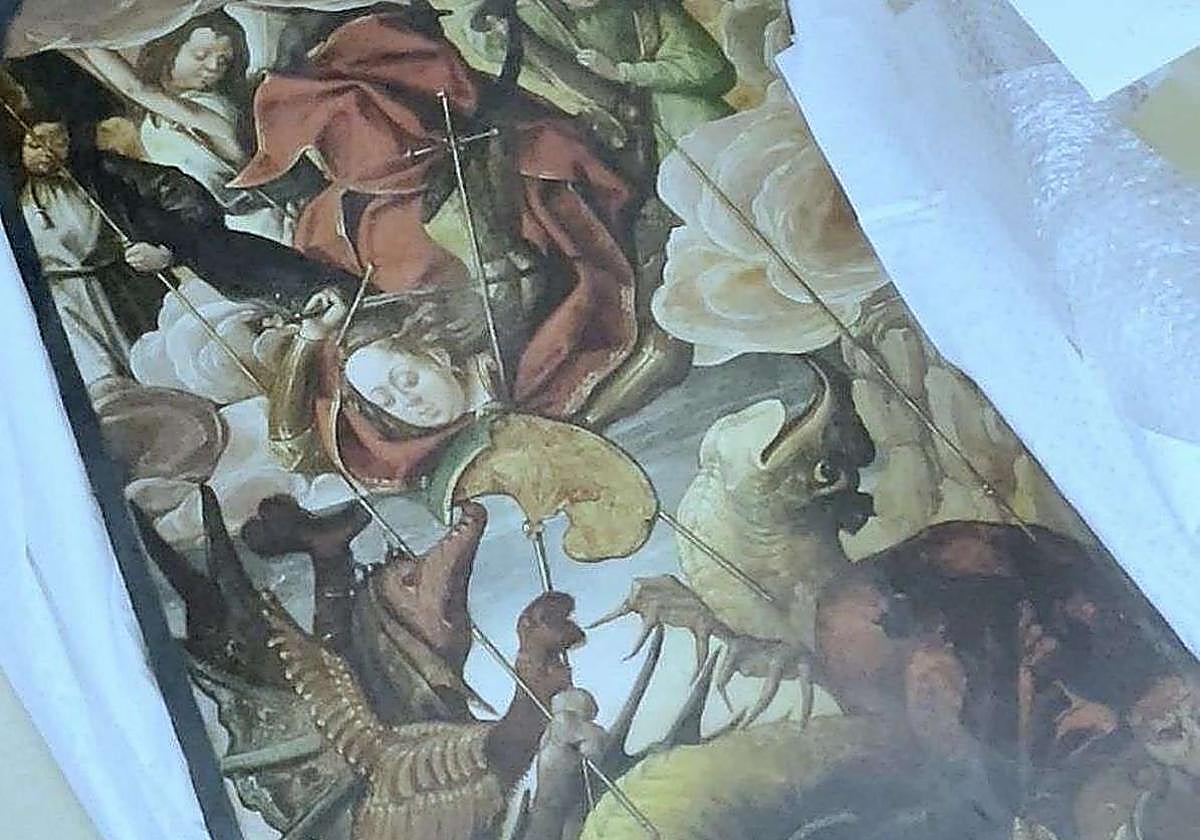
Images released by the judicial police show the interior of the house with the walls completely plastered in artwork. Among them, along with other pieces, is a painting that reproduces one of Velázquez's famous 'Meninas' painting, (the three, young, ladies-in-waiting at Spain's royal court). However, its authenticity, like that of the rest of the collection , is yet to be determined.
The art experts who accompanied police officers during the searches have preliminarily classified many of the pieces as genuine, although authorities insist that an exhaustive technical analysis will be necessary. Meanwhile, the police are investigating whether the works of art could have been acquired illegally and do not rule out their possible connection to illicit markets or even international criminal networks.
"We're talking about a huge number of pieces that, for now, are considered authentic, but they will undergo formal, expert analysis to eliminate any doubt," stated Lima. The collection's monetary value also remains as an estimate. While those in charge of the investigation consider it premature to offer concrete figures, they have indicated that it could be "in the millions".
The "phantom" collector
The figure of the owner, whom some Portuguese media outlets have already dubbed the "phantom American", adds an element of mystery to the case. His low profile and lack of known ties to the art market contrast sharply with the magnitude of the collection found in his home.
In an interview with Portugal's CMTV channel, the butler - who remains at liberty while the investigation is ongoing - asserted that "nothing was stolen" and that the artworks are "true replicas", stating that there are "receipts for everything". It is currently not known if the collector had any heirs. After his death, this employee reportedly remained in the house and considered himself the rightful custodian of the estate.
While the investigation continues, the pieces remain in the custody of the authorities, awaiting technical reports that will determine their authenticity and value.
![[]](http://static.vocstatic.com/voc26/latest/assets/images/favicon/surinenglish/apple-touch-icon-57x57.png)