
Heritage
Saving Ronda's shifting historic bullring: innovative use of ultrasound to preserve heritage
The Real Maestranza de Caballería, the association that owns the bullring, is using non-destructive techniques to analyse the internal condition of its stone columns to ensure accurate conservation of the whole structure

Ronda
The ongoing work to preserve one of Ronda's main heritage symbols is progressing with new technical tools.
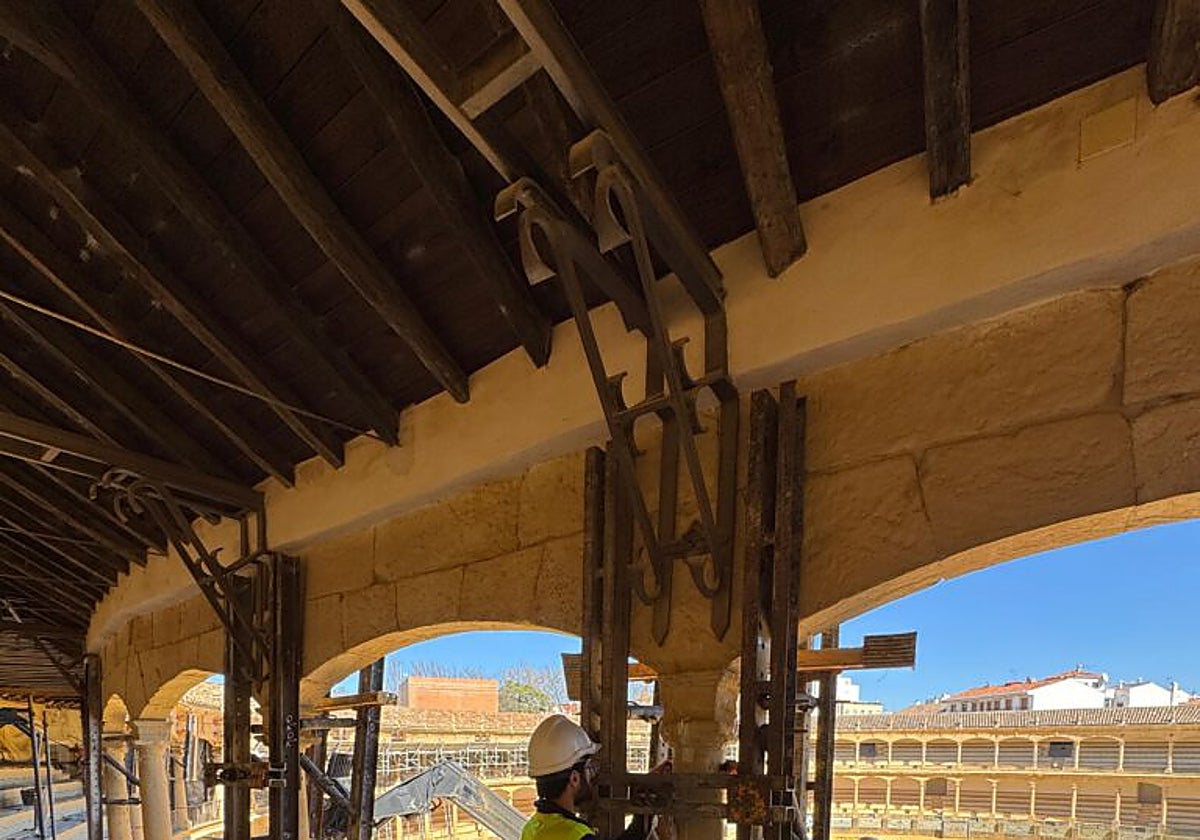
The Real Maestranza de Caballería, the association that owns this Malaga town's famous bullring, continues to deepen its understanding of the bullring's structural condition through the application of non-destructive testing techniques, in this case, an ultrasound study focused solely on its shifting stone columns.
This is not a visible intervention, but it is crucial to the conservation effort. This type of analysis makes it possible to "see" the interior of the materials without messing with them (for instance, by drilling into them), something particularly relevant for an historic site that is an Asset of Cultural Interest (BIC) where any work done must be carried out with the utmost respect.
The objective is clear: to accurately understand the monument's true condition in order to plan future interventions based on sound, technical criteria.
The procedure, although complex in its scientific basis, follows a simple format. An ultrasonic signal emitter is placed at one point on the column and a receiver on the opposite side. Measuring the time it takes for the wave to pass through the stone, together with the distance between the two points, allows the propagation speed to be calculated. This data is key, as it serves as an indicator of the stone column's internal state.
When the values obtained fall within the normal parameters for this type of stone, the structure is considered to present no significant alterations. However, if the speed decreases significantly, it may be a sign of cracks, fissures or deteriorated areas that are not yet visible to the naked eye. This is where the study becomes especially valuable, as it allows for the detection of potential problems before they manifest themselves externally.
Systematic approach
The fieldwork is being carried out systematically. Each column is analysed along two perpendicular axes and using profiles taken every 20 centimetres along its height. This process generates a detailed map of all measurement points. These are then translated into technical profiles drawn up in the office. From these, a precise analysis of the structural behaviour of each element is obtained.
This process generates a detailed map of measurement points. These are then translated into technical profiles drawn up in the office.
The results go beyond the theoretical realm. All the information gathered is shared with the team of architects responsible for the overall restoration project, allowing them to identify accurately which areas require intervention and which are in good condition. This approach avoids unnecessary actions and focuses efforts on the areas where they are truly needed.
The study is part of a broader strategy supported by the Real Maestranza to guarantee the long-term conservation of this monument. The overall project for the structural consolidation and improvement of the bullring is led by the architect Ricardo Aroca and relies on these types of tools to base every decision taken on objective data.
![[]](http://static.vocstatic.com/voc26/latest/assets/images/favicon/surinenglish/apple-touch-icon-57x57.png)