
Infrastructure
Reclaimed water ready within a year
A 6.5-million-euro pipeline will supply parks, Malaga football academy, the Parador Golf and the airport
José Rodríguez Cámara
The use of the reclaimed water from the Guadalhorce Waste Water Treatment Plant (WWTP) to irrigate green areas in the Churriana and Torremolinos districts will be possible in approximately 12 months, which is the time needed to carry out the necessary works.
The work, which is already underway, involves, on the one hand, increasing the capacity of the WWTP, so that it can meet the new demands with guarantees thanks to the optimisation of its filtering systems, and, on the other hand, pumping the water to the west of the capital. Two pieces of equipment have been planned for this purpose, which will drive the supply through pipes that will extend over 10.3 kilometres, of which 9.1 will be ready in this first phase, awaiting the extension that will come in line with the procedures and the urban developments that require it. The intervention includes the separation of the rainwater and wastewater networks on the Guadalmar road.
The result of the project will be a 3,647-metre-long canalisation, which will run under the Avenida de Velázquez and the MA-21 road, from which there will be five secondary branches totalling 4,459 metres to reach the district of Torremolinos and Churriana, which includes high consumption facilities such as the Camp Benítez park and the one planned in Arraijanal, the Malaga Golf Parador, the Malaga Football Club Academy and the Rojas Santa Tecla area for a future housing estate between Churriana and Torremolinos.
A separate 2,278 metre pipeline is also planned for the supply of ultrafiltered water to Malaga-Costa del Sol Airport for other uses.
Public and private effort
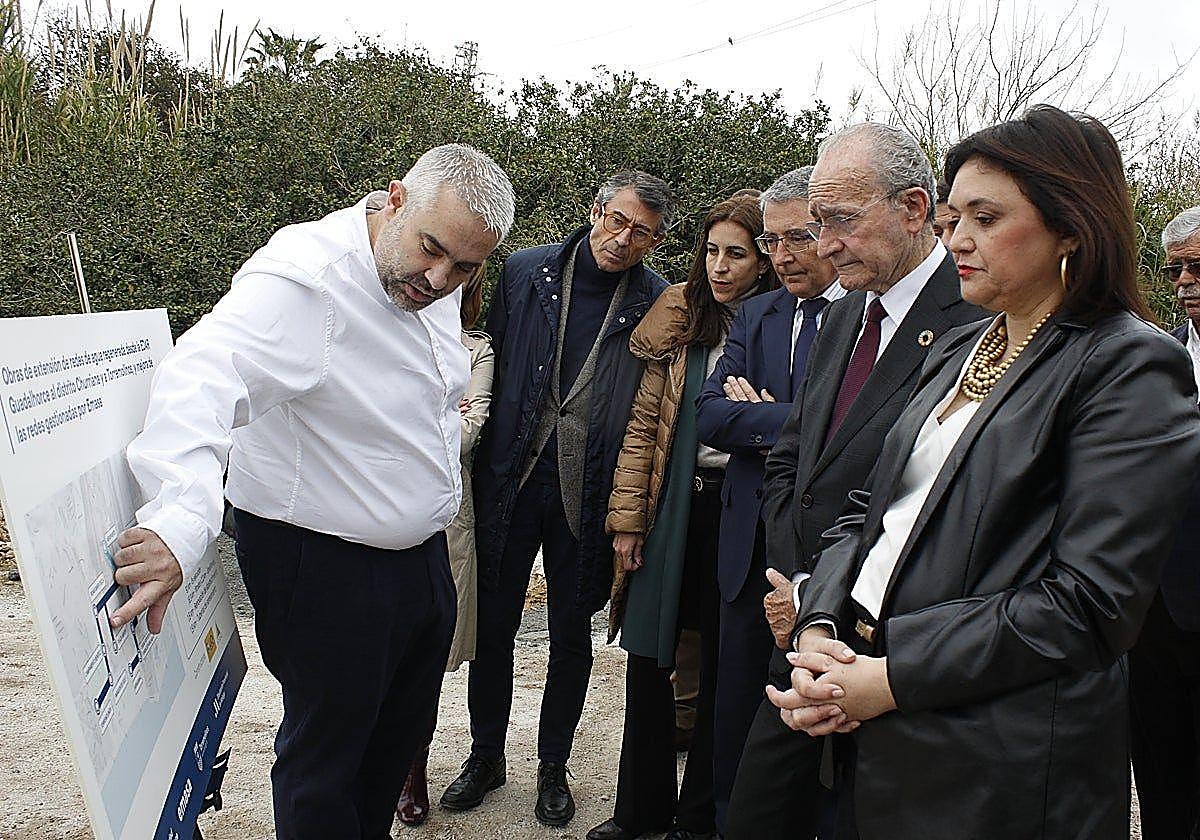
The ceremonial act of laying the first stone of this infrastructure was held on Avenida Montserrat Caballé, next to the access to the Bahía Azul shopping centre, right next to where trenches are already being dug for this water system. The event was attended by representatives of Malaga town hall, headed by mayor Francisco de la Torre, his counterpart in Torremolinos, Margarita del Cid and the president of the provincial authority, Francisco Salado. The project is being delivered through an inter-institutional agreement under which Emasa (Malaga's municipal water company) will manage and contract the works. Funding comes from Torremolinos council via a capital transfer to Emasa, with additional support from the provincial authority in the form of a direct subsidy, alongside private contributions. Money will also come from future private beneficiaries. The successful bidder, with a budget of 6.5 million euros, is the joint venture formed by the PTOC and UC10.
Institutional commitment
De la Torre, Del Cid and Salado agreed in highlighting the efforts of the councillor of the district of Churriana, Penélope Gómez, to ensure that this joint effort to improve the availability of water has been successful. "It is an example of what needs to be done," said the mayor of Malaga, who is committed to a circular model of water management and public-private collaboration to move forward.
The mayor of Torremolinos made it clear that, thanks to the reclaimed water, new avenues are opening up for the future growth model of the town, which for the moment is dependent on aquifers. She also recalled that, together with the supply that will come from Malaga, another source of recycled water will be added, this time from Benalmádena, thanks to the works being carried out by Acosol with the support of the Junta de Andalucía.
Provincial president Francisco Salado welcomed the project's timing, noting that acting now - while there is no drought - means the infrastructure will be ready to meet future water shortages. He highlighted the provincial authority's commitment to improving water supply, pointing to 40 million euros invested in related works over the past four years.
The project will meet a demand of almost two cubic hectometres of water per year, reducing pressure on existing resources: around 700,000 cubic metres drawn from the Bajo Guadalhorce aquifer and 625,000 cubic metres from the Sierra de Mijas reserves that currently supply Torremolinos.
The project also includes the renovation of the drinking water supply network, which will share the same route as the regenerated water trunk pipeline, making the most of the works already being carried out.
The reclaimed water element of the project carries a total cost of over four million euros, including the branch connections required. Once the private sector contribution is deducted, each participating administration will cover approximately 750,000 euros.
![[]](http://static.vocstatic.com/voc26/latest/assets/images/favicon/surinenglish/apple-touch-icon-57x57.png)