
Mijas
Drones for public buildings: Mijas launches a pilot scheme to modernise cleaning
The council is trialling an innovative system that enables these tasks to be carried out more quickly and efficiently, while eliminating the need for working at height

Mijas
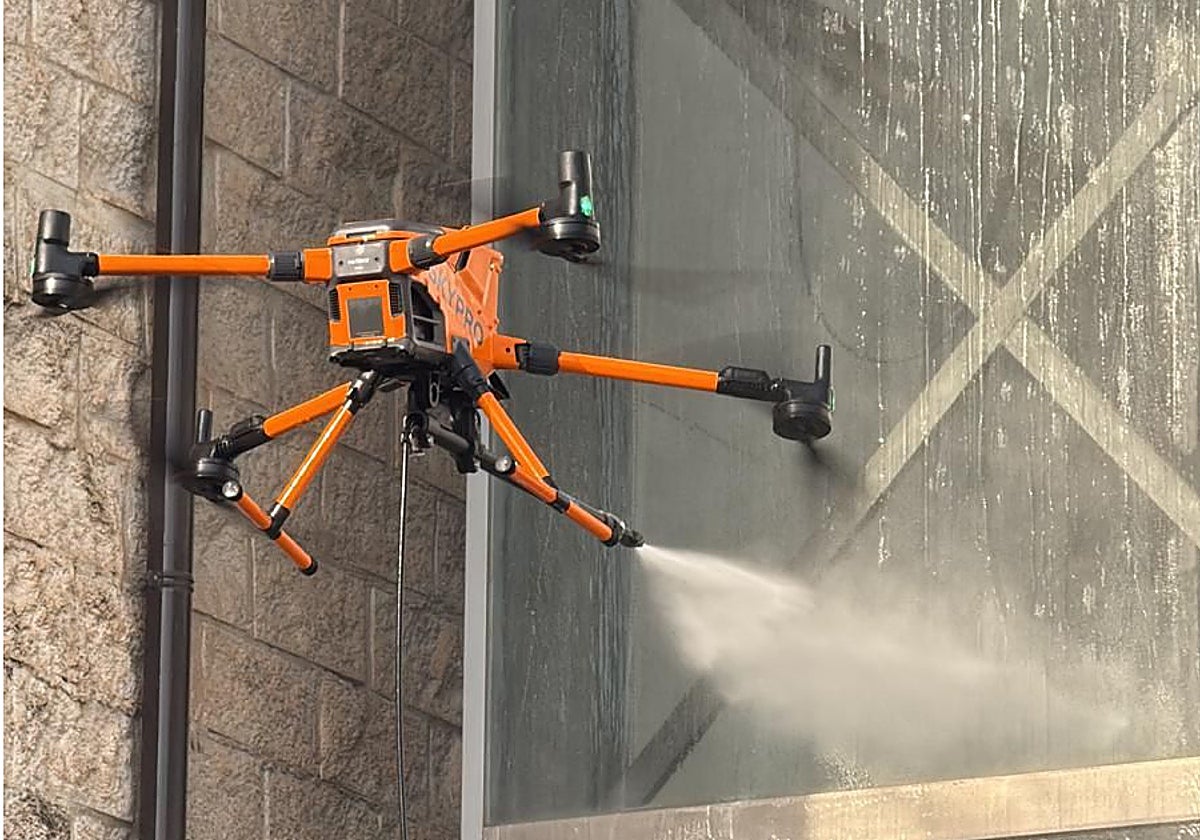
Mijas council’s cleaning department has launched a pilot scheme to evaluate an innovative cleaning system using drones, which aims to make it easier to ... clean hard-to-reach areas of municipal buildings. The project is being carried out on the side façade of the town hall and on the panoramic lift in Plaza Virgen de la Peña, as part of the improvements set out in the new contract for the cleaning of public buildings.
The aim is to provide a service that is “more efficient, safer for workers and delivers better results” in the maintenance of municipal buildings.
“Mijas is taking another step forward in the modernisation of municipal services, incorporating technological solutions that are already beginning to be rolled out in some of the country’s most innovative local authorities,” the council said.
The councillor responsible for the area, Eloy Belmonte, said that the new contract includes services that were not previously carried out on a regular basis, such as the external cleaning of large glass surfaces or particularly complex areas. “When we put a new contract out to tender, this is precisely what we are looking for: to have the best technology and all available resources to improve the service we provide to residents. This trial will allow us to check whether the drone delivers the results we expect and, if so, to extend its use to other municipal buildings,” he explained.
The drone uses filtered water to prevent limescale build-up and can operate with either cold or hot water using specific detergents
In order to carry out this work, it has been necessary to put in place specific safety measures, including the relevant authorisation for the drone flight, cordoning off the surrounding area and installing a lifeline, as required by current regulations for this type of operation in urban environments. During the test, a drone was used that was connected to a supply of water which has been filtered to remove limescale and prevent marks on the windows. Depending on the type of dirt, the system can operate using either cold or hot water and utilise specific detergents to ensure an optimal finish.
Advantages
Clece, the company awarded the contract for the service, favours this technology because of the advantages it offers in terms of both efficiency and the prevention of workplace risks. The company’s team leader in Malaga, Andrés Alarcón, explained that this system makes it possible to carry out work in areas where traditional methods would require complex abseiling or the erection of scaffolding. “Using the drone, we can carry out cleaning more quickly and efficiently, while reducing the risks to workers by avoiding work at height wherever possible,” said Alarcón.
Belmonte said that this initiative reflects the management model promoted by the department of cleaning. “We want Mijas to set an example in the way public services are delivered too. When technologies exist that enable us to do the job better, faster and more safely, it is our duty to adopt them. That is the path we want to continue along.”
The council explained that this experience will enable it to assess the feasibility of introducing this system into other municipal buildings with similar characteristics, thereby “consolidating Mijas council’s commitment to public services that are increasingly modern, efficient and adapted to the possibilities offered by technological innovation”.
![[]](http://static.vocstatic.com/voc26/latest/assets/images/favicon/surinenglish/apple-touch-icon-57x57.png)