
Roads
Marbella is bringing 32 traffic light junctions into line with the new regulations
The work has made it necessary to reschedule the use of the facilities and adjust crossing times, which may lead to longer waiting times for vehicles and pedestrians

Marbella
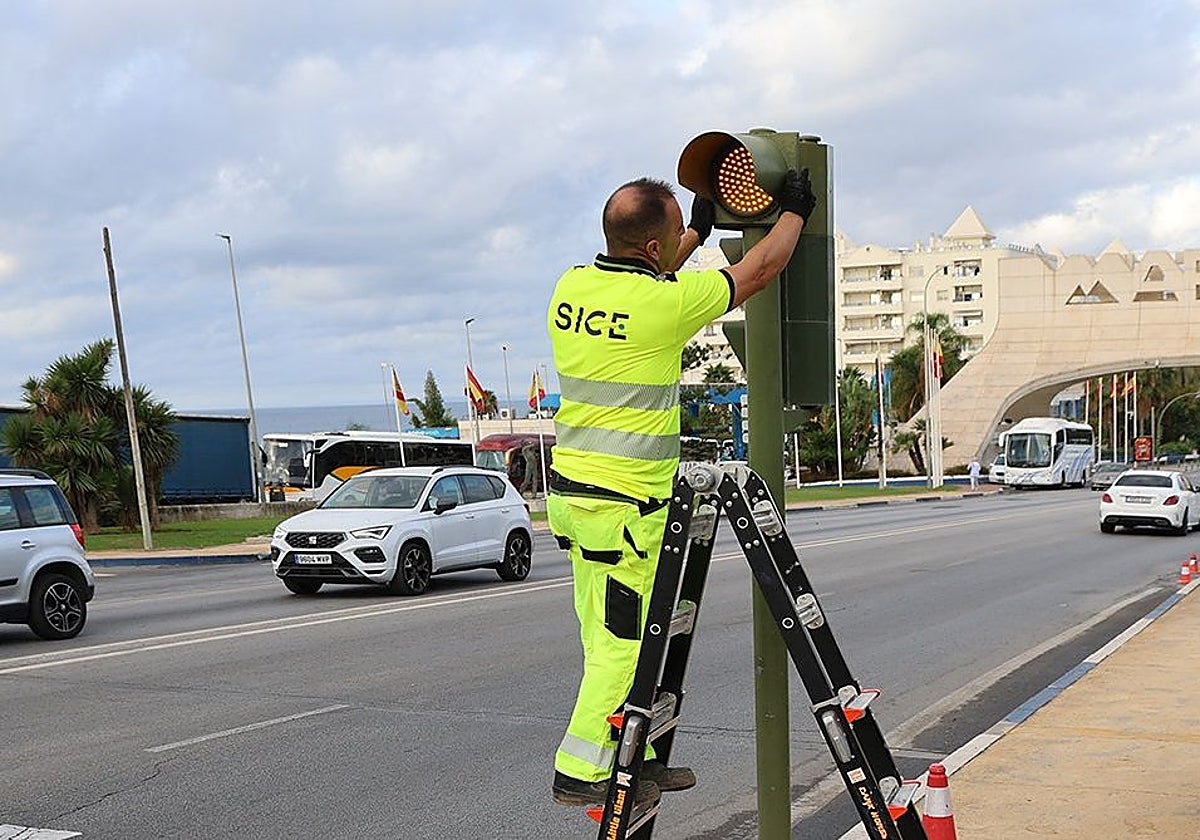
Marbella town hall is adapting 32 of the municipality’s 60 traffic light junctions to the amendments to the general traffic regulations approved by the ... central government and in force since 1 October. The work, scheduled to continue until the end of November, will cost approximately 100,000 euros. The council is carrying out the necessary work to comply with the new national regulations, although it warns of the technical difficulties involved in their implementation and their potential impact on traffic flow. The work requires a detailed assessment of each junction and its coordination with neighbouring junctions to minimise disruption to traffic.
Of the 32 junctions affected, 16 require their traffic light controllers to be reprogrammed, while the other 16 also require modifications to various parts of the installations. More than 300 traffic lights are affected by this measure introduced by the central government. Furthermore, at 18 of these junctions, the countdown timers will be adapted to bring them into line with the new pedestrian crossing phases. Among the junctions affected are Calle Serenata and Avenida San Bernabé, Avenida Julio Iglesias and Calle Antonio El Bailarín, Avenida Salamanca and Avenida de Burgos and Calle José Echegaray and Calle Lyon. The main change affects those crossings where, until now, the flashing amber light for vehicles coincided with the steady green light for pedestrians. This combination allowed drivers to proceed with caution when no one was crossing, while still being obliged to give way.
The new regulations stipulate, as a general rule, that the two signals must not coincide and that the flashing amber light for vehicles must be preceded by a steady red phase. This necessitates changes to crossing times and the coordination of traffic light systems. Among the solutions being implemented is keeping vehicles on red while the pedestrian signal is steady green, and subsequently allowing the flashing amber signal for vehicles to coincide with the flashing green signal for pedestrians. The duration of these phases is adjusted to suit the characteristics of each junction.
The council reminded drivers that they must exercise extreme caution and give way to pedestrians when the amber light is flashing. It also shares the aim of protecting the most vulnerable road users, but considers that the general restriction imposed by this traffic light combination may lead to longer waiting times and slow down traffic, as it keeps vehicles stationary even when no pedestrians are crossing. This is particularly true at traffic light junctions with high levels of traffic congestion.
Adjusting the cycle times may reduce the duration of the fixed green phase for pedestrians or extend the wait until the next crossing phase
Depending on the configuration of each junction, the reallocation of cycle times may also reduce the duration of the steady green pedestrian signal or prolong the wait until the next crossing phase. Accroding to the council, these delays may lead some pedestrians to cross the road illegally while the traffic lights are red. Another option is to extend the flashing green pedestrian signal to synchronise it with the flashing amber signal for vehicles. The town hall warned that this solution requires users to be properly informed to avoid confusion and to ensure they do not start crossing in the final seconds. For this reason, the technical services and the contractor are analysing each junction and the surrounding traffic lights, as any changes may affect nearby crossings and journey times, including those of public transport.
Until the end of November
The directorate-general for traffic has issued a recent new instruction clarifying that the restriction is the general rule, but not an absolute ban, and provides for exceptions at certain junctions. The council considers it necessary for its implementation to take into account the technical and safety circumstances of each location. The work will involve the installation of 43 new three-phase traffic lights, each 200 millimetres in diameter, the installation of 16 peripheral modules, 26 output cards and 129 LED pedestrian signals with countdown timers, as well as the laying of 3,729 metres of cable.
Furthermore, to help people adapt, the local authority is set to roll out countdown timers at 18 junctions – across a total of 129 traffic lights – so that the time displayed corresponds to the new timing schedule. These devices provide an additional reference point for those already crossing the road, without replacing the instructions given by the traffic lights. The council will continue to carry out the planned measures until the end of November to comply with national requirements, while striving to ensure pedestrian safety and minimise the impact on transport within the municipality.
