
Business
Malaga is second Spanish province with most companies per 1,000 inhabitants
Although only Madrid surpasses it, the Costa del Sol still lacks large corporations

Cristina Vallejo
Malaga was the fourth province with the most new businesses in 2025, with a total of 6,271. Only Madrid (26,865), Barcelona (17,204) and Valencia (6,645) surpassed it. With this number of new companies, Malaga also ranks fourth in overall contribution: 5.6% of all companies founded in Spain are based on the Costa del Sol, compared to 3.8% in Seville, for example, although far from the almost 25% in Madrid.
These figures come from an Accumin Intelligence report, which shows that 111,784 new companies were established last year, representing a 1.1% increase compared to 2024. It is in this indicator, however, that Malaga falls behind. Its business creation in 2025 was 7.3% lower than in 2024. In fact, there were only five provinces in Spain with worse performance: Asturias, where business creation fell by 15.3% year-on-year; León and in Cáceres, also with double-digit declines; and Toledo and Ávila, with drops of 8.8% and 7.5%, respectively.
Related story
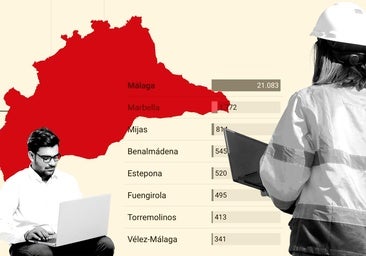
The drop in new business creation doesn't overshadow Malaga's second-place in terms of new company creation relative to its population. Last year, 3.7 new businesses were created in the province per thousand inhabitants, a figure surpassed only by Madrid, with four new businesses per thousand inhabitants. Malaga ranks ahead of the Balearic Islands (3.5), Alicante (3.3), Barcelona (3) and Valencia (2.6). The Spanish average in 2025 was 2.4 businesses per thousand inhabitants. The other Andalusian provinces fall below this figure. The closest is Seville (2.2), while the furthest is Jaén, with just one new company per thousand inhabitants.
The data reveals that provinces such as the Balearic Islands, Malaga and Alicante stand out for their high entrepreneurial intensity, for the greater relative weight of business creation and for their greater capacity for growth.
Malaga's weak points
Although Malaga has consistently ranked fourth in Spain in terms of the number of new businesses (according to other statistics, it ranks third), there are other metrics where its productive sector falters.
One example is the indicator that measures size of new businesses by their initial capital: in 2025, according to the national institute of statistics, the average was 35,200 euros, below the national average of 45,200 euros.
Furthermore, around 30 provinces ranked ahead of Malaga and topped the list with over 200,000 euros in initial subscribed capital. The initial capital of new businesses in the two provinces leading the ranking for new companies, Madrid and Barcelona, was quite similar to that of Malaga last year, at 35,300 and 38,700 euros, respectively.
Malaga also "falls short" in terms of company size as measured by the number of employees. Although the Costa del Sol province has the most companies of any Andalusian province, Seville surpasses it in the number of companies with between 100 and 249 employees, with 479 compared to Malaga's 284, and also in companies with more than 250 employees, which number 186 in Malaga and 245 in Seville.
A third shortcoming of Malaga's productive sector is the scarcity of headquarters for large companies with more than 1,000 employees. According to the most recent report by Accumin Intelligence, the province of Malaga has only 16 headquarters for these types of corporate groups. This means that the decision-making centres of large corporations may have their production facilities spread throughout Spain. Among them, the most important are Unicaja, Mayoral and EPAM.
Returning to the study Accumin Intelligence published this Tuesday, the sector that led business creation in Spain in 2025 was real estate, with 17,334 new companies, representing 15.5% of the total; followed by the construction sector, with 14,677 companies, 13.1% of the total; and wholesale and retail trade, with 14,213, representing 12.7% of the new businesses. The fourth most active sector was professional services and the fifth was hospitality.
![[]](http://static.vocstatic.com/voc26/latest/assets/images/favicon/surinenglish/apple-touch-icon-57x57.png)