
Infrastructure
Malaga's mayor sets eight-year deadline for 'plaza-bridges' over Guadalmedina riverbed
De la Torre plans to request funding from the EU, the central and the regional governments for a project that will cost around 330 million euros
Jesús Hinojosa
Malaga
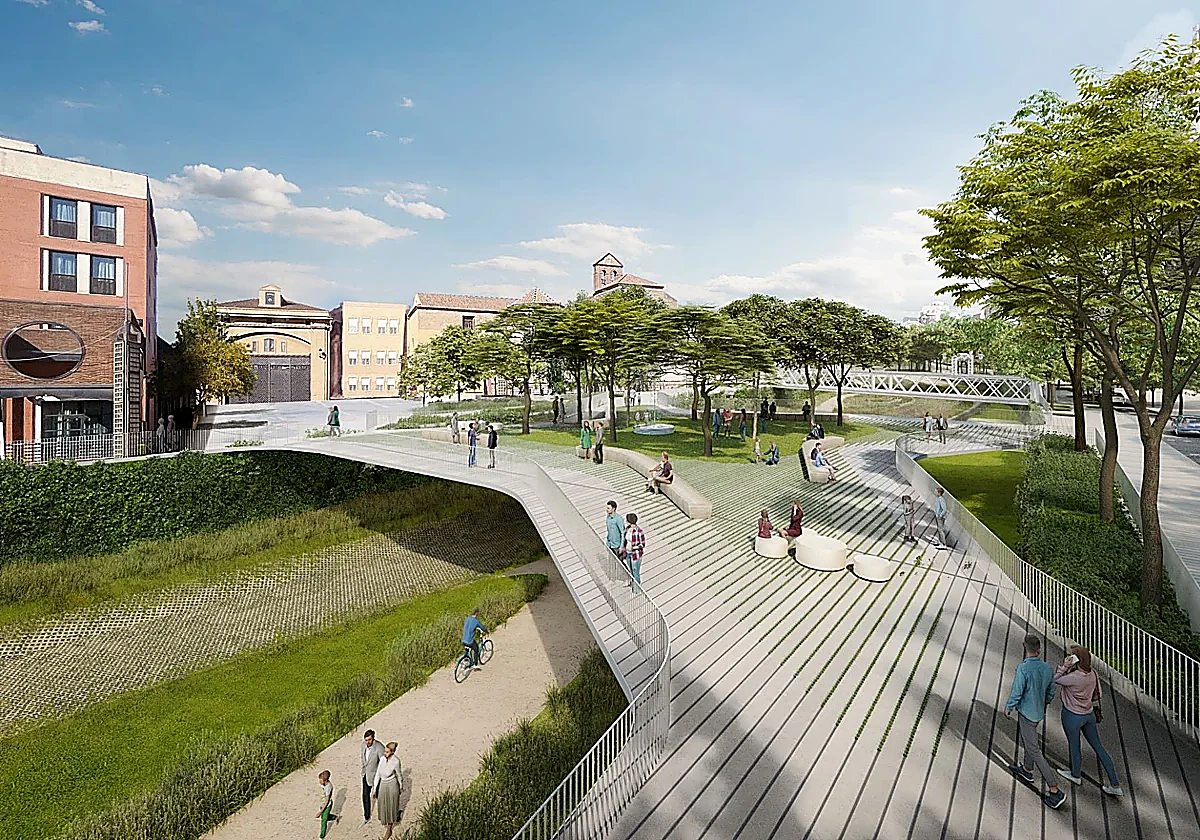
Malaga city council has set in motion the administrative procedure to implement in the coming years the 'plaza-bridges' plan with which Mayor Francisco de la Torre wants to stabilise and beautify the Guadalmedina riverbed. The project includes five structures that will connect the city centre with the La Trinidad and El Perchel districts, creating a kind of big square with garden areas.
On Saturday, the city council put out to tender the drafting of the construction project, based on a preliminary design, which consulting firm Esteyco had prepared, as commissioned by municipal company Promálaga. Companies interested in carrying out this work, with a budget of two million euros, will have eleven months to complete it.
The final draft of the plan for the urban integration of the Guadalmedina will not be ready until at least the middle of next year. The tender specifications for drafting the project indicate that "the execution of the works will foreseeably take place" between 2028 and 2034, that is, over the next eight years.
The city council has set this deadline so that the Guadalmedina plan can benefit from the next multi-year European funding framework. Financing is one of the main unresolved issues for this project. Initial calculations set the costs at 300 million euros, although the figure could be higher once the project plan analyses the necessary works in detail.
Therefore, one of the requirements of the environmental sustainability department is to analyse potential funding sources "other than municipal ones". The city council is considerings European funds, a loan from the European Investment Bank (EIB) or financial assistance from "other national or regional programmes related to green infrastructure, climate change adaptation, flood risk management or urban regeneration".
The city council has asked the company to prepare a project that anticipates the requirements that would make it eligible to receive this type of funding. It must demonstrate that the project contributes to mitigating climate change, complies with the principle of "not causing significant harm", has a cost-benefit analysis in accordance with the European Commission's methodology and is compatible with financial instruments from the EIB or "funds with a sustainable investment component".
In short, De la Torre is aware that, without help from other administrations, the city council would find it very difficult to cover the cost of the 'plaza-bridges' for the Guadalmedina river and the conversion of the riverbed into a riverside park. The preliminary design includes five X-shaped 'plaza-bridges' (three ranging from 2,600 to 4,500 square metres in area between the Armiñán and Aurora bridges and two of 1,300 and 1,400 square metres in the Santo Domingo area).
Structures in the riverbed will support the 'plaza-bridges', without reducing the Guadalmedina's capacity to channel water during periods of heavy rainfall. The regional government requests that the structure have a sufficient cross-section to accommodate a flow of up to 460 cubic metres per second from the river and its tributaries.
To guarantee this maximum flow and, at the same time, be able to remove the walls that delimit the riverbed between Avenida Fatima and Avenida Rosaleda, the city council has planned to lower the riverbed between the Armiñán and Aurora bridges, remove obstacles to favour the passage of water and create two waterfalls (one upstream of the Armiñán bridge and another downstream) to increase the slope in this section.
The project must allow the construction of the 'plaza-bridges' and the river park in the riverbed to be carried out independently of the planned undergrounding of traffic - an operation that is not part of this work but must be compatible with construction.
Acoustic alarms and barriers to control access to the riverbed
The Guadalmedina plan envisages turning the riverbed into a riverside park where residents will be able to walk along its paths. That use of the river channel requires an emergency plan "to ensure the prevention of risks linked to the park's floodability during periods of high water".
In this regard, the company must analyse at least "a system to control access to the park, including barriers, surveillance cameras and acoustic warning alarms", as well as integrate it with the existing network of sensors in the riverbed and its tributary streams to monitor water flow in real time.
The project must also include a maintenance plan for the riverbed, setting out routine and exceptional cleaning and upkeep operations, particularly to remove debris carried by rainfall that reduces the river's capacity.
![[]](http://static.vocstatic.com/voc26/latest/assets/images/favicon/surinenglish/apple-touch-icon-57x57.png)