
Pilar Vilella, Lego Brand Manager Spain
'Building with Lego helps you manage frustration'
"Once you start building and see all the positive effects, you get hooked," she admits to having "caught the brick bug"
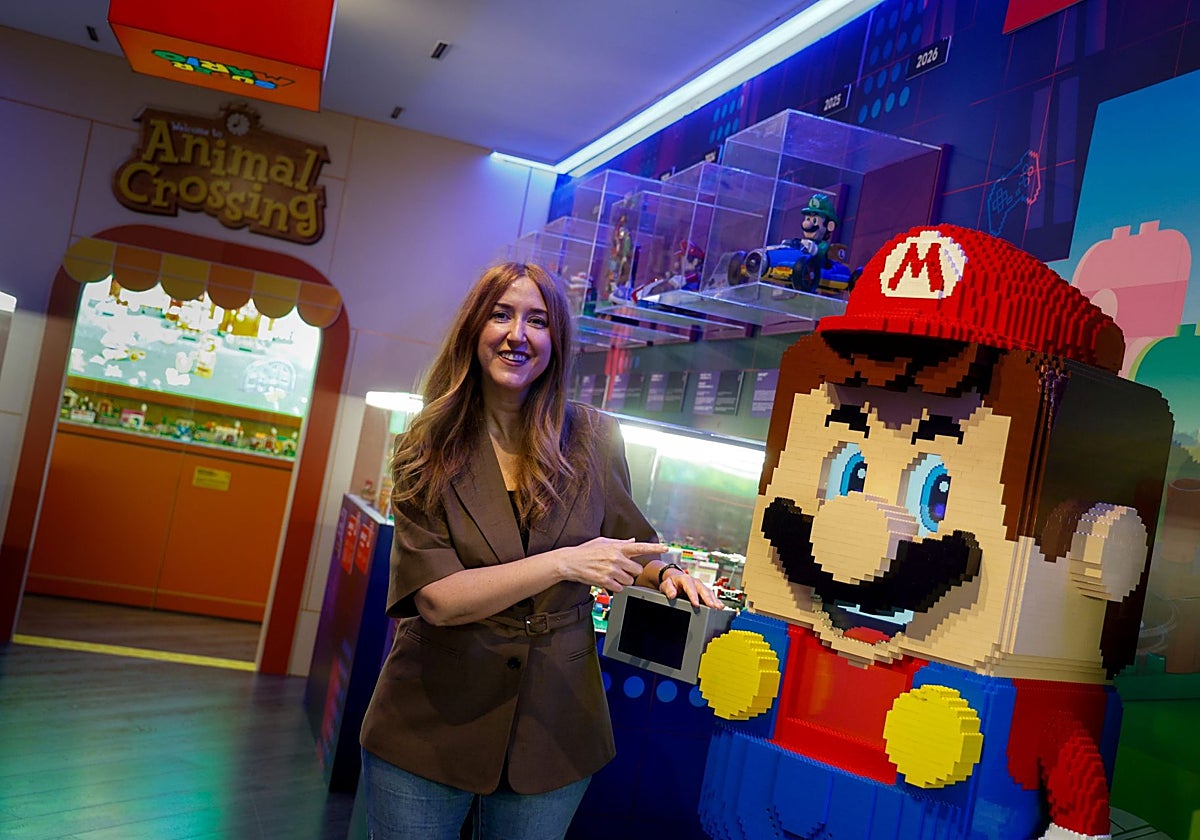

Is the state of the world and the stresses of daily life leaving you overwhelmed? Perhaps you could try building a Lego bouquet as a ... relaxation technique. Or even Harry Potter's Diagon Alley, made from more than 5,000 pieces, for about 450 euros.
It wonderfully evokes the children's world of the 1990s, when everything seemed to be going well. Back then, Danish bricks were the material from which children built their pirate ships and police stations.
Lego sells much more than just learning toys: many of its products are explicitly aimed at adults. Lego sees itself as an 'analogue detox' for digital overload, but it turns out it also makes video games. This contradiction is addressed by Pilar Vilella (Zaragoza, 1975), Lego's brand manager in Spain, who is taking advantage of her visit to the Video Game Museum, where an exhibition has just opened that revolves entirely around the world of bricks.
–Do you remember your first encounter with Lego?
–My first encounter with Lego was when I had the interview to join the group. As a child, I used to play with Playmobil.
–I understand that it has become a kind of "religion" for you.
–Absolutely. My house is full of Lego; I can't fit any more in. I've caught the brick bug. Once you start building and see all the benefits – mathematical thinking, problem-solving, tolerance, patience, self-esteem… – you're hooked.
–What is the best set for you?
–Of all of them, the one I like best is Lego Ideas. It's a collection that comes about as a result of requests from fans.
–Has Playmobil now become a sort of antichrist?
–No, not at all. Competition within the toy industry is very healthy. There's a lot of communication between the brands.
–Lego was founded in Billund, a small Danish town with barely 6,000 inhabitants. Is there still any trace of Danish philosophy in the company?
–The principles that inspired the brand's founder continue to guide the group's philosophy to this day. It is a family-run business; it remains in the hands of his heirs and is not listed on the stock exchange. I really like that because it means we never lose sight of our mission and objective, which is to inspire and develop the builders of tomorrow.
To date, over 800 billion bricks have been produced. Where are they all?
–Well, they're in people's homes, in children's bedrooms. Lego is passed down from generation to generation. Bricks from the 1960s are compatible with those made today. Bricks aren't thrown away; they're kept.
–The bricks are made of plastic. There is too much plastic in the world. When will you start making bricks from natural materials?
–This is one of the major challenges we face as leaders in the toy industry. We feel a great responsibility to find a solution to this issue. We are investing heavily in addressing the plastic issue and have committed to finding a substitute material by 2032. Much of the collection is already made from a material derived from sugar cane.
–How has the way children play changed?
–The way children play has changed enormously and we've had to adapt. What hasn't changed is creativity, enthusiasm, the benefits that come with play, and the fact that something as simple as a brick can unlock such a powerful world of imagination.
–There's now a Lego video game. Isn't that a bit like betraying the very essence of what makes Lego what it is?
–That's a good question. For me, it's linked to the previous one, to the need to evolve in line with what children want. We can't ignore the fact that they spend a lot of time in front of screens. So, what is our commitment? On the one hand, to create suitable video games, in which humour and building are integral parts. On the other hand, to turn their favourite video games into something physical so that children, using their creativity, can develop new levels and different ways of playing with their favourite characters. Ultimately, it's a process of adaptation: we don't want to betray our origins, but rather adapt to reality without losing sight of the fact that, for us, the core of our business will always be physical play and the brick.
– There is also clothing, the video games mentioned earlier, watches, theme parks and even films. What is the risk that the bricks might become nothing more than a by-product?
–We cannot ignore the fact that Lego has become a cultural icon, transcending the boundaries of how this toy originated. Consequently, the ecosystem has become very open: from TV series to films and clothing. I don't see this as a risk, but rather as an opportunity for the brick to become a reference point in popular culture. But the brick is the heart of our business, and that is something we will never lose sight of.
"We have committed to finding a substitute material for plastic by 2032".
–Adult Lego fans have their own name: AFOL, 'Adult Fan of Lego'. How much do you have in common with these enthusiasts?
–AFOLs are a step above the average fan. They're very creative, avid collectors. I wouldn't dare call myself an AFOL: it's like a mark of top-tier quality; it's a big deal.
–A bit geeky, aren't they?
Exactly, but I like the word 'geek'. I like that kind of geek, the very creative people. There are lots of engineers, lots of designers and lots of girls too who, from a very young age, have played with Lego and who, as adults, have reconnected with it and are capable of building their own worlds from the bricks.
–Do you have any children?
–No, I don't have any children. I have nieces.
–Do they ask you for Lego for Christmas?
–I'm not just my nieces' favourite aunt, but also my friends' children's favourite aunt. They love it, and I love watching them grow up and move from simpler sets to more complicated ones, and seeing them explore worlds like Harry Potter or Star Wars.
–Lego is over 90 years old. Do you think it will still be around in 90 years' time?
Of course. The sky's the limit.
![[]](http://static.vocstatic.com/voc26/latest/assets/images/favicon/surinenglish/apple-touch-icon-57x57.png)