
Infrastructure
Malaga business owners request third reversible lane to alleviate traffic between the city and Rincón de la Victoria
They also demanded improvements to the most congested links and progress in the coastal rail link
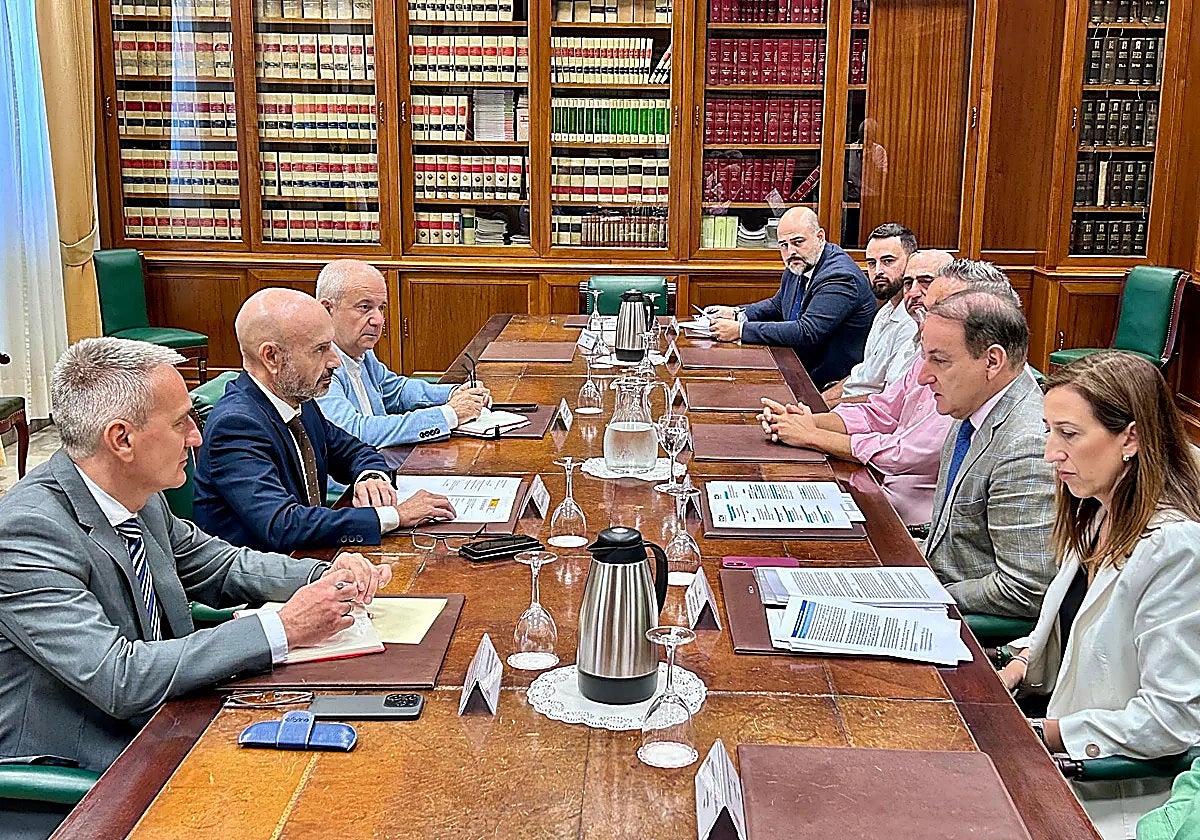
Chus Heredia and Eugenio Cabezas
The confederation of Malaga business owners (CEM) and business associations from the Axarquía area held a meeting with government delegate Francisco Javier Salas to present a series of proposals aimed at improving traffic between the Axarquía, the city of Malaga and its commuter area.
The meeting highlighted the need to combine urgent actions with medium- and long-term infrastructure planning.
As their main short-term action, business organisations proposed a study to implement a third reversible lane on the most congested sections of the eastern A-7 motorway. This would allow for an additional lane in the direction of highest traffic volume, towards Malaga during the early hours of the day and towards the Axarquía in the afternoon.
Related story

The CEM considers this measure a priority due to its rapid implementation, minimal territorial impact and compatibility with other subsequent projects.
For business representatives in the province, this emergency measure must be complemented by improvements to the most congested links and access points along the eastern corridor, specifically in the areas around Malaga Este, El Palo, La Cala del Moral and Rincón de la Victoria.
This aligns with the proposal president of the provincial authority Francisco Salado and Mayor of Malaga Francisco de la Torre made last year.
In the medium and long term, the CEM is committed to a rail connection and improvements to public transport. In fact, the associations emphasised that the reversible lane is not a single or definitive solution, but rather a first phase within a broader strategy.
Rail link
The employers' association has pointed out that the eastern coast still lacks a rail link, a deficiency that limits alternatives to private vehicles and hinders a sustainable transport system. It also demands improvements to intercity public transport, optimising both its frequency and coordination between municipalities.
"The demographic, residential and economic growth of the Axarquía has not been accompanied by a corresponding improvement in its transport infrastructure. The A-7 motorway remains the only high-capacity road connecting it to the city," CEM President Javier González de Lara said.
"The lack of alternatives causes immediate delays in the event of any incident, increasing costs and travel times for thousands of residents who travel daily for work, education, health or commercial reasons and impacting the transport of goods from strategic sectors such as tourism, agriculture and the agri-food industry," he stressed.
"We are facing a problem that affects the present and future of an area that is strategic for Malaga. Transport is not just a business issue: it impacts thousands of workers, students and families every day," De Lara said.
Deputy government delegate calls for metro extension to Rincón de la Victoria
Salas announced that they will push for several projects to be included in the general state budget. He said the Ministry of Transport is currently undertaking studies to improve connections between Malaga city and the Axarquía.
"We ask the other political parties to join us in approving this budget because it will be good for the province," he said, while also urging other institutions to address the challenge of transport.
He demanded that the Andalusian regional government improve intercity bus services. "The concessions haven't been updated for 20 or 30 years," he stated. He also called for the extension of the metro to Rincón de la Victoria.
Access the broad Malaga and Costa del Sol index
![[]](http://static.vocstatic.com/voc26/latest/assets/images/favicon/surinenglish/apple-touch-icon-57x57.png)