
Rail transport
Malaga AVE rail line remains without certain reopening date
Although rail operators have already received the thumbs up to start operating in the province on 27 April, the Ministry of Transport cannot confirm whether this will be possible
Ignacio Lillo
Malaga
Just five days before the latest date state infrastructure company Adif had announced for the reopening of the high-speed rail in Malaga (27 April), the Ministry of Transport has avoided answering SUR's requests for confirmation.
"We will announce it when we have it. Adif will communicate the date when it considers the infrastructure is clear, always prioritising safety," sources from the ministry told the newspaper.
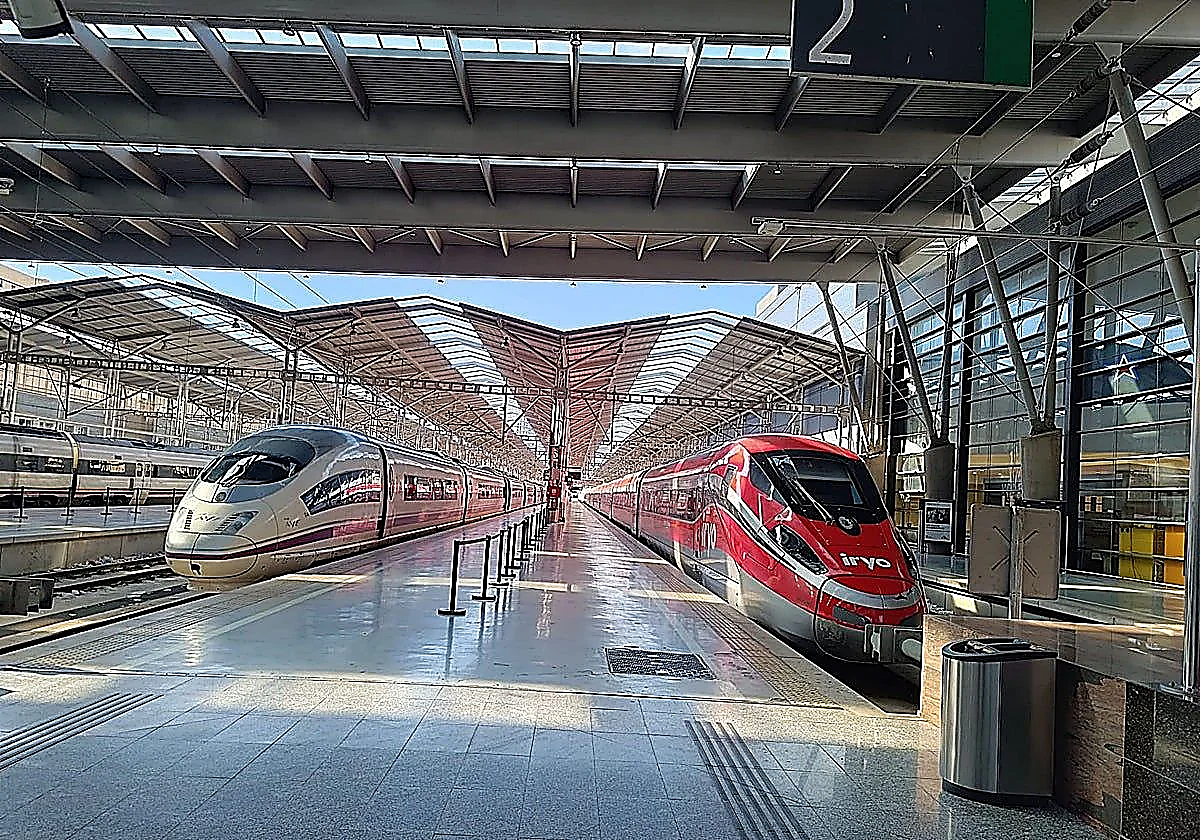
When the ministry first announced that the AVE line could reopen on 27 April, Adif notified the three opertors in the area (Iryo, Ouigo and state-owned Renfe) that they could make their trains available at the end of the month.
While Ouigo and Iryo have trains running on that date, Renfe has very limited direct options. "Adif told the operators that the trains wouldn't be running before 27 April. If they wanted to start selling tickets, that was up to them," the ministry said.
In the absence of an official announcement regarding the date, there are certain signs that do not bode well. Although there are still a few days to go until Monday, as of Wednesday, Renfe has only one direct train to Madrid and four to Malaga on sale for that day. If the line were open, many more trains could be running. Renfe has simply stated that they are "awaiting official information".
In addition, several passengers who had planned trips with Renfe for next Monday have complained about the uncertainty surrounding their journey at such a short notice. For some, the trip is work-related and unavoidable, so Renfe has refunded them. They will ultimately travel by plane.
Almost three months of waiting for the AVE in Malaga
Almost three months after that fateful 4 February, when a series of storms triggered a serious landslide near Álora, the Malaga-Cordoba high-speed line is nearly ready to reopen. However, the exact date of this milestone remains unknown. The only timeframe currently available is the one government subdelegate Javier Salas recently mentioned. He stated that direct trains would resume "next week", without providing further details.
Next week is not just any other week. During the upcoming May bank holiday weekend, if the train is open, thousands of people can take advantage of the opportunity to travel by train, as the dates are perfect (Friday is a public holiday). It would no longer be necessary to change buses between Antequera-Santa Ana and María Zambrano, which would substantially reduce travel time.
Once it happens, the return of the high-speed trains to Malaga will be gradual, as the damage has been far greater than initially anticipated. This has led to several miscalculations regarding the timeline, with two announced dates that were not met.
Initially, the closure in Álora overlapped with the line closure further up, which had been in place since 18 January following the tragedy in Adamuz (Cordoba). The Ministry of Transport subsequently announced that trains might resume services on 8 March. The next date was 23 March, just a few days before the start of the Holy Week. That long-awaited milestone could not be confirmed either, sparking a bitter row between the government, the opposition and businesses in the tourism sector.
Head of Adif Pedro Marco de la Peña visited the Álora construction site on 16 March and announced that they would reopen the rail "no earlier than the last week of April".
Fewer and slower frequencies
Once it reopens, the line will remain only partially operational for several more months. Initially, service will run on a single track (the track further from the slope). This has two direct consequences: first, there will be significantly fewer trains than before the incident. The number of services will drop from 26 in each direction to a maximum of 18.
The second obstacle will be the speed limits. Passing through this stretch of barely 500 metres will require travelling at a limited speed and the same applies further up, at the site of the Adamuz accident.
At least it will be much better than the more than four hours Renfe currently provides with a bus transfer at Antequera Santa Ana.
First phase
Iryo is currently offering three frequencies in each direction (half the number before the suspension) starting next Monday. The second private operator, Ouigo, has scheduled two departures between the two cities for the same day.
Renfe is currently updating its online service. Technical sources have told SUR that the plan is to have an average of 13 daily AVE and Avlo departures from Atocha to María Zambrano, although this number fluctuates depending on the day of the week.
An average of 12 trains will run from the Costa del Sol to the Spanish capital, although this is still pending official confirmation. As of 22 April, Saturday (25 April) is the last day that combined journeys with road transfers are available for purchase.
Back to normality
According to the schedule Marco announced in March, the double track could reopen in June, but a 54-kilometre stretch requires travelling on a single track.
This is because the landslide damaged a major piece of track equipment in the affected area. Replacing the part requires between five and seven months for manufacturing, followed by installation. Therefore, the complete restoration of the infrastructure to its original condition (and capacity) will take at least until the end of the year.
Rail connections between Malaga and Madrid are facing a tough summer. Until the equipment is replaced, trains will have to run on a single track, as there is no possibility of trains crossing from one track to the other on that extensive stretch.
This will result in a clearly vulnerable infrastructure with little room for manoeuvre, especially in the event of a train or track failure in that area. Should such an incident occur, the entire line will be blocked, with no option to use the other track as an escape route.
![[]](http://static.vocstatic.com/voc26/latest/assets/images/favicon/surinenglish/apple-touch-icon-57x57.png)