
Rail transport
Madrid-Andalucía rail line to reopen ten days after court grants permission, but with fewer services
The Transport Minister is in favour of maintaining the Madrid-Barcelona route open during the works
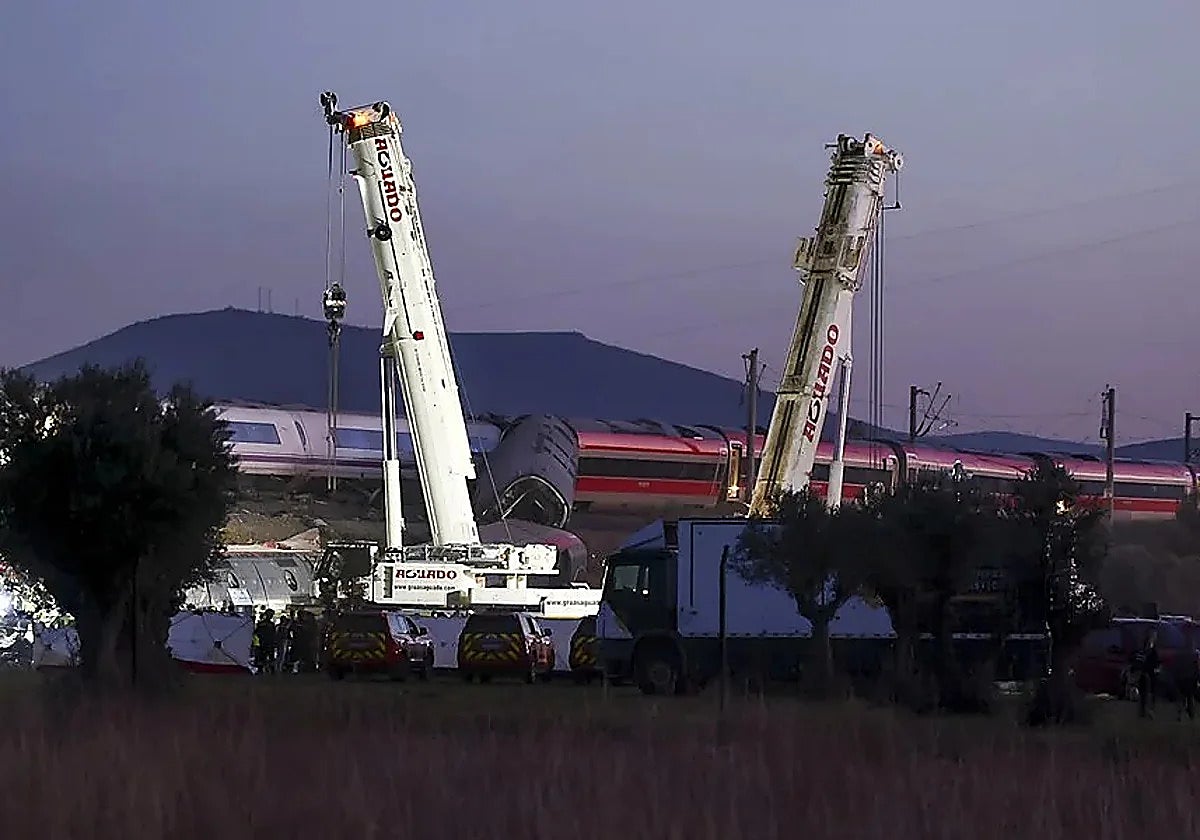

The Madrid-Andalucía high-speed line will reopen around ten days after the judge investigating the Urda accident authorises the repair work, but with fewer ... trains than before the tragedy.
Transport Minister Óscar Puente announced on Tuesday a reduction in service frequencies until the new ERTMS (European rail traffic management system) comes into operation, which is likely to be in early 2027.
Following the Cabinet meeting, Puente explained that the work to remove the trains involved in the accident on 28 October is now over and that the Adif infrastructure company has applied for a court order to begin rebuilding the track. The direct damage affects around 40 metres of track, but the transport department has decided to extend the repairs to cover 400 metres.
The reopening does not mean an immediate return to normality. Puente said that Adif will temporarily reduce the number of services to increase safety margins while the technological modernisation of the line is completed.
The minister did not specify how many trains would be cancelled, which timetables would be affected or how the restrictions would be distributed among Renfe, Iryo and Ouigo (the three operators using the corridor). He also did not specify how many seats would no longer be available over the coming months.
The decision will result in a reduction in capacity on one of Spain's main railway lines, where traffic has grown considerably since the liberalisation of passenger transport and the arrival of new operators.
The government is taking this measure six days after the Urda accident, which killed 69 people, and nine and a half months after the Adamuz accident, in which 46 people lost their lives. These two disasters on the Madrid-Seville line have placed rail safety at the forefront of the ministry's concerns.
"We must recognise, and we do recognise, the seriousness of the situation," Puente said. The minister also promised: "We will work tirelessly to restore the public's confidence in high-speed rail."
Puente used his appearance to clarify another of the announcements that had caused the most concern in recent days: the possibility of completely closing the Madrid-Barcelona line while Adif carries out modernisation works, scheduled to begin in 2027.
Puente has now opted to carry out the works while maintaining the service open, even though this decision will necessitate extending the completion times and may affect train punctuality.
The change of stance came after he publicly raised the possibility last Friday of adopting the German model, which involves suspending rail services during major railway refurbishments in order to speed up the works.
"We are considering making changes and cutting the service," Puente admitted at the time. He also warned of the consequences of that option: "There will be a backlash if we take that decision."
The minister explained that a project scheduled to take five years while services continue to run could be reduced to 12 or 24 months by closing the line, but during that period passengers would be deprived of rail services.
The prospect of completely suspending the Madrid-Barcelona service was met with opposition from the Catalan regional government. Its president, Salvador Illa, said that the refurbishment work must be carried out in accordance with the highest safety standards, while ensuring that the work affects the service "as little as possible".
Puente himself had already toned down his remarks on Friday and clarified, during a television interview, that they had not taken a decision and that a hypothetical cut "would under no circumstances be immediate".
He also dismissed that comment as having nothing to do with the causes of the Urda accident. "It has nothing to do with safety. It's more to do with comfort, punctuality and incidents," the minister clarified.
The ministry ultimately opted to keep the rail open during the modernisation works. The final decision on how the works will be organised is still pending.
As for the Madrid-Andalucía line, the timetable for the restoration of services depends on two separate measures: the reconstruction of the damaged section at Urda and the commissioning of level 2 ERTMS.
The ministry had been planning this latest modernisation for years before the trafedy. In December 2021, Thales announced two contracts worth around 98 million euros to upgrade the signalling and safety systems on the Madrid-Seville line. The main contract had a completion period of 52 months.
A report by the national commission for markets and competition, approved in May 2024, stated that the replacement of the LZB with ERTMS on the southern corridor was scheduled for between 2025 and 2026. The ministry now expects it to come into operation in early 2027.
Puente explained last Friday that the physical installation of the ERTMS had been completed in June, but that the tests, technical checks and authorisations required for it to be brought into service were still pending.
Meanwhile, the judicial investigation continues to hold up the reopening of the damaged infrastructure in Urda. The presiding judge is keeping the proceedings confidential and overseeing the investigations at the scene of the collision.
The accident occurred at 8.53am on 28 October, when a Renfe AVE train collided from behind with an Iryo train that had come to a halt at the entry signal at Urda, following a fault in the LZB system. The Renfe train resumed service following authorisation from the Atocha control centre.
The technical investigation provisionally estimates that the impact occurred at a speed of between 160 and 200 kilometres per hour. On-board recordings and data from the facilities should make it possible to reconstruct the sequence of events.
Over the weekend, the judge intervened to demand that the crane company hired by Adif and Renfe ensure it had sufficient staff to continue the work of removing and searching for wreckage. The work had been interrupted overnight due to a lack of staff.
