
High clouds, low sun and clear horizon: the fiery skies over the Costa del Sol explained
The curvature of the Earth and the light in the atmosphere explain the fiery red tones that light up the sky over Malaga. This is the half hour before dawn
High clouds, low sun and clear horizon: the fiery skies over the Costa del Sol explained
The curvature of the Earth and the light in the atmosphere explain the red and mauve tones that can be seen at dawn and dusk

In the footage we have just seen, filmed in Malaga at dawn on 27 September 2026, the sky is still dark as the first light begins to appear. Gradually, the blue gives way to mauve, and then the clouds glow red on the horizon. In just a few minutes, the landscape is bathed in red: a 'candilazo' has occurred.
Something similar, albeit the opposite way round, occurs at dusk, when the sun disappears below the horizon and the last rays of light once again colour the clouds. In both cases, the phenomenon is due to a combination of geometry and light: the sun’s position relative to the horizon, the height and arrangement of the cloud formations, as well as the long distance its rays travel through the atmosphere.
The duration and intensity depend on how these formations are distributed, on the patches of clear sky visible at any given moment, and on how clear the air is. These are the key factors in understanding why, for a few minutes, the sky treats us to this spectacle.
Geometry: you can’t see the sun, but it can light up the clouds
The sun has not yet risen above the horizon, but its rays are already reaching the clouds above our heads. They come from far away, skimming the sky, having travelled hundreds of kilometres through the atmosphere and above the Earth’s surface, until they illuminate the part of the cloud facing the sun.
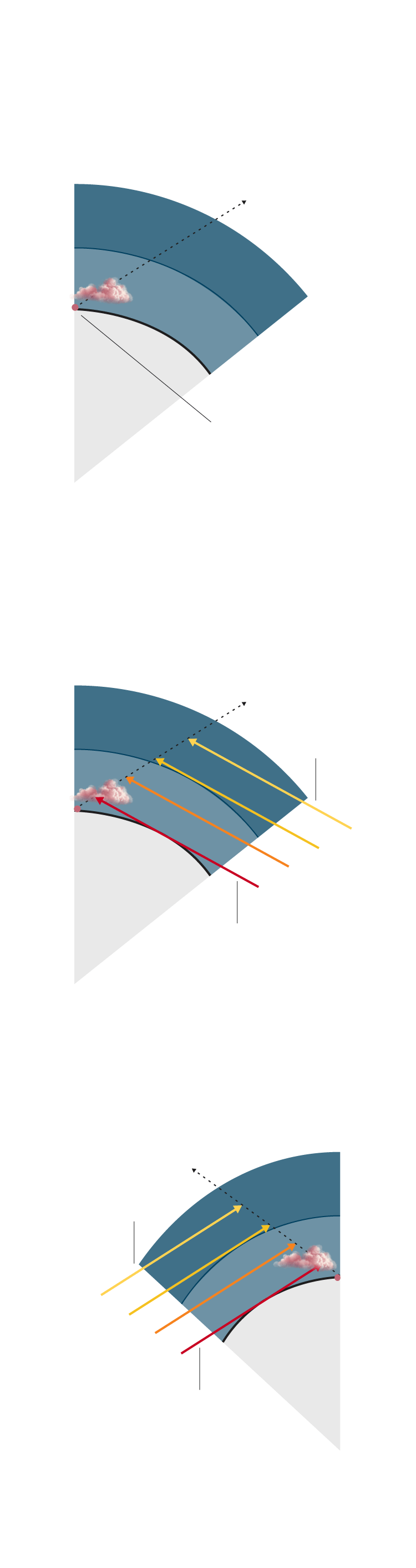
At dawn
The sun is below the horizon and the observer is still in the dark.
Direction the observer is looking in
Stratosphere
Troposphere
Earth
Horizon
Observer
The sun's rays are parallel and pass over the horizon. The rays that brush against the Earth pass hrough so much air that they are red; those that are higher go through less atmosphere and are yellow.
Yellowish sunlight
Earth
Reddish sunlight
At dusk
It happens facing west and the order is in reverse: after the sun sets, the clouds light up in red, then comes mauve and in the end the sky goes dark.
Yellow sunlight
Stratosphere
Observer
Earth
Reddish sunlight
Source: Lee and Hernández-Andrés, «Measuring and modeling twilight's purple light», Applied Optics (2003). Adapted with clouds added.
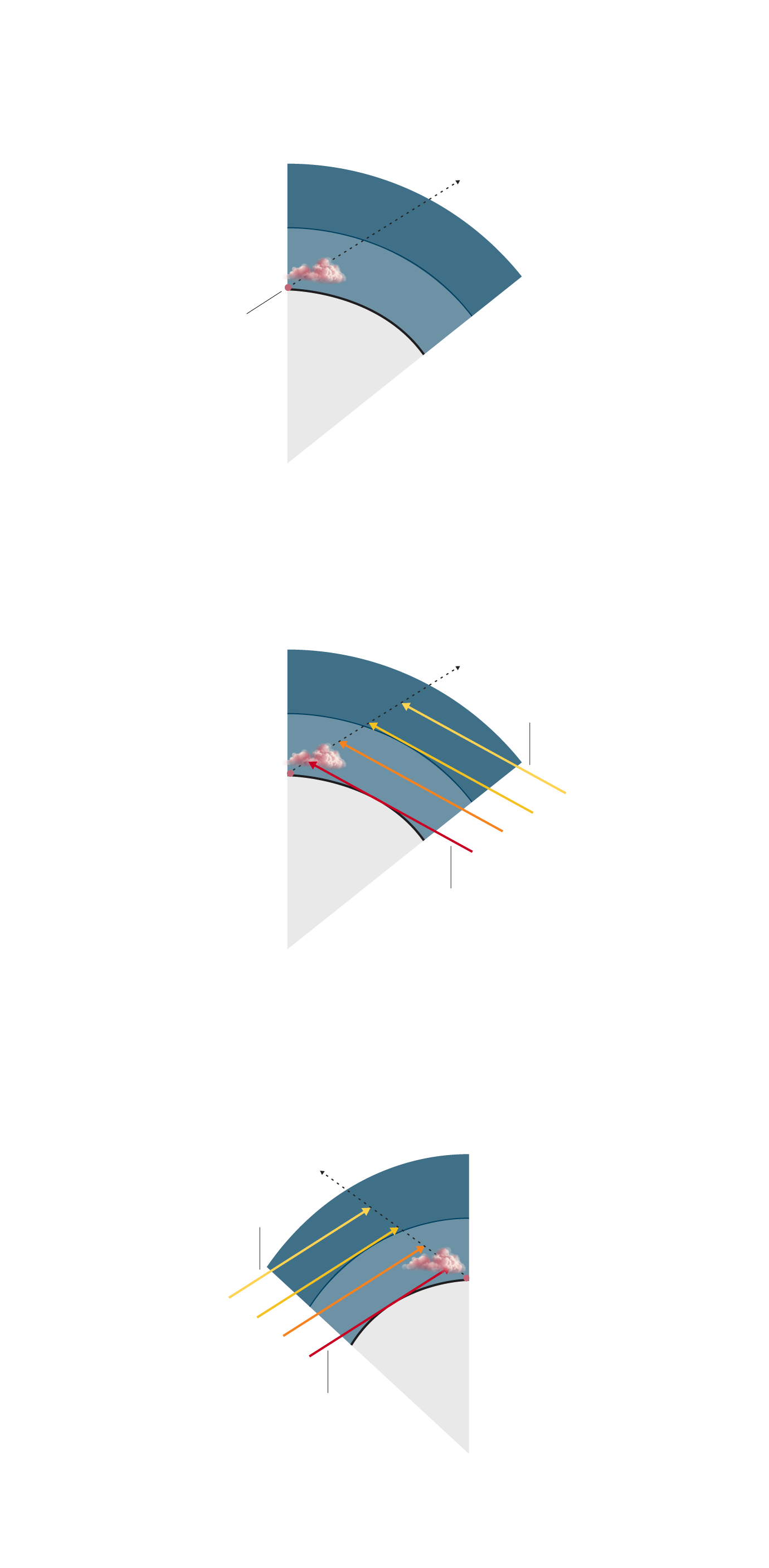
At dawn
El Sol está por debajo del horizonte y el que mira el candilazo sigue a oscuras.
Direction in which the observer is looking
Stratosphere
Troposphere
Observer
Earth
Horizon
The sun's rays llegan en paralelo y pasan por encima del horizonte. Los que rozan la Tierra atraviesan tanto aire que llegan enrojecidos, los que cruzan más alto atraviesan menos y llegan amarilleados.
Stratosphere
Luz solar amarilleada
Troposfera
Tierra
Luz solar enrojecida
Al atardecer
Ocurre mirando al oeste y el orden es inverso: tras la puesta, las nubes se encienden de rojo, después llega el malva y, al final, el cielo se apaga.
Stratosphere
Luz solar amarilleada
Troposfera
Observador
Tierra
Luz solar enrojecida
Fuente: Lee y Hernández-Andrés, «Measuring and modeling twilight's purple light», Applied Optics (2003). Adaptado, con nubes añadidas.
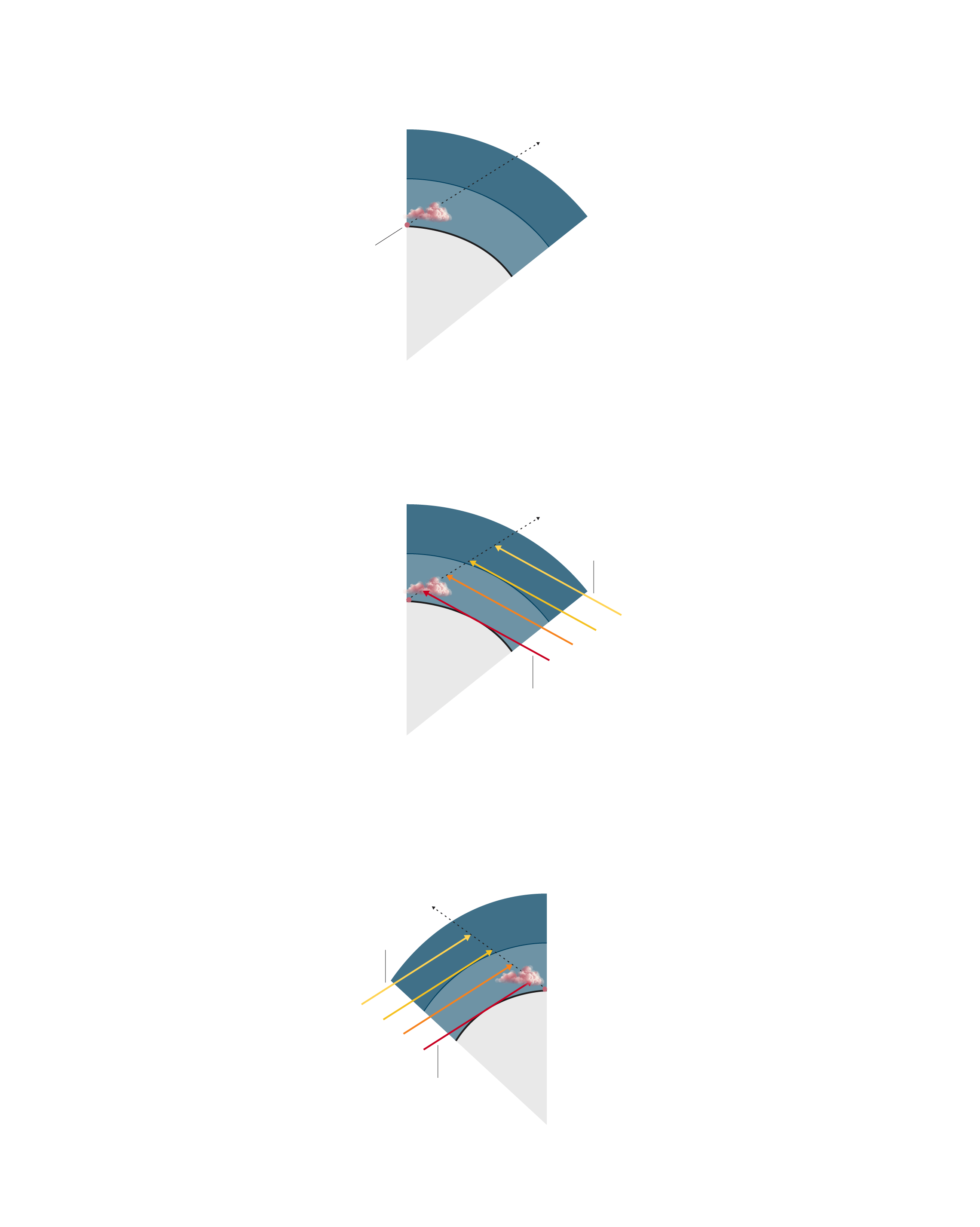
At dawn
El Sol está por debajo del horizonte y el que mira el candilazo sigue a oscuras.
Dirección a la que mira el observador
Stratosphere
Troposphere
Observador
Tierra
Horizon
The Sun's raysarrive in parallel and pass above the horizon. The rays that brush against the Earth pass through so much air that they are red; those that are higher go through less atmosphere and are yellow.
Estratosfera
Yellow sunlight
Troposphere
Earth
Red sunlight
At dusk
Looking west the order is reversed; after sundown the clouds light up in red, then comes mauve and finally the sky is in darkness.
Stratosphere
Yellow sunlight
Troposphere
Observer
Earth
Red sunlight
Source: Lee y Hernández-Andrés, «Measuring and modeling twilight's purple light», Applied Optics (2003). Adapted, with clouds added.
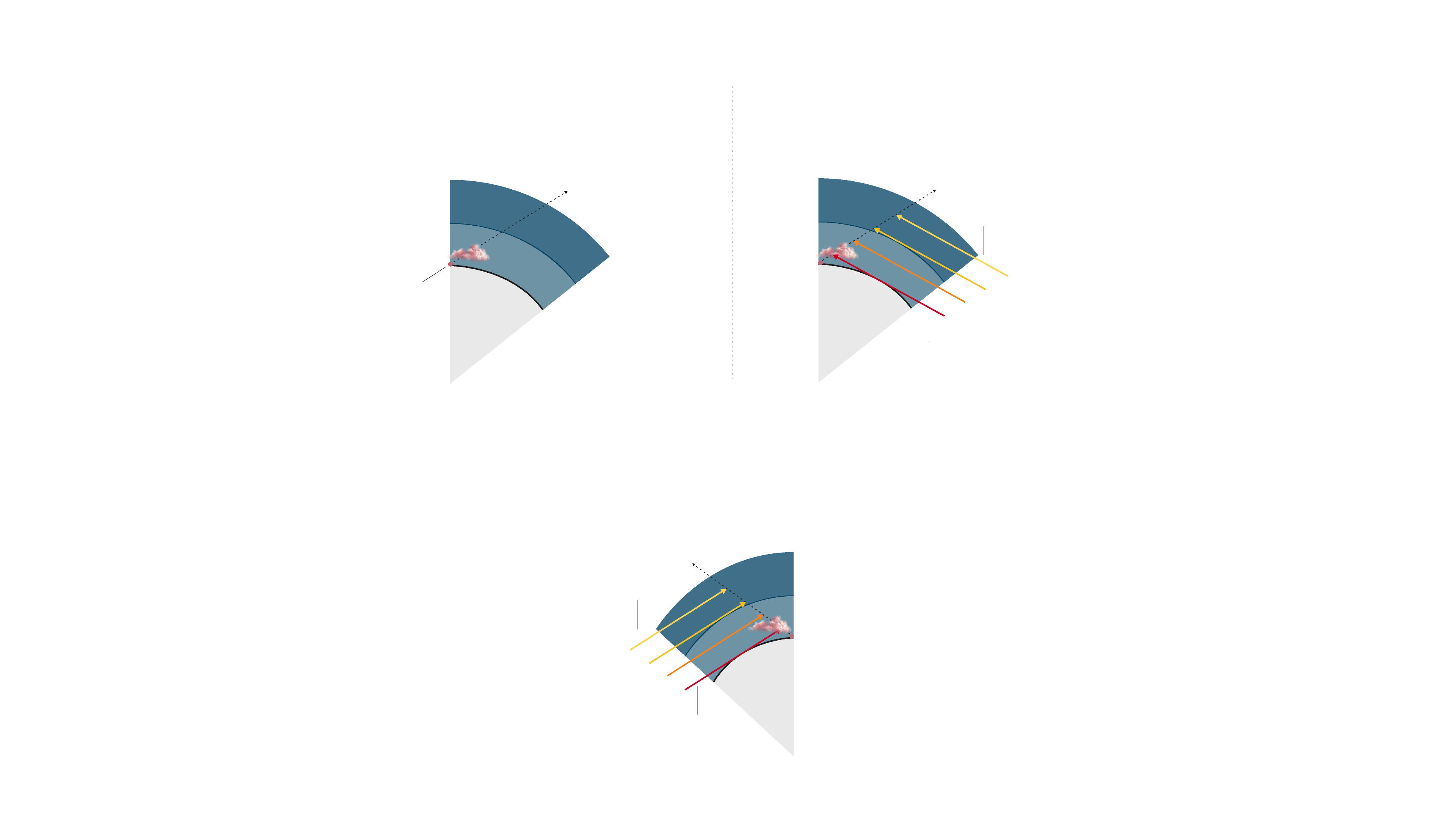
At dawn
The sun's rays arrive in parallel and pass above the horizon. The rays that brush against the Earth pass through so much air that they are red; those that are higher go through less atmosphere and are yellow.
The sun is below thehorizon and the observer is still in the dark.
Direction the observer is looking in
Stratosphere
Stratosphere
Yellow sunlight
Troposphere
Troposphere
Observer
Earth
Earth
Horizonte
Red sunlight
At dusk
Looking west the order is reversed; after sundown the clouds light up inred, then comes mauve and finally the sky is in darkness.
Stratosphere
Yellow sunlight
Troposphere
Observer
Earth
Red sunlight
Source: Lee y Hernández-Andrés, «Measuring and modeling twilight's purple light», Applied Optics (2003). Adapted, with clouds added.
A dawn or dusk glow is the same phenomenon seen in reverse: in one case, the light begins to reach the clouds before we see the sun appear; in the other, it continues to illuminate them after it has disappeared below the horizon.
Why red
Sunlight contains all the colours mixed together. Our eyes perceive them all at once and the brain combines them into a single colour - white - but the atmosphere does not scatter all colours equally. Air molecules scatter blue light much more than red light. Some of that blue light is scattered in all directions and reaches us from different points in the sky: that is why we see the sky as blue during the day. Red light appears when it has to travel a much longer distance.
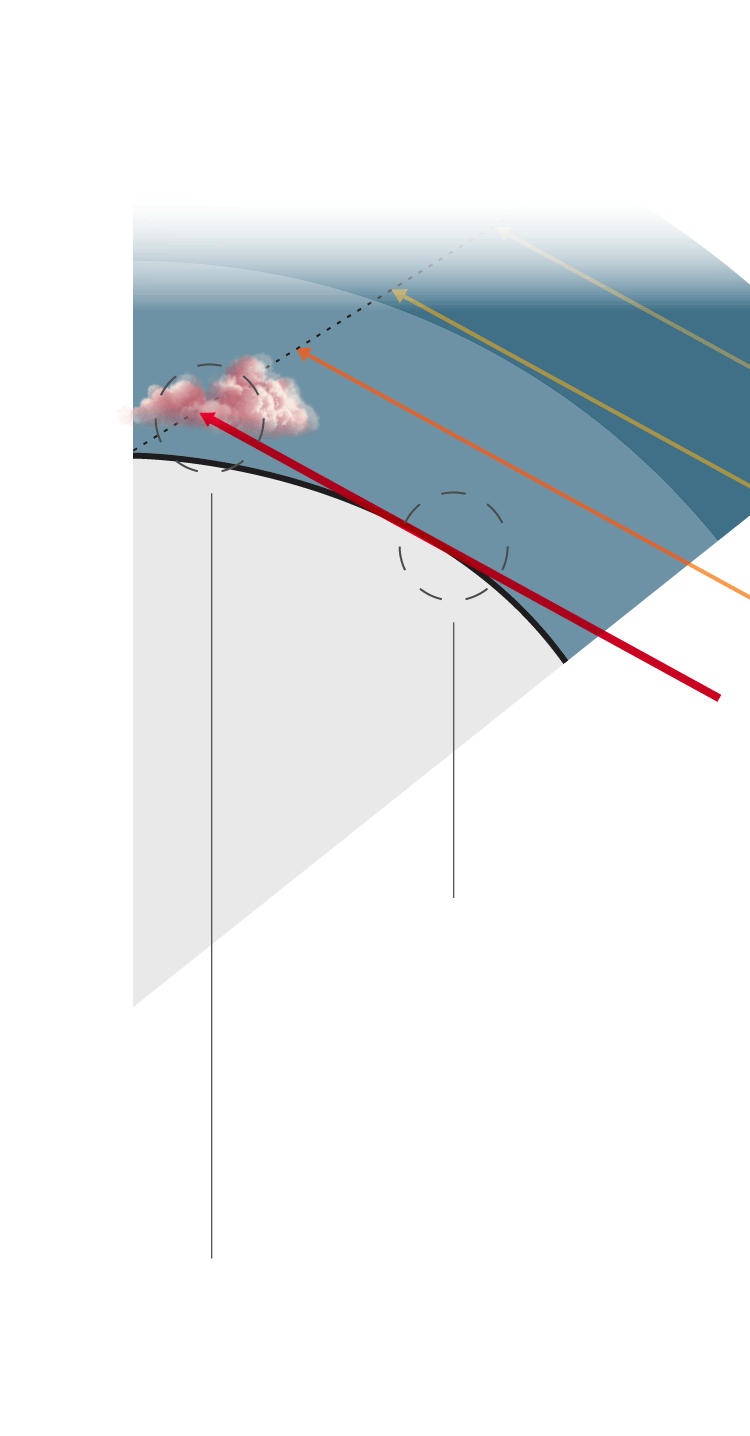
At dawn or dusk the sun is very low and its rays cross the atmosphere at a small angle.
Troposfera
Tierra
Sunlight
Here it brushes the Earth and crosses a lot of air. The blue is diverted along the way, a greater proportion of red, orange and yellow ight continues advancing...
...when the clouds come, the light has warmer tones.
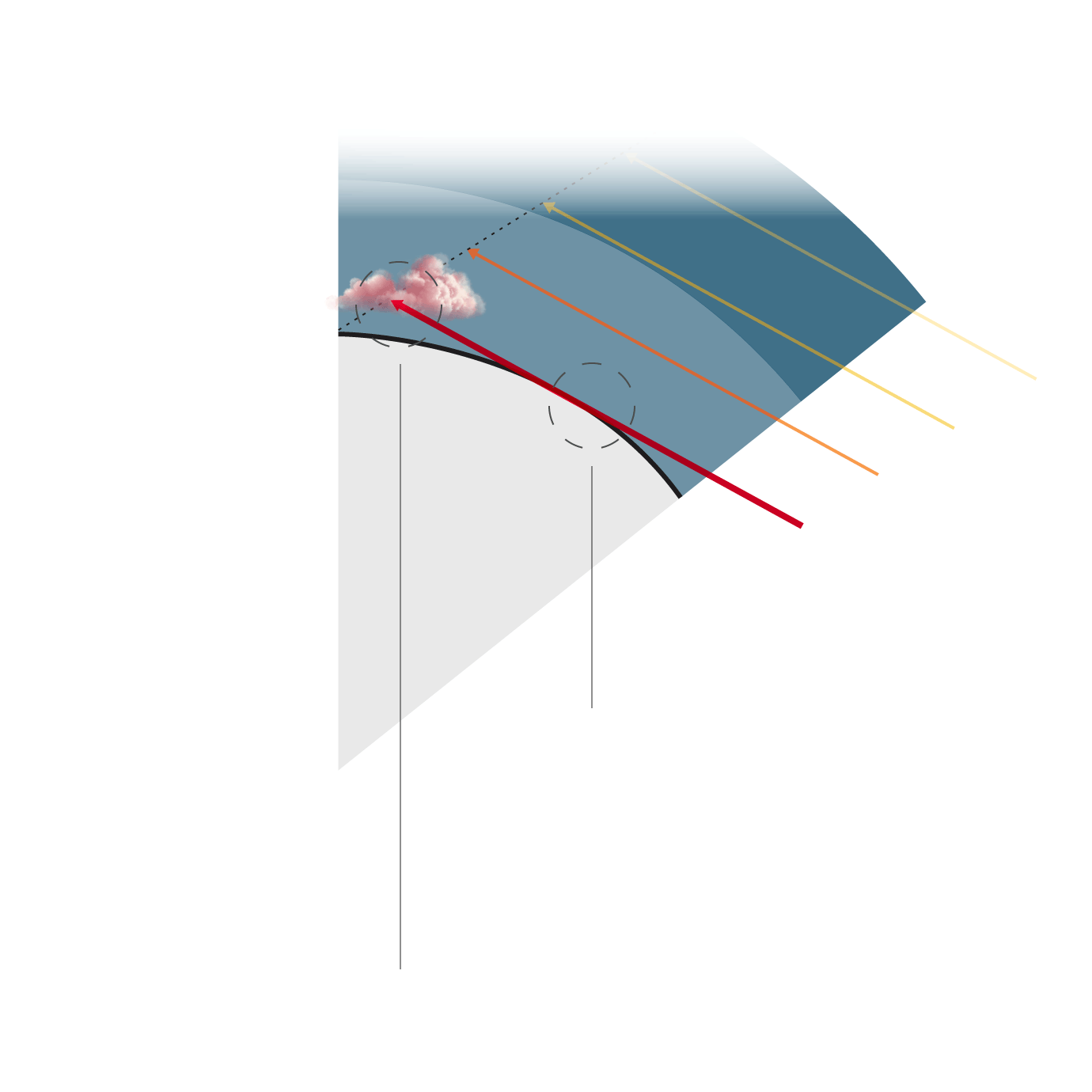
At dawn or dusk the sun is very low and its rays cross the atmosphere at a small angle.
Troposfera
Earth
Sunlight
Here it brushes the Earth and crosses a lot of air. The blue is diverted along the way, a greater proportion of red, orange and yellow ight continues advancing...
...when the clouds come, the light is full of warm tones.
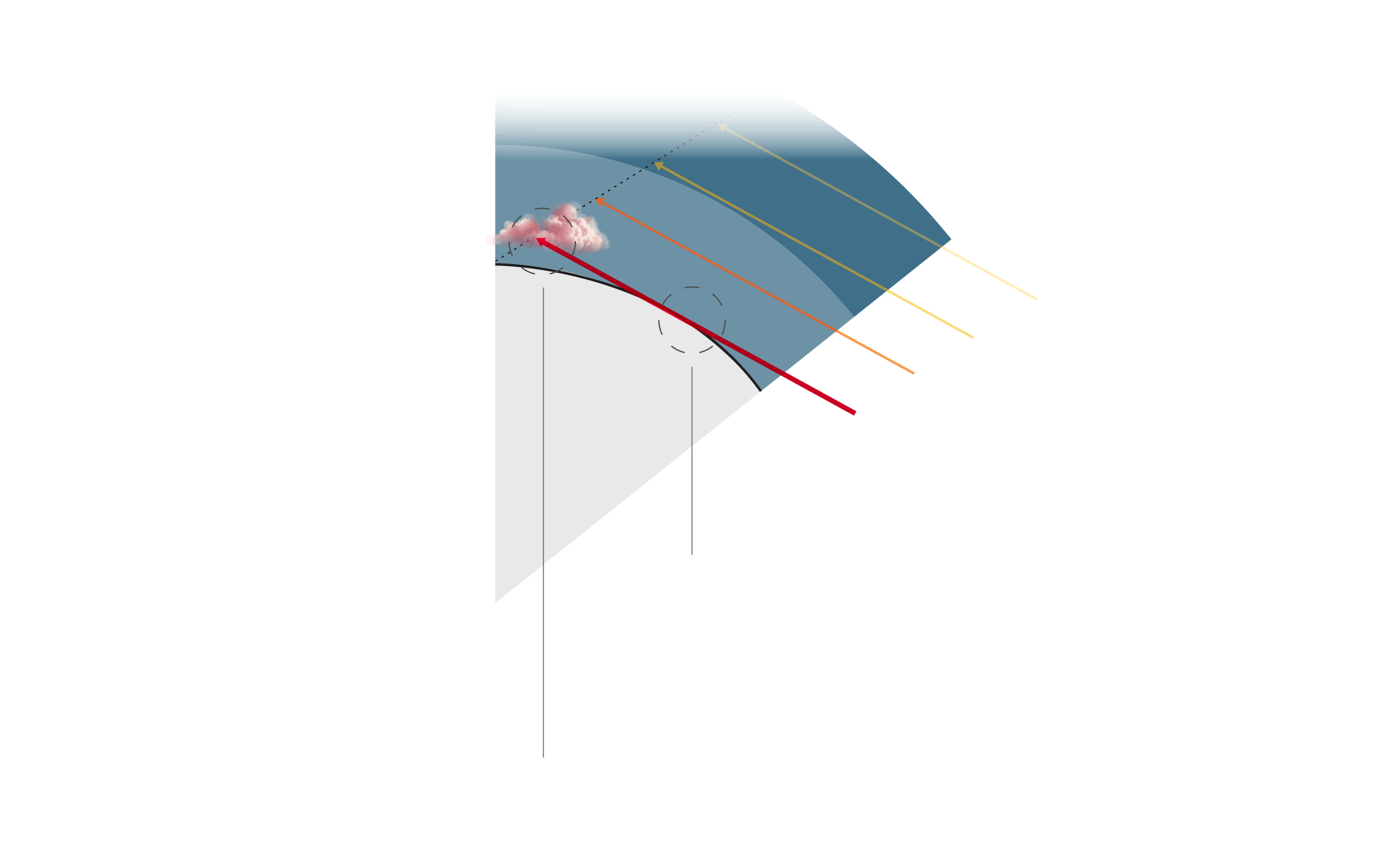
At dawn or at dusk the sun is very low and its rays cross the atmosphere at a very small angle.
Troposphere
Tierra
Luz del sol
Here it brushes against the Earth and crosses through a lo of atmosphere. The blue is diverted on the way, a greater proportion of red, orange and yellow light continues moving forward...
...when the cloouds come, the light is full of warm tones.
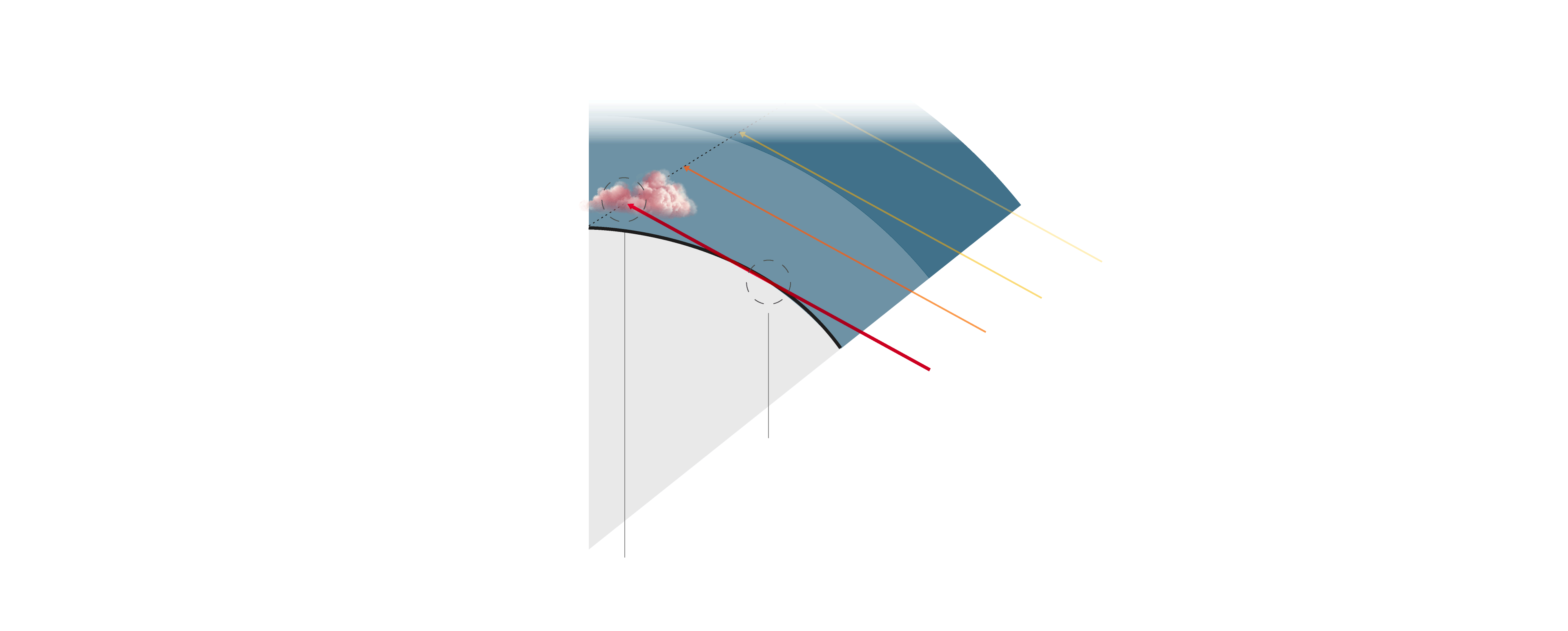
At dusk or at dawn, the sun is very low and ita rays cross the atmosphere at a small angle.
Troposphere
Earth
Sunlight
Here it brushes the Earth and crosses a lot of air. The blue is diverted along the way, a greater proportion of red, orange and yellow ight continues advancing......
...when the clouds arrive the light has more warm tones.
Let’s remember that clouds do not have a colour of their own; they reflect the light they receive. If the light reaching them is rich in reds and oranges, those will be the shades we see. When this happens at dawn or dusk, we are witnessing a spectacular display of colour.
-
Sources
Lee y Hernández-Andrés, Applied Optics (2003); Lange, Rozanov y von Savigny, Atmospheric Chemistry and Physics (2023); Hulburt, Journal of the Optical Society of America (1953); Stephen F. Corfidi (NOAA); NASA and Met Office.
Credit
-
Initial time-lapse José Luis Escudero
![[]](http://static.vocstatic.com/voc26/latest/assets/images/favicon/surinenglish/apple-touch-icon-57x57.png)