
Archaeology
Malaga rock carvings in Cañete la Real shelter attributed to Neanderthals
Researchers believe the artists consciously left the engravings in an area where natural light can enter
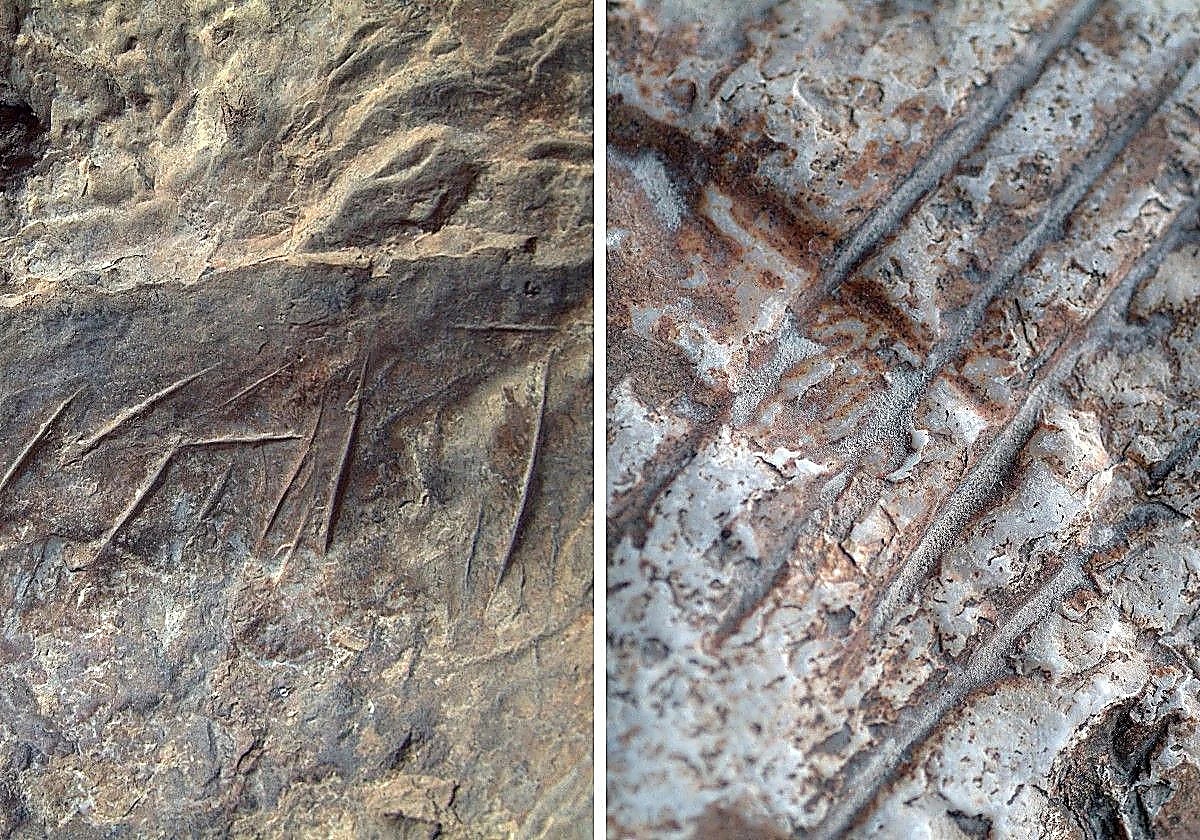

Recent archaeological research at Cadiz University has placed engravings in the Cañete la Real area more than 40,000 years ago, attributing them to Neanderthal ... groups.
Researchers already knew that Neanderthal groups had lived in this area of Cañete la Real, in Malaga's Guadalteba area. Thousands of years ago, a lake occupied the site, providing abundant natural resources. Archaeological finds from the area, dating to the Palaeolithic, have long confirmed their presence.
However, the engraved markings on the walls of the rock shelter where they took refuge, now known as La Herriza, proved much harder to interpret. Because the engravings are non-figurative, they attracted little academic interest. Their rectilinear form also led researchers for many years to classify them as examples of schematic art from the later Prehistory period.
Related story

A research team led by Luis-Efrén Fernández, Pedro Cantalejo, Cristina Liñán and José F. Ramos have now overturned this assumption. They have re-examined the engravings while compiling archaeological sites across Malaga province.
Although the markings had never before been documented in Malaga, the team found they closely matched similar examples previously identified in Granada and around the Strait of Gibraltar.
In every case, people repeatedly engraved the rock in areas reached by natural daylight rather than deep inside caves. The engravings also tend to have spindle-shaped forms: elongated, broader in the centre and tapering towards both ends.
At Cueva de las Ventanas in Píñar, Granada, uranium-thorium dating has placed similar engravings at more than 35,000 years old. Some were carved over surfaces that had previously been coated with red pigment, a feature also identified at La Herriza.
Researchers have also documented very similar markings in a small cave in northern Morocco, near the Strait of Gibraltar, where they found Palaeolithic stone tools. The same pattern appears in Gorham's Cave in Gibraltar, one of the last known Neanderthal occupation sites. There, non-figurative engraved signs lie beneath Middle Palaeolithic archaeological layers that establish a minimum age of 39,000 years.
The engravers did not create these markings with a single incision. Instead, they repeatedly retraced the same lines using exceptionally hard flint flakes. At Gorham's Cave, the study notes, researchers calculated that creating the widest and deepest groove required at least 54 precise strokes in exactly the same place, with between 188 and 317 strokes needed to complete the motif.
"This clearly demonstrates their symbolic and intentional nature," the researchers write. "These sites in southern Iberia confirm a form of expression based on the non-naturalistic application of red pigment and spindle-shaped linear engravings on naturally illuminated rock surfaces."
Researchers had already documented similar practices at several Palaeolithic rock art sites along Spain's Cantabrian coast.
Archaeologists have catalogued a total of 220 rectilinear engraved motifs at the La Herriza rock shelter. They describe them as displaying "remarkable repetitive uniformity, entirely aniconic and devoid of any recognisable naturalistic forms".
The site may hold even more discoveries. During the investigation, the team identified a second, smaller rock shelter around 30 metres away. Although part of its overhang has collapsed, it also contains similar engravings.
Researchers have not yet examined the second shelter because they lack permission to carry out an excavation, but they have officially reported its existence for future study.
They have also stressed the need to excavate directly beneath the engraved panels, convinced that archaeological deposits remain buried there.
The incised lines appear to represent another element of the symbolic repertoire left behind by these populations, alongside pigment lines, painted patches and other markings found at sites they occupied.
For archaeologist Pedro Cantalejo, the engravings were deliberately placed where natural light would illuminate them, serving as a conscious record of the group's presence: effectively a Neanderthal-era "I was here".
If confirmed as Neanderthal in origin, the La Herriza engravings could strengthen the bid to secure Unesco World Heritage status for Malaga's Palaeolithic rock art caves. The current nomination already includes 12 cave sites.
![[]](http://static.vocstatic.com/voc26/latest/assets/images/favicon/surinenglish/apple-touch-icon-57x57.png)