
Education
Five Malaga students win Andalusian debates tournament in French
The boys and girls from the Christine Picasso secondary school spent months preparing arguments and conclusions for both the 'for' and 'against' sides
Matías Stuber
Thanks to the hard work and exceptional debating skills of five 15-16-year-olds, the Christine Picasso high school in Malaga now has a shiny trophy on display.
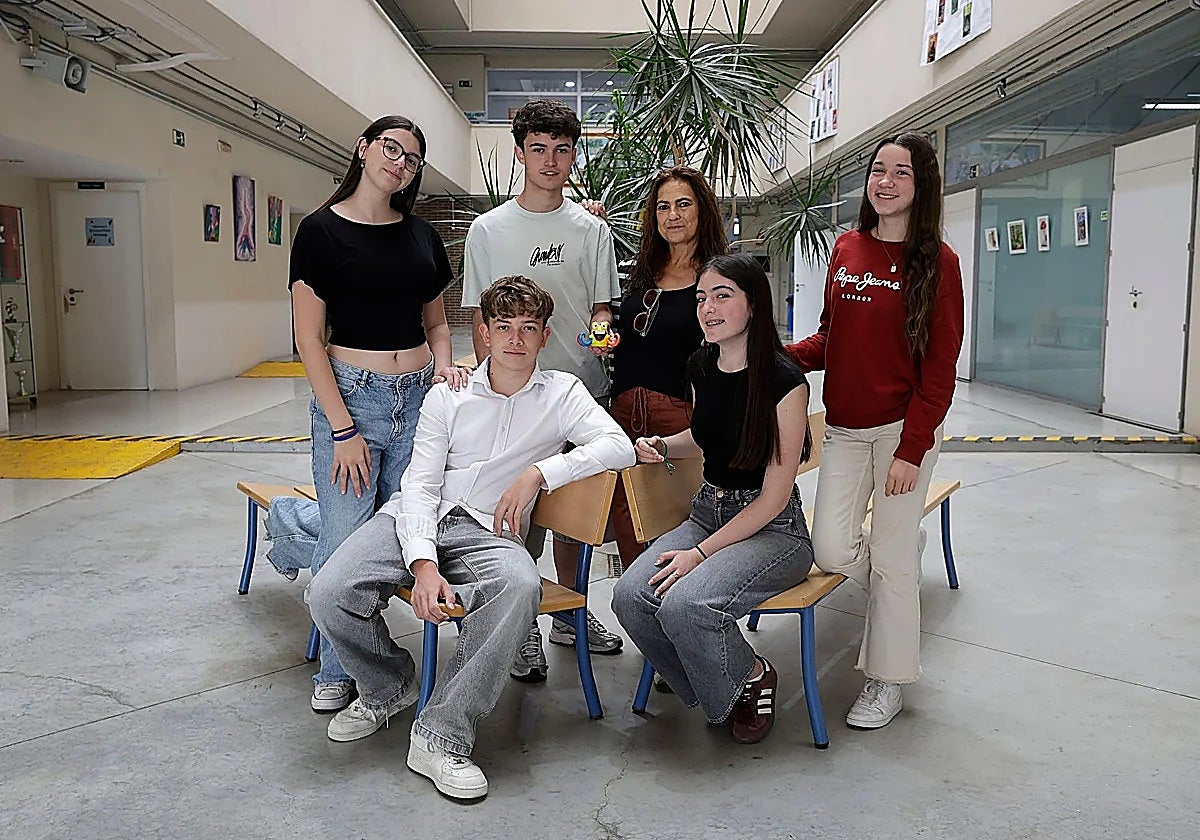
Pedro Morales, Paz Ruiz, Carmen Sánchez, Chloé Allez and Mario Mellado are winners of the Andalusian educational debate tournament. In recent months, they have learnt how to collect their thoughts, build arguments and calm their nerves to prevent their words from stumbling over each other.
SUR spoke with the students and their teacher Ana Cerezuela, who coordinated the project, acting as both a responsible advisor and a confidante to ensure everything ran smoothly.
All five students have demonstrated the ability to understand and synthesise a topic of interest in order to then defend a particular position. They are the winners in the French category, since IES Christine Picasso is one of the leading bilingual schools.
Debate competitions have become increasingly popular in recent years. Following a tradition deeply rooted in Anglo-Saxon culture, young people throughout Andalucía have been engaging in heated debates for years.
The final of the fifth tournament of its kind in Andalucía took place in Jerez on 5 and 6 May. The students from the Christine Picasso school reached the final after winning the provincial phase, which took place in March at the language school in Malaga.
Each debate lasts just under half an hour. It begins with a brief opening statement, followed by an open discussion that concludes with a summary. At the end, one of them is responsible for delivering a closing speech.
To ensure the debates are not superficial, students have a month to prepare. They don't know which position they will have to take, whether for or against. For example, they might debate whether supranational organisations like the UN are effective in resolving geopolitical conflicts or whether platforms should be held responsible for cases of cyberbullying on social media.
"This not only develops their debating skills, but also sparks their interest in the language and gives them the ability to synthesise and reflect," Ana Cerezuela said.
After each debate, the young people's self-confidence grows. The topics aren't always easy. Some are controversial and, most importantly, they might have to defend a position they disagree with. This isn't necessarily a problem, but it can increase pressure.
"Thorough preparation is key," Paz Ruiz said. She acknowledged that everyone had made sacrifices to fit in afternoons at the library after classes.
For the students of IES Christine Picasso, it was an exciting few months. They remember how they easily won at the provincial level. The real surprise came in Jerez: after delving deeper into the debate topic (the aforementioned question of the extent of social media platforms' responsibility), they beat the teams from the other Andalusian provinces.
They put what they had learnt into practice and the judges felt they had performed better than anyone else, even though they are a year younger than the competitors in the other teams.
"No matter how well prepared you are, nerves appear when you have to present your arguments in front of a jury and in an unfamiliar environment," Mario Mellado said.
What's the formula for success? After an initial brainstorming session in Spanish, the students quickly begin to outline the rest of the debate in French. "This requires a high level of language proficiency," Ana Cerezuela stated. She stated that the students at IES Christine Picasso finish their compulsory secondary education with a B1 or B2 level in French.
After that, the students prepare various lines of argument. Of course, a broad knowledge of society and politics in general, but especially of the specific topic, is fundamental and very useful, as it helps to decipher the arguments and stimulate the debate.
For the Jerez case, the students researched the French penal code and studied newspaper clippings from the neighbouring country. The goal is to prepare in such a way that arguments can be adapted or quotes included during the presentation.
Pedro, Paz, Carmen, Chloé and Mario feel the pride of a job well done, like an astronomer naming a star. What they have taken away from this, beyond the success, is the camaraderie they've forged with the other young people from the different schools. The logic of success is dangerous if it turns into selfishness and these students from Malaga have shown that you can win without crushing others.
![[]](http://static.vocstatic.com/voc26/latest/assets/images/favicon/surinenglish/apple-touch-icon-57x57.png)