
Ver fotos Ver fotos
Chasing the bad guys from the air
Security. They started watching criminals from above in 1986 when the National Police Air Unit was introduced; the crime rates nowadays are even higher
IRENE QUIRANTE
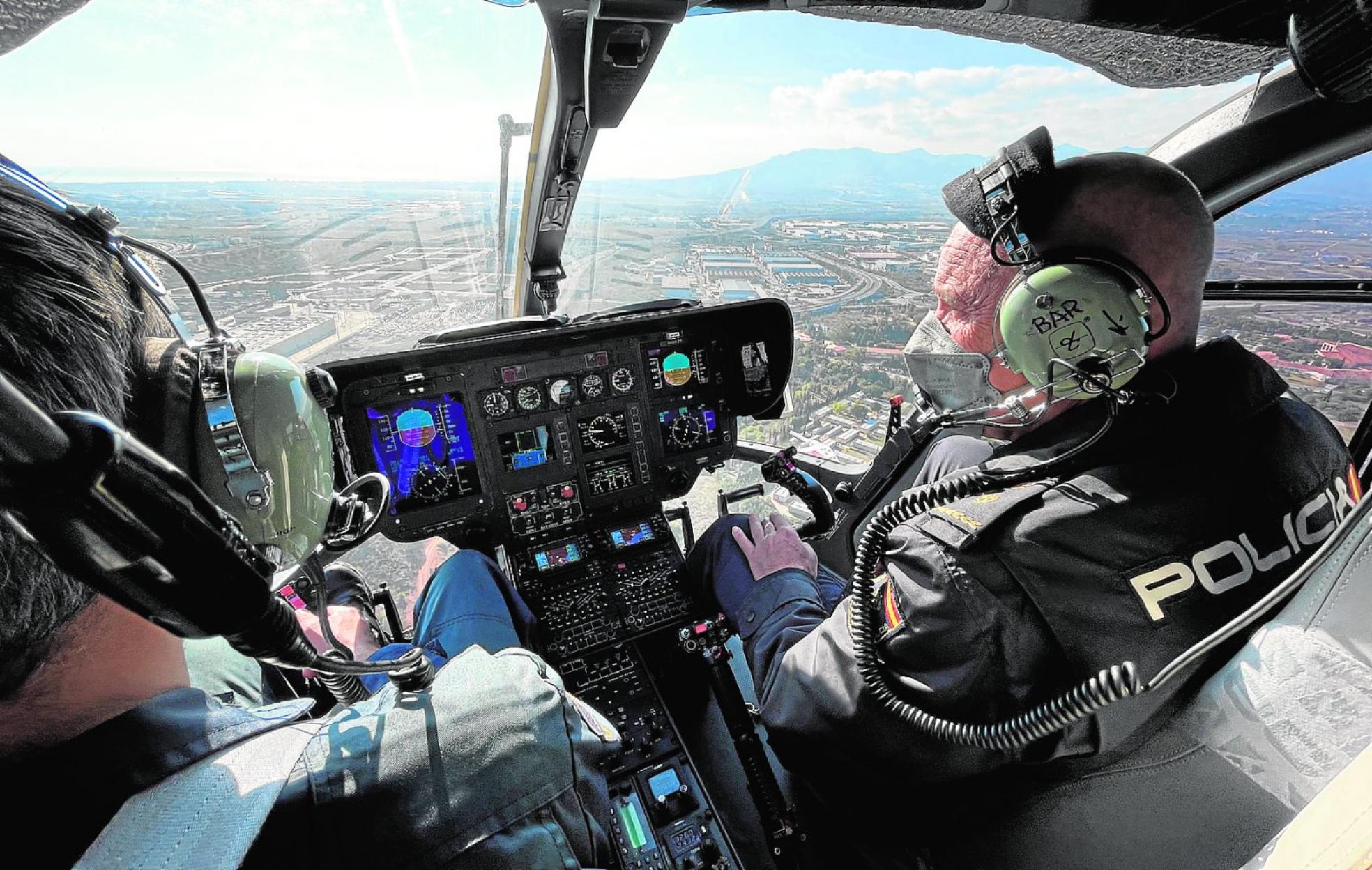
Their presence alone is usually enough to scare off the bad guys. They started watching criminals from the sky in 1986, when the National Police's Air Unit was introduced. Its chief, Inspector Pedro Luis Bardón, joined this brigade just one year after it was created, and, having seen it evolve over nearly 40 years, he says the unit has seen a great deal of action during this time. It played an important role in the fight against ETA and now these officers are tackling "other forms of terrorism" and a crime rate which is much higher than it was then. However, when it comes to resources, this veteran police officer says they are "nearly on a par" with those who are breaking the law.
He doesn't mention it in our conversation, probably out of modesty, but it was Bardón who inspired the helicopter chases in the popular film El Niño (2014).
The National Police's impressive flying machine stands on the runway at the headquarters in Malaga, awaiting its next mission. It has always been the unit's favourite piece of equipment, but in the past 18 months a fleet of drones has also given the officers a decisive advantage: they can now see without being seen. All the aircraft are fitted with the latest thermal cameras and, while the pilots are in the air, their colleagues on the ground are able to follow closely what is happening on numerous screens in their office.
"The air unit is available 365 days a year; if we have to look for somebody on Christmas Eve, we do it"
The air unit works in close collaboration with practically all the groups in the police force. Bardón explains, for example, how useful it is. "If we have to go into a house to arrest a subject who is highly dangerous, we go there first and, with our cameras, we can check everything: who is there, what movements there are and whether there is anything that could pose a risk during the operation," he says.
These images are not only transmitted in real time to the Malaga base: the head of the GOES squad in Madrid, who is responsible for operational decisions, can also see everything that is happening on his mobile phone.
Bardón laughs now when he remembers that, not so long ago, they had to narrate everything they saw from the helicopter over a radio. "It seems like something out of science fiction, but nowadays we don't act in response to what we are told, but to what we are seeing as it happens," he says.
He explains that when the air unit began, a great deal of their work was to do with ETA. He remembers it well because he took part in numerous operations concerning the terrorist group, which was obsessed with carrying out attacks on tourists who were spending their summer holidays on the Costa del Sol.
"Once we received that information we used to set off immediately, from seven o'clock in the morning and nearly every day, to locate the places where the bombs might be placed," he says. When the helicopter began to be used, it discouraged some of the attacks. "At other times, though, there was nothing we could do," he says, regretfully.
These days, the unit is tackling other types of terrorism, Bardón explains, referring to organised crime and drug trafficking.
"The criminals of today use different methods. Before, at least, they used to hide when they saw us, and would pretend they were doing something else, but not now. They see us and couldn't care less, they just carry on," he says. This is why the squad are permanently on alert, watching out for every movement of suspicious cars, monitoring houses believed to be related to criminal activity and every road the suspects use frequently.
He also points out that the air unit is very important in Malaga because it is a strategic location and that is vital for the intense criminal activity. However, the unit also covers the provinces of Granada, Jaén and Almeria. In a matter of 25 minutes they can be flying over Granada. "The helicopter can go at 300kms an hour, although the speed always depends on the mission," he says.
"We don't think about whether or not we are in danger when we set off; if we are, then like the other police officers who are on the street, we accept that and carry on," says Bardón. He says there have been several situations in which, part way through a chase, the crew have had to change their plans and have ended up rescuing the criminals they were pursuing.
"One of these times, we were going after a boat in the Strait of Gibraltar, and they were doing crazy things to shake us off, and then it capsized," he says. That was at the end of 2020. The six suspects fell into the water and, in a matter of seconds, the priority of these police officers changed from finding out where these drug traffickers were going to helping them get out of the water alive.
He also recalls that in the summer of the same year, two other traffickers died while transferring packages of drugs in La Línea. "It wasn't us that time; if it had been we would have gone to their aid as well, because safety is our priority," he explains.
365 days a year
The helicopters are available to deal with anything that arises every day of the year and it doesn't matter what time it is. The unit, which consists of 11 officers - nine of whom graduated with other careers in mind - mobilises every time the situation requires it.
"If we have to go out on Christmas Eve, and that has happened, because we have to look for somebody, we do it. If on New Year's Eve they say we have to chase a boat, we'll be there. And if on January 1st a child goes missing or there is a fire and we are needed, the same," says Bardón.
The officers decide on the resources to be used according to each operation. Sometimes they are told that an obvious police presence is needed, and on others it is vital that they are not seen.
Bardón would not change his duties in the sky for anything. "You're here, you go out to fly, and every day you come across something different," he says. His passion for the job goes far beyond the pay packet at the end of every month. When each mission begins, he is very aware that this is his vocation. And, he says, looking at the helicopter, "if you get to do your job in a fabulous toy like this, that makes it even better".
![[]](http://static.vocstatic.com/voc26/latest/assets/images/favicon/surinenglish/apple-touch-icon-57x57.png)