
Heritage
More time for the careful restoration of the Casa de María Barrabino in Torremolinos
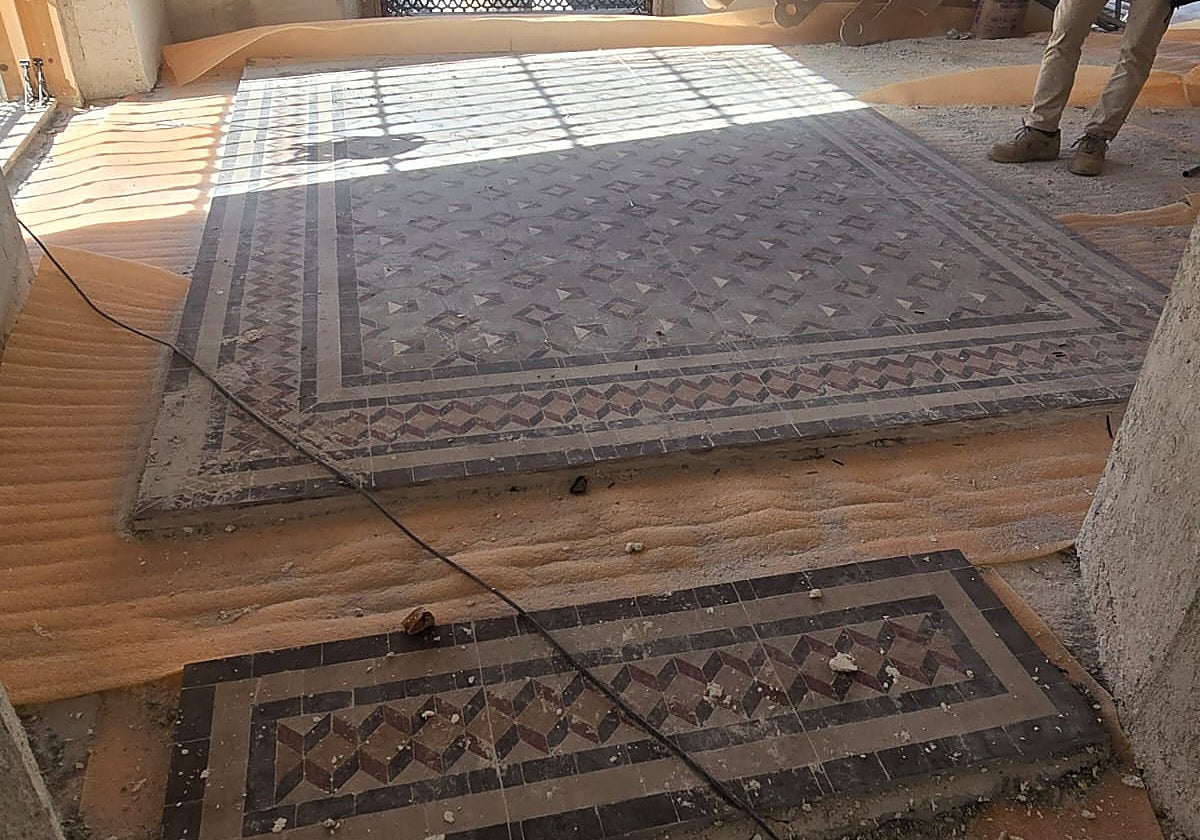
The works are focused, in this phase, on the recovery and relocation of the pieces of the original 19th century Nolla flooring

Torremolinos
Torremolinos town hall has applied to the Directorate General for the Urban Agenda and Architecture for an extension of the deadline for the execution of the grant awarded for the project it has underway to open the Casa María Barrabino as a public space. This is an operation under the Programme to Promote the Rehabilitation of Public Buildings, co-financed by NextGenerationEu Funds, within the framework of the Recovery, Transformation and Resilience Plan.
The granting of this aid from Brussels, which represents 65.03 per cent of the 2.5 million euros invested in the building, is subject to strict deadlines and conditions, and it was initially stipulated that the work had to be completed and accepted by 26 February 2026. Now that this period has passed, the work is continuing thanks to the extension granted. To obtain it, the local administration submitted a request, "duly substantiated and accompanied by the relevant documentation" which, as the town hall points out, "has been favourably resolved". It is becuase, they explain, that the request responds to "duly justified reasons beyond the control of the beneficiary, and despite having adopted the technical and planning measures that were required".
In short, more time with which to make up for the delays after a rain-filled start to the year, which affected the work that, according to the town hall, "is rigorous, respectful of the historical value of the property and is in line with the highest standards of quality in its execution". Although the house is not considered an Asset of Cultural Interest, it is subject to protection set out in the General Cataloguing of the Junta de Andalucía.
Although the house is not considered an Asset of Cultural Interest, the property is subject to protection set out in the Junta de Andalucía's General Cataloguing of Cultural Heritage
This means that strict precautions must be taken with, among other things, the materials that give personality to a unique flooring, which requires care out of "respect for the identity of Torremolinos".
María Barrabino's house had, in several of its rooms, hydraulic floor tiles made with the design known as Nolla mosaic. A type of tile, manufactured in Valencia and associated with Modernism
Several rooms in the Casa de María Barrabino feature hydraulic floor tiles in the distinctive Nolla mosaic style - a Valencian tile associated with Modernism that reached its peak popularity from the mid-19th century onwards. Given their ornamental and historical value, the restoration has carefully preserved these tiles wherever possible, treating each one individually, just as was done with the period roof tiles.
Before restoration began, a detailed planimetric survey was carried out mapping each room and the pattern of the mosaic tessera. The tiles are then carefully dismantled in a controlled process, first protected by fabric adhered with removable glue, allowing them to be handled in larger panels - essentially like puzzle pieces. According to the technicians, "this system facilitates both cutting and removal, which minimises losses and alterations to the original design.
The home straight
Once the base is prepared, the recovered tiles are cleaned and repositioned, respecting the original geometry, composition and layout. The pieces are carefully levelled and aligned before grouting and final cleaning, resulting in a stable, integrated floor. The council acknowledges that "we are talking about handcrafted works, which go beyond what a conventional project involves," meaning any unforeseen issue can affect progress. It adds, however, that the Barrabino house restoration "is entering its final stretch, always with the aim of ensuring both correct execution and strict compliance with technical and heritage requirements.
![[]](http://static.vocstatic.com/voc26/latest/assets/images/favicon/surinenglish/apple-touch-icon-57x57.png)