
History
New paintings discovered in Axarquía cave show footprints of a baby and a child
The Victoria cave in La Cala del Moral on the eastern Costa del Sol was occupied for was used a refuge for Neanderthals and a burial place in the Neolithic period

Experts have identified three new paintings in the Victoria cave in La Cala del Moral (Rincón de la Victoria) on the eastern Costa del Sol, ... which correspond to two very different periods of prehistoric times.
The painting were found during archaeological explorations of the cave being led by Pedro Cantalejo and María del Mar Espejo.
Thousands of years ago the Cueva de la Victoria, in El Cantal, had two entrances - one at each end of the cave, which made this place a refuge protected from predators and with natural light for a good part of the day.
It was also close to the sea, which guaranteed a warm climate and a diet based on fish and shellfish. This explains why it was inhabited from the time of the Neanderthals until around 6,000 years ago. A prolonged occupation has been engraved on the walls and still holds some surprises.
The cave can be visited in small groups so as not disturb the site
In the first room, used during the Neolithic period as a burial place, where the bones of the dead were deposited next to vessels, there is a mural in the style of prehistoric art, the most modern and advanced, with simplified human and animal figures, composing scenes and situations to which a symbolic charge is attributed.
Related story

Yellowish in tone, the images represent individuals, a pair of archers and other quadrangular signs that refer to seated people, according to the researchers. But recently they detected one that had not been recorded: a very small individual, with the same shape but much smaller than the rest. "It is a child character," explains the archaeologist Pedro Cantalejo.
At another point on the panel a series of motifs make up a circle, as in a dance scene, but this year something else has been detected that was not previously identified: in the centre there is another figure. "The wall is normally dry and the paintings are less visible, but now it is very damp", Cantalejo celebrates as he focuses on this new discovery.
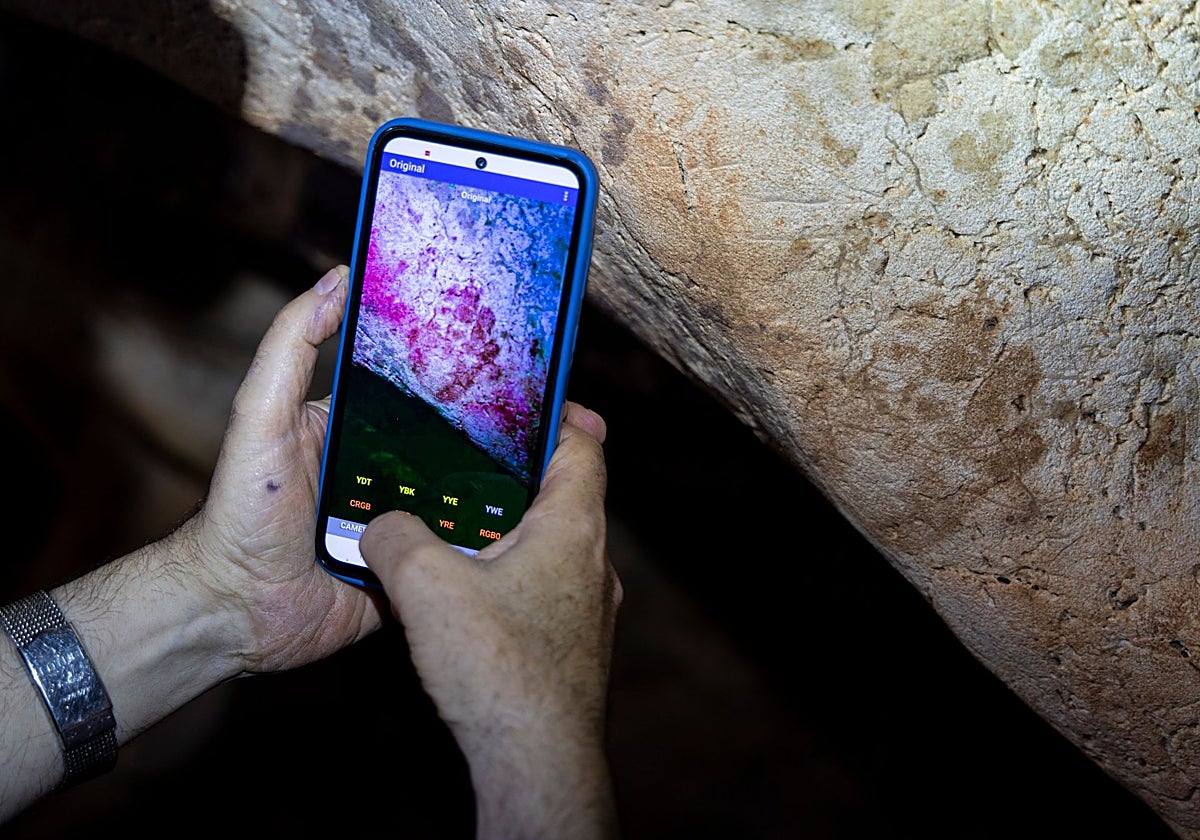
The most recent find is on the other side of the cave, in the room where the archaeological excavations that trace the life of Neanderthals and Homo Sapiens are concentrated. Here, on a rock ledge, archaeologists have just detected a baby's hand in red pigment. It is visible to the naked eye, but when processed with the D-Stretch tool for Images, the tiny fingers appear in detail.
The Cueva de la Victoria is open to the public twice a day, except Tuesdays and Wednesdays, in groups of a maximum of ten people so as not to alter a cavity that has hardly been modified by human intervention. For this reason, the activity is classified as active speleological tourism and is not suitable for people with mobility problems or claustrophobia. Sturdy footwear, like hiking boots, must be worn. More information and bookings can be found on the Tourism in Rincón website.
![[]](http://static.vocstatic.com/voc26/latest/assets/images/favicon/surinenglish/apple-touch-icon-57x57.png)