
Housing
Business leaders in Nerja set up working group to find solutions to lack of affordable housing
The eastern Costa del Sol town's business association wants to have a document setting out proposals on land, rent, social housing and administrative procedures by the end of the year

The lack of affordable housing has moved from being a concern to becoming a key focus for business leaders in Nerja on the eastern Costa ... del Sol. The Nerja business association (AEN) has held the first meeting of its working group on affordable housing, set up to analyse the difficulties faced by young people, families and workers in living in the town and to propose possible solutions to the authorities.
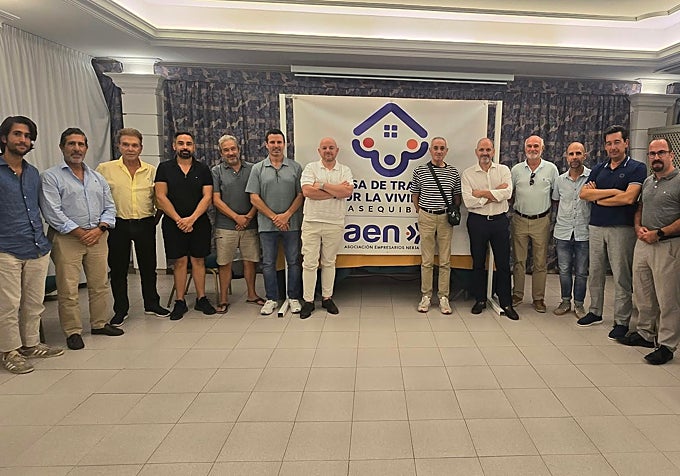
The first meeting took place on Thursday, 24 September at Hotel Plaza Cavana and brought together architects, quantity surveyors and other professionals involved in town planning, as well as businesspeople from various sectors and two representatives from homeowners’ associations. The AEN’s aim is to incorporate these different professional perspectives into its analysis of the residential property market in Nerja.
Issues such as land availability, planning, the promotion of affordable and social housing, long-term lettings and the streamlining of administrative procedures were discussed. The participants also analysed possible forms of collaboration between the private sector and public authorities, against the backdrop of the housing crisis in Spain.
The AEN aims to have a document containing proposals on land use, rent, social housing and streamlining administrative procedures by the end of the year
The president of the AEN, Raúl Rivas, believes that the meeting confirms that access to housing has now become a shared concern across much of the town's economic and social fabric. “This first meeting has shown that there is a real and growing concern about housing in Nerja, but also a clear willingness to work together and find solutions,” he said.
The next step will be to organise the contributions and compile them into a document setting out proposals. The association aims to have this completed by the end of 2026, with measures categorised as short-, medium- and long-term. “Our aim is to produce a serious, inclusive and realistic document,” explained Rivas, with the intention of subsequently using it as a roadmap when engaging with institutions and public authorities.
PGOM
The initiative marks a further step in a direction that the employers’ organisation has been pursuing over recent months. Back in June, it put forward proposals during the drafting process for the new general municipal development plan (PGOM), calling for more land for affordable housing and warning that the difficulty in finding accommodation is making it harder to recruit and retain staff in sectors such as hospitality, retail, construction and services.
The context helps to explain this concern; according to the latest data from the National Statistics Institute (INE), holiday homes accounted for 16.36 per cent of Nerja’s housing stock at the end of 2025, the highest percentage amongst the municipalities in Malaga province. The INE recorded 2,719 holiday homes, although the regional register used a different methodology and showed more than 4,300 authorised units.
Housing also features amongst the explicit objectives of the new general urban development plan (PGOM) currently being drawn up by thetown hall. The document must set aside sufficient land for affordable housing, with particular attention paid to young people and groups facing the greatest difficulties in accessing housing, as well as regulating urban growth and public facilities. The municipal public consultation process prior to the draft plan began this year.
The round-table brings together experts and business leaders while Nerja is drawing up a new general urban development plan and continues to face significant pressure from holiday accommodation
The issue is not limited to new-build properties. Since November 2025, Nerja has had a municipal housing and land use plan for 2025–2030 and this year it has continued to run specific renovation programmes and support schemes for families on low incomes. The tenth municipal renovation programme, for example, has a budget of 145,000 euros and provides grants of up to 12,000 euros per property.
The working group now aims to bring together land, planning, social housing, rental accommodation and administrative procedures into a single assessment. Over the coming weeks, the AEN will continue to collate input from experts and business leaders, with a view to turning this into concrete proposals by the end of the year and subsequently submitting them to the relevant authorities. “We are facing a problem that affects us all and requires everyone’s commitment,” summarised Rivas.
![[]](http://static.vocstatic.com/voc26/latest/assets/images/favicon/surinenglish/apple-touch-icon-57x57.png)