
Tourism
Malaga province sees surge in August 2027 accommodation bookings ahead of next year's total eclipse
Rural accommodation has seen a 500% increase in the number of nights booked, while demand for holiday rentals has quadrupled compared with this Wednesday's figures

Málaga
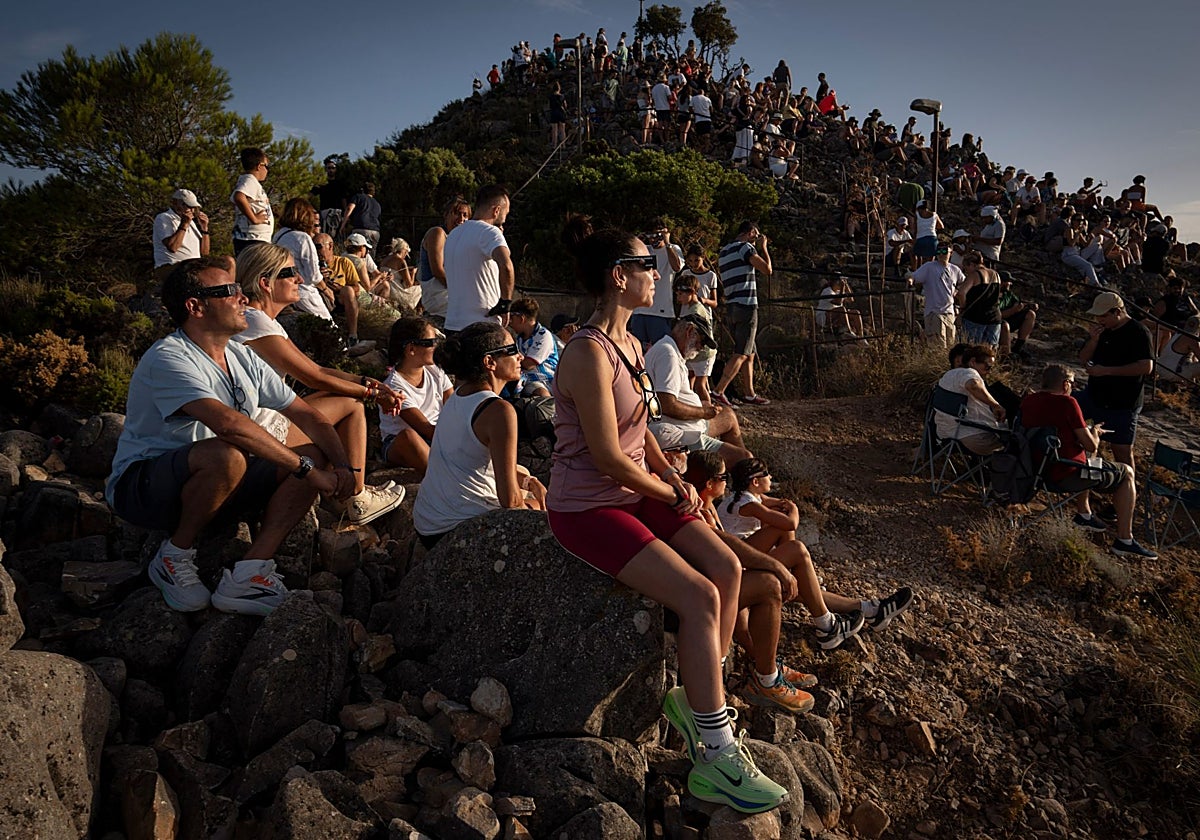
The partial eclipse that took place on Wednesday is actually a foretaste of what is to come on 2 August 2027. In just under a ... year's time, Malaga will be at the epicentre of a total zenithal eclipse, which will put the province in the spotlight for hundreds of thousands of astronomy enthusiasts.
Although the date seems a long way off, there are already "astronomy tourists" who have marked it in their diaries to come and see it in the Costa del Sol, which will be one of the best places in the world to view it and for the longest duration.
Perhaps they've learnt their lesson about how prices skyrocket if you don't book accommodation well in advance, because bookings have already seen a surge.
Nearly half a million tourists travelled from all over the world to various destinations in Spain to watch this Wednesday's eclipse, according to figures from the Ministry of Economy. For the eclipse on 2 August 2027, it is clear that anticipation is running high.
Rural accommodation providers are already reporting a 500% increase in bookings for holiday homes in Andalucía, with the province of Malaga leading the way.
It is in rural accommodation where the surge in demand is most noticeable a year in advance. This is partly because this type of accommodation is better suited to tourists seeking contact with nature, more open spaces and quieter destinations.
According to co-founder of the Ruralidays platform Félix Zea, demand has soared in the villages along the Malaga coast for 2 August. He says that it is mostly international visitors that book stays for that date specifically: 27% British, 18% German, 13% Spanish, 9% Danish and 7% Dutch.
Zea explains that the most sought-after areas in the region are the municipalities along the Malaga coast, which account for 72% of these bookings, followed by the Cadiz coast, with 23%. However, he points out that there are exceptions, such as the high demand in towns like Periana, Cómpeta, Alhaurín el Grande, Alhaurín de la Torre and El Borge.
Hotels in Malaga have also noticed a higher volume of bookings for 2 August next year, although they were not entirely sure why until they analysed the profile of these guests, which does not match that of the typical holidaymaker at this time of year.
Deputy president of the Costa del Sol hoteliers' association (Aehcos) Javier Hernández says that the impact is not particularly significant, but it is certainly noticeable. "There is some interest. Some hotels are experiencing higher-than-normal demand for August, a year in advance."
Hernández says that, following a series of meetings, they have been able to confirm that certain hotels are already "seeing higher occupancy rates than in previous years, for the same dates". In other words, looking a year ahead, they are seeing higher occupancy rates for 2027 than they had in 2025 for 2026, and in 2024 for 2025.
"It's quite a curious and unusual situation. Mind you, it's not that the hotels are full, but rather that some which, at this time of year, had 7% of bookings for that date in 2027 are now at 12%," Hernández says.
This has taken many hotel managers by surprise and they acknowledge that had they been better informed, they would have blocked off rooms and even postponed events already confirmed for that day. They also explain that the increase in bookings is not yet particularly significant due to the large number of rooms available a year in advance, which leads enthusiasts to book at shorter notice, confident in the province's high accommodation capacity.
Other experts state that it is "too early" to establish a link between current demand and the astronomical phenomenon of 2027, partly because it is common to have bookings a year in advance, particularly at the start of August.
The eclipse effect has also reached the holiday rental market. The Andalusian association of tourist accommodation (AVVA-Pro) has carried out a comparison of the impact of this Wednesday's eclipse in terms of bookings made a year in advance and those already generated by the 2027 eclipse. The conclusion is very clear: interest in the eclipse on 2 August 2027 is much higher.
For 2 August 2027, the province of Malaga currently has bookings at 3.2%, compared with 0.8% for this past Wednesday's eclipse. "This means that the paid bookings currently recorded for the 2027 eclipse are four times those recorded for the 2026 event," AVVA-Pros says.
This surge in demand already has an impact on prices. According to AVVA-Pro, the average daily cost currently stands at 344 euros for the 2027 eclipse, compared with the 325 euros this year. In other words, rates are already almost 6% higher.
"The comparison shows that, although there is still a year to go before the August 2027 eclipse, the market is already recording a significantly higher level of paid occupancy than that seen, under the same analytical framework, for the 2026 event," experts conclude. The excitement is obvious.
![[]](http://static.vocstatic.com/voc26/latest/assets/images/favicon/surinenglish/apple-touch-icon-57x57.png)