
Civil War
The second Civil War mass grave in Campillos has revealed 22 victims: six have already been exhumed
A further 16 bodies will remain protected until work resumes, which could enable the project to be completed in 2027
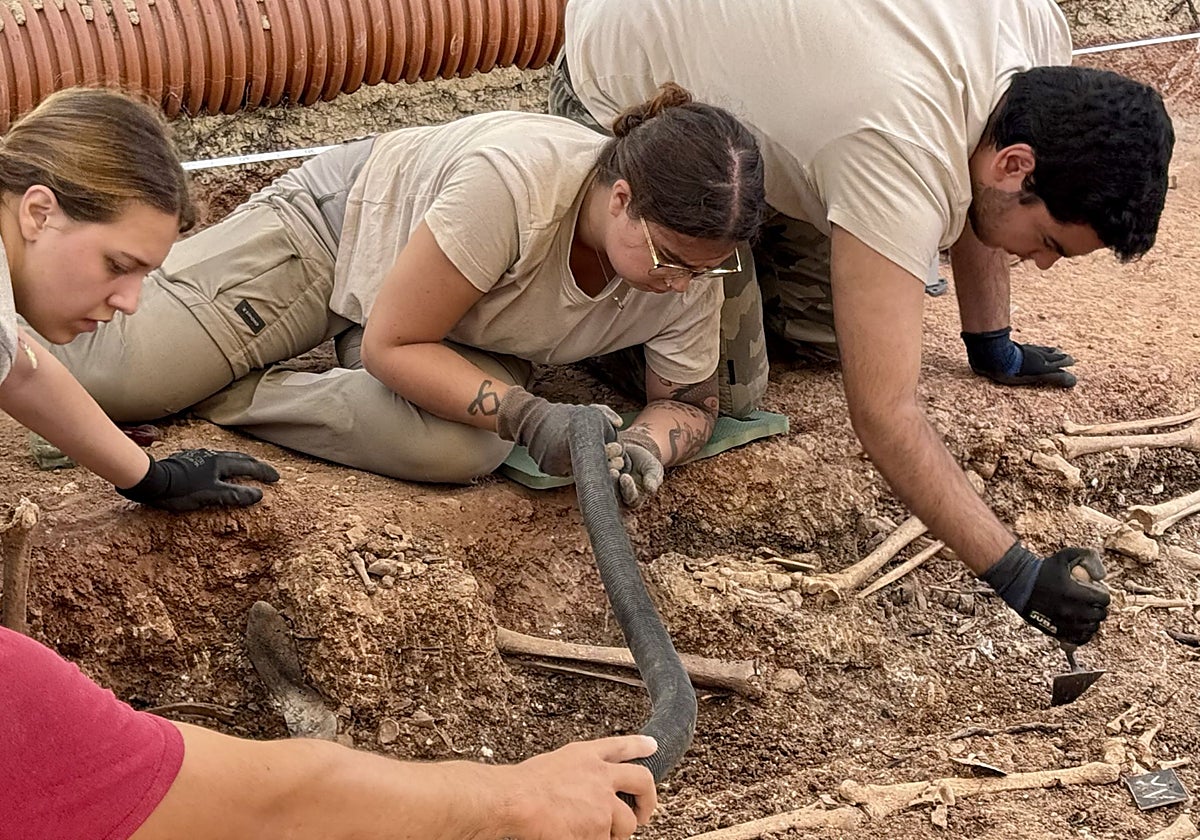

The second mass grave at Campillos cemetery has also begun to reveal the extent of the repression suffered in the municipality during the Civil War. ... Initial work carried out at this burial site has led to the discovery of the remains of 22 people: six of them have already been exhumed, whilst the other 16 will remain protected underground until work can resume in a new phase scheduled for 2027.
These results mark the conclusion of the second campaign carried out at the Campillo mass graves. The bulk of the work had initially focused on completing the first excavation site, where this same phase enabled a further 40 bodies to be recovered. Added to the 73 exhumed during 2025 and the six now recovered from the second burial site, a total of 119 victims have now been recovered since the start of the project.
The first mass grave was sealed with 113 bodies, as reported by SUR last May. The budget of 40,000 euros for this second phase subsequently enabled work to proceed on the parallel burial site and for the first on-site inspections to be carried out. What began with six identified bodies grew as the excavation progressed, eventually bringing a further 16 to light.
“As we have progressed, the number has been increasing,” explains María José Berlanga, a lecturer in the Department of Historical Sciences at the University of Malaga and one of the project coordinators. These latest remains will not be exhumed for the time being. The team will leave them covered and protected to allow the cemetery to continue operating normally until the agreement is renewed and the researchers return.
Lime and the presence of women
The first differences between the two burials have also begun to emerge. In this second grave, the use of lime has been detected - a finding that had not been documented in the first - and which, according to Berlanga, is thought to be linked to hygiene considerations and the aim of reducing the odours associated with the burials.
Researchers have also found evidence of female presence. Items associated with women have been found amongst the remains, a finding that will need to be confirmed as the anthropological study progresses. This would not be unusual in Campillos: the first grave was notable precisely for the high proportion of women amongst the recovered victims.
Of the 46 bodies exhumed during this second phase - 40 from the first burial site and six from the second - 40 were men and four were women, whilst in two other cases it has not yet been possible to determine the sex with certainty.
The progress made over the last few weeks also makes it possible to narrow down the timeframe. Berlanga believes that, given the results and the size of the second pit, there is a ‘high probability’ that the work will be completed by 2027, provided that the project being carried out by the Regional Government of Andalusia and the University of Málaga is renewed.
“There is a very good chance that we will be able to complete the project here in Campillos by 2027,” says the project coordinator, María José Berlanga
Alongside Berlanga, the project is being co-ordinated by the historian Encarnación Barranquero. This week, both have been monitoring the latest work alongside the mayor, Daniel Gómez, and the councillor for Historical Memory, Tamara Garnica. Students and volunteers from the University of Malaga (UMA) and other universities, including the Complutense University of Madrid and the University of Granada, have once again taken part in the excavation.
For the mayor, the number of victims whose remains have been recovered and identified reflects the scale of the repression suffered in the municipality. Gómez argues that, once completed, the investigation will provide further information about what happened in Campillos and help to restore the dignity of those buried in these mass graves.
![[]](http://static.vocstatic.com/voc26/latest/assets/images/favicon/surinenglish/apple-touch-icon-57x57.png)