
Malaga province's Herrera lagoon comes back to life: the rebirth of an ephemeral natural jewel
The abundant rains have revived the Antequera wetland, which the authorities during Franco's dictatorship artificially drained in the 60s to use it for agriculture
Ignacio Lillo
Málaga
The landscape of the Antequera plain has undergone a transformation that the area's oldest residents consider historic. The Herrera lagoon, an ephemeral jewel that remained almost dry for decades, at the mercy of agricultural use, has burst forth again this year.
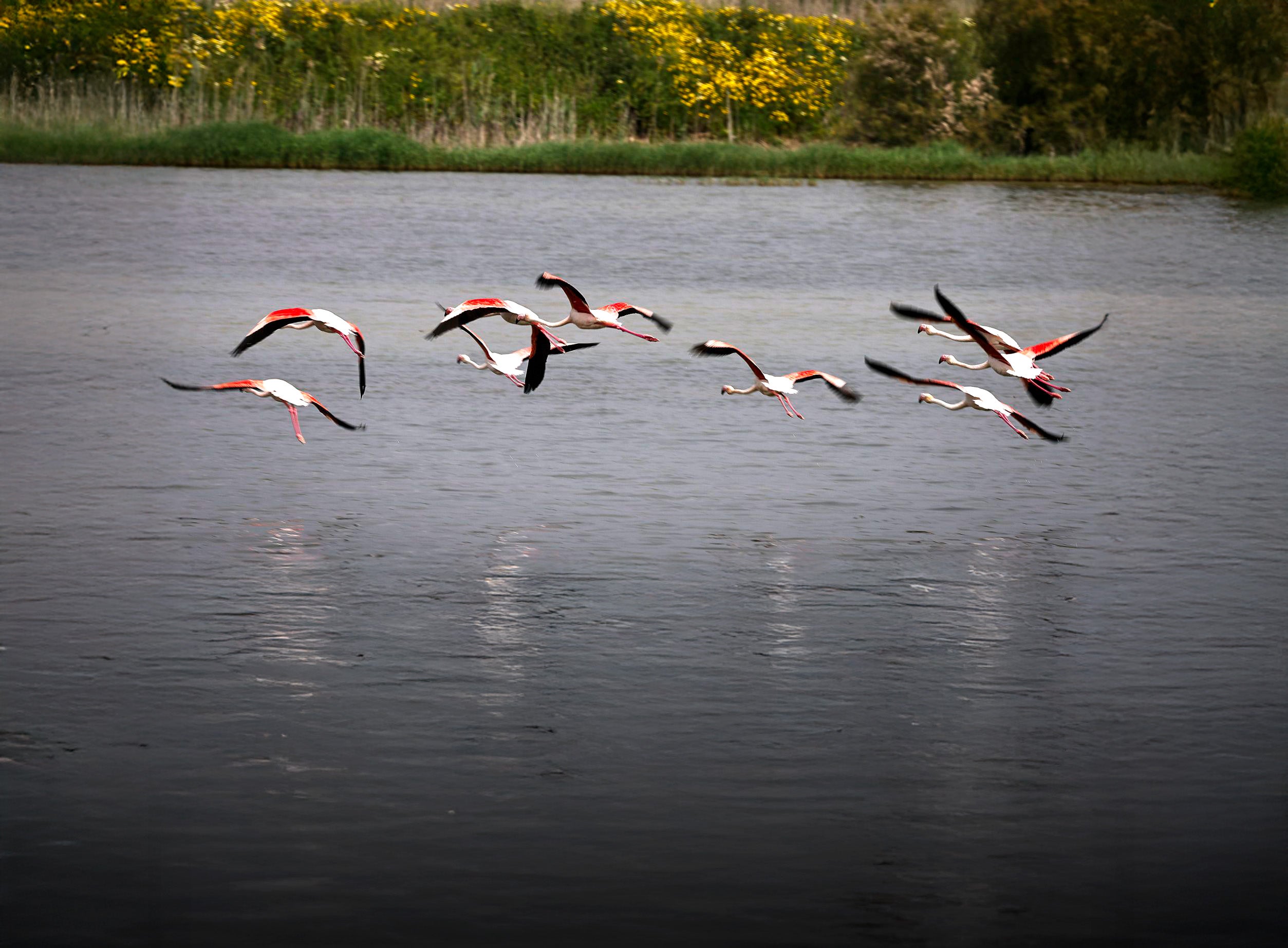
Thanks to the exceptional rains from this winter's storms, this wetland in Malaga province retains a large amount of water well into spring. This has turned it into a hotbed of biodiversity, where hundreds of flamingos and dozens of other bird species find food and an ideal breeding ground.
1964
This wetland was artificially drained between 1963 and 1964, when large drainage channels were built to dry it out.
SUR ventured into this remote area with the help of Francisco García, commercial director of the Cortijo de Pozoancho group in Los Llanos de Antequera, which manages a 460-hectare pistachio farm, among other crops and activities, such as olive groves and cereals. Part of the Herrera lagoon lies within their land, which has allowed them to re-discover and appreciate it.
"From what we're told, it's been a very long time since it's looked like this. It's not common to see it so full of water and life. Historically, it has been one of the most important lagoons in Europe, much larger than Fuente Piedra," García said.
The authorities artificially drained the wetland between 1963 and 1964 to use it for agriculture.
García said that the pistachio orchard's design, with interspersed rows and natural ground cover where vegetation grows freely, fosters a natural ecosystem that supports rabbits, mice and other small animals. These animals serve as food for numerous birds of prey, including several large eagles, which nest in the olive grove.
A historic rebirth
To understand the magnitude of this phenomenon, SUR consulted ornithologist, researcher and Malaga University professor Antonio Román Muñoz, who highlighted the importance of this resurgence.
The Herrera lagoon is no ordinary wetland: due to its size and characteristics, it is "one of the largest lagoons in mainland Spain and Portugal" and a first-rate site in Andalucía.
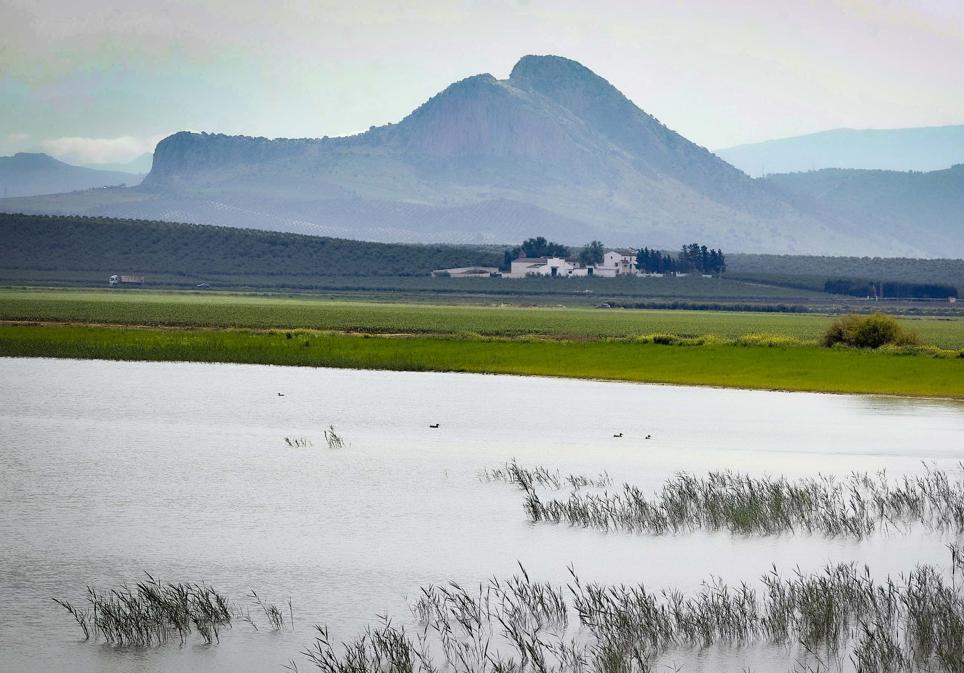
However, the land has extremely efficient artificial drainage, which is why water doesn't usually accumulate. In fact, it is currently divided in two, with one of the large canals running lengthwise through it.
Thanks to the combination of engineering and exceptional weather, Herrera has been bursting with life in recent days
"Currently, it's a cultivated area that doesn't flood because the drainage system was very well installed," Román Muñoz said. However, nature has reclaimed its space this year.
This year's rainfall has been so heavy that, even though the drainage system is still functioning, the lagoon still has a high volume of accumulated water. The ornithologist predicts that it will take quite some time for it to dry out.
This interplay between human ingenuity and exceptional weather has allowed Herrera to teem with life these days. The presence of at least 100 flamingos, according to the approximate count SUR made during the visit, is just the most visible sign of rebirth. "It's not just flamingos. We're also seeing species that aren't common in the province. There's an abundance of birds this year, that's unusual."
Flamingos in search of food
Flamingos go to the lagoon to find food, since their large breeding colony is very close by in Fuente de Piedra. Herrera serves a complementary function, providing them with food and, unlike Fuente de Piedra, offering them fresh water to drink and maintain their plumage.
The flamingos flock there in search of food, as their large breeding colony is very close by, in Fuente de Piedra
What's more, the resurgence at this particular time of year couldn't be more ecologically opportune. The flooding in Herrera coincides with the migration period, from south to north. "These days, Europe begins to fill with birds that have spent the winter in Africa. During their journey, they see a large body of water, as wetlands are very productive terrain, and they stop because they find food."
50
different species of bird
They are currently staying at Herrera Lagoon, a stopover point on their migration from Africa to Europe, where they spend the summer
The UMA professor estimated that ornithologists can identify between 40 and 50 different species these days. Among them, the waders stand out, with up to 14 species, including the spotted redshank, the common redshank and the common sandpiper.
There are also anatids (various duck species) and a vast array of migratory passerines. Antonio Román Muñoz particularly highlighted the reed warbler group, including the common reed warbler and the common reed warbler.
The Herrera lagoon could also harbour critically endangered birds. "I wouldn't be surprised if the aquatic warbler were there as well," Muñoz said, referring to this ornithological rarity. Furthermore, the lagoon is one of the few places in the province where the great reed warbler breeds.
In fact, this spot is now a stopover for all migratory species ascending from Africa, highlighting its value as an ecological niche. During its brief existence, this spring the Herrera lagoon will aid thousands of birds on their return journey to Europe.
When and why the Antequera wetland dried out?
The Herrera lagoon has always been one of the most important wetlands in Malaga province. With an original surface area of over 450 hectares, it was an essential ecosystem for migration in Southern Europe.
However its situation changed drastically in the mid-twentieth century due to Franco's colonisation and agragarian transformation policoes, it was decided that its "unhealthy and unproductive" state had to end. This was written in the decree of June 16 1954, which declared the colonisation of the Herrera Lagoon area to be of national interest, published in the Official State Gazette (BOE) No.183, of July 2 1954.
The draining process was decided by the decree in June, which stated that the land would be distributed among settlers for irrigated cultivation.
The works were carried out by the National institute of colonisation (INC) and were completed in 1964, when large drainage channels were finished to release the stored water .
Despite the channels and the powerful drainage system, the lagoon has a geological memory. In cycles of heavy rainfall, like the one last winter, the land recovers to its natural state, flooding again and reclaiming its space in front of the cereal and pistachio crops that now surround it.
In this way, it cecomes, even if only temporarily, a key point for biodiversity in Spain once again.
![[]](http://static.vocstatic.com/voc26/latest/assets/images/favicon/surinenglish/apple-touch-icon-57x57.png)