A hidden Baroque jewel trapped between social housing
An 18th-century chapel that stands amid a residential complex in Malaga city is about to be restored by the Junta
JESÚS HINOJOSA
Martes, 16 de febrero 2021, 11:52
Few people are aware of this, but hidden amid one of the social housing projects in the area behind Calle Mármoles in Malaga city, where the districts of La Trinidad and El Perchel meet, there is an architectural treasure, a Baroque chapel which has survived between the apartment blocks in Plaza Imagen.
Despite the building works and numerous changes which have taken place in the area over the years, this remarkable chapel has remained as a reminder of a Malaga which used to be filled with churches, convents and chapels, so many of which have disappeared from the urban landscape over the centuries.
Praying the rosary
The tower which houses the chapel was built shortly before 1713 and was part of a church run by one of the many groups of faithful of that time who used to pray the rosary through the streets. According to Rosario Camacho, Professor of the History of Art at Malaga university, this would have been the Congregación del Rosario de la Aurora María.
This congregation paid homage to an image of the Virgen de la Aurora, and in all probability they prayed to her in this chapel. In 1739, this group of devotees moved to a new church beside the Guadalmedina river (it is now the local headquarters of the Cáritas charity) and this one was then run by nuns from the first Dominican convent in the city until the end of the 18th century.
The nuns' house
During the 19th and 20th centuries the church, which was referred to locally as "the nuns' house", was used as a community centre for residents until it was demolished in 1998 to make way for a development of social housing. However, the developers decided to leave the Baroque chapel standing. Its interior contains valuable plasterwork which art experts say is very similar to that which decorates the impressive chapel of the Virgen de la Victoria, the patron saint of Malaga city. On the exterior, remnants of the fake brick decoration that covered its eight sides can still be seen, as this is an octagonal construction.
After many years of neglect, the Junta de Andalucía, which owns this 18th-century building, finally decided to restore it and has commissioned architect Ignacio Dorao to draw up the plans for this so that the contract for the rehabilitation works may then be put out to tender.
Dorao was commissioned by the Junta to design the complete restoration project using experts with experience in this type of construction from centuries past.
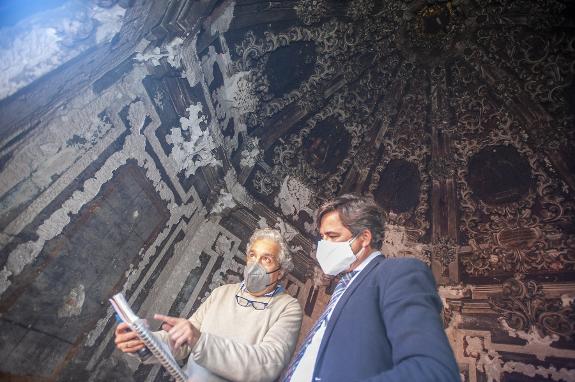
SUR went with Ignacio Dorao and Junta-representative Juan Jesús Bernal on a visit to this disused chapel. Inside, the tower is currently divided into a ground floor and two upper levels, and this splits what was the original room of the chapel into two parts. These floors which had been added will be removed.
The plasterwork on the dome of the chapel is very impressive. It has been blackened by fire but even this cannot hide its early polychromy. Eight reliefs of the Virgen de la Aurora stand out.
Below these are others which are smaller and contain verses referring to the scenes which feature the Virgen. However, only four of these texts remain because the others have been destroyed by vandals who, after the fire, also removed much of the Baroque decoration that framed the windows.
"My intention is to open up the windows again so the light can come back in," said Ignacio Dorao, whose plans will need to be given the go-ahead by Junta technicians.
"It really is impressive," said Juan Jesús Bernal, who is keen to get the project under way as soon as the plans are finalised. Nevertheless, both men agree that to complete the definitive restoration of the chapel, it will be necessary to create another access separate from the apartment blocks amid which it stands.