
Malaga, the coastal province with the longest summer traffic jams in Spain
Costa tailbacks, which are much bigger than many other tourist destinations, increase in the summer by up to 27 per cent
IGNACIO LILLO
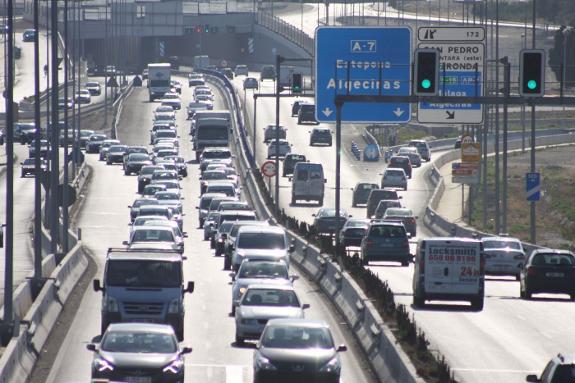
No other coastal area in Spain has as many traffic jams during the summer months as the province of Malaga and the Costa del Sol. This will come as little surprise to those who have been caught up in tailbacks on the way to or from the beach this summer so far, especially last Saturday when there were twelve kilometres of queues on the Malaga province's coastal highways with the A-7 between Arroyo de la Miel and Torremolinos (towards Marbella) and between El Palo and La Cala del Moral (towards Almeria) worst affected.
According to figures supplied by central government, in July and August last year, on the state-controlled highways in the province, principally the A-7 coast road and the A-45 (Las Pedrizas), there were 1,700 kilometres of tailbacks - an increase of 27 per cent on the previous year. This is a far cry from the 3.8 per cent total increase in traffic, according to data from the DGT.
To put the situation in Malaga into perspective, you can make a comparison with a similar province: Valencia. Like Malaga, it is a popular tourist destination based around sun and sea. However, in the same period, there were 1,450 kilometres of queues in Valencia - 17 per cent less than in Malaga. It should be noted, however, that these central government figures do not include highways in Catalonia nor in the Basque Country, where control of the highways has been devolved.
But what is the cause of this situation? Trinidad Hernández, provincial head of the DGT (the government department responsible for the Spanish road transport network), has stressed that the average daily volume of traffic (IMD) is above the level seen nationally. What's more, high season in the resorts in Malaga province is longer than in other holiday destinations, starting after Easter Week and continuing until October.
The first traffic surge of the year, on 1 July, saw an increase in long-distance trips, according to data from the DGT in Malaga. There were 178,000 vehicles on the road, an increase of 8.7 per cent on the previous year.
The head of the DGT points to traffic generated out of Malaga Airport and the surge in car rentals with more companies opening up with larger fleets. "There are a lot more cars and as a result there are more accidents and more traffic jams," said Hernández. Last year there were a number of crashes on the A-7, she recalls, involving lorries which caused jams in both directions, but Hernández praised the work of the traffic authorities in reducing the number of deaths and overall road safety, despite the increase in the volume of traffic.
In her view, to ease congestion, the solution is to improve public transport, especially links to the airport and not to build new motorways. In Valencia, there is less congestion because there the A-7 is primarily a toll road and the only alternative, the old N-340, passes through a number of towns. As a result, and contrary to what happens in Malaga, in Valencia short distance and long distance travel is kept mostly separate.
Low capacity
Mario Arnaldo, president of Automovilistas Europeos Asociados, highlights one key figure: Malaga has 402 kilometres of state-operated highways, compared to 792 in Valencia. Despite a higher volume of traffic, Malaga has much fewer high-capacity roads.
Last year the AP-7 between Valencia and Alicante had an average daily flow of 19,027 with a peak in August of 31,396. Meanwhile, between Fuengirola and Guadiaro has an annual IMD of 31,952, reaching 43,324 in the middle of summer. The volume of lorries is double, also slowing traffic flow.
"Malaga has a higher intensity on a smaller high-capacity network, that's why there's so many traffic jams," says Arnaldo, who also warns that the number of both cars and accidents is increasing. In his view, the only short-term solution is to improve information available to drivers "in real time so they can plan better or take alternative routes".
Arnaldo also calls for a more flexible pricing policy on the toll roads to incentivise their use and ease traffic flow.
Socialist MP Miguel Ángel Heredia, to whom the figures were delivered, believes that the previous PP government's lack of investment over the last seven years is the root cause of the problems and has called for a number of studies into possible solutions, including increasing the speed limit on various stretches of both the A-7 and A-45, as well as improving access at junctions.
![[]](http://static.vocstatic.com/voc26/latest/assets/images/favicon/surinenglish/apple-touch-icon-57x57.png)