
Exhibition
Seeing a fire up close: Photojournalists capture the battle against the flames
Journalists Ñito Salas and Juanjo Madueño have published En el Corazón de la Brigada, a book and an exhibition chronicling the heroic and day-to-day work of the Bricas forest firefighters

Málaga
A fortnight, seven fires, 5,000 photos and a pair of burnt-out boots. That is the outcome of the "madness" of journalists Juanjo Madueño ... and Ñito Salas when they set out to experience and report on the fight against the fires from the inside.
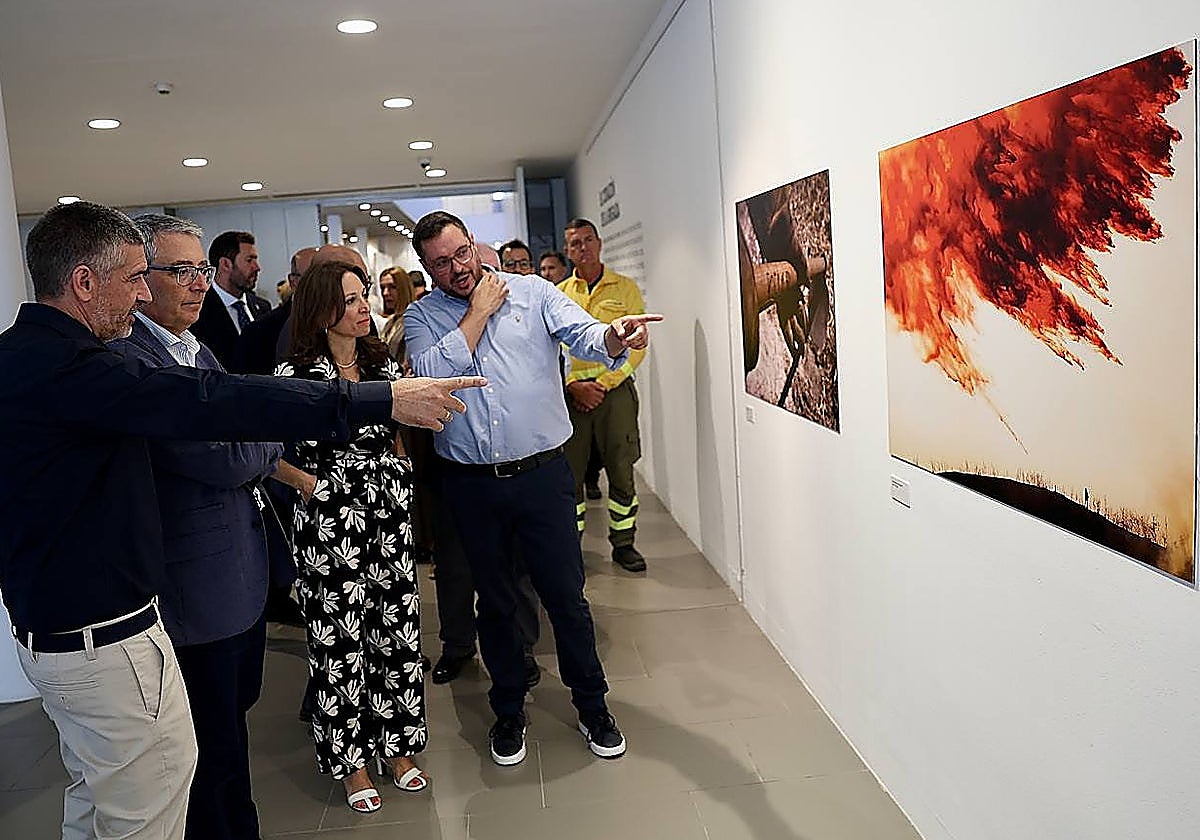
Both reporters embedded themselves with the Infoca fire brigades and boarded the helicopter to capture what is not seen when the "gates of hell" open, as recounted by these eyewitnesses to the horror which, as is happening once again this summer, features almost daily in the pages of newspapers or on the news. But what we see as mere facts in barely a minute – or, at best, in a feature, is recounted in detail, with depth, epic scope, emotion, a sense of everyday life and camaraderie in "El Corazón de la Brigada" (The Heart of the Brigade), which comes in two formats: a book and an exhibition – both of which were unveiled on Monday at the Pacífico 54 exhibition space run by the Malaga provincial council.
“These photographs make it clear that if the gates of hell are to be opened, it is best to have them by your side,” explained Juan José Madueño, a journalist with ABC, on Monday.
Madueño highlighted not only his camaraderie with SUR journalist Ñito Salas, but also the close bond between the two of them and the members of Brica, the elite helicopter-borne units of the Infoca plan specialising in fighting forest fires.
The authors give these firefighters names and faces, after the protagonists spent fourteen days in 2024 not only fighting the fire, but also looking after the journalists at critical moments, as the photographs show.
The journalists say they weren’t in any danger, but they did see the danger And up close
Walls of fire in shades of orange, red and yellow feature prominently in this exhibition and book, which take a close look at the disasters – such as that image in which the silhouette of a lone firefighter is set against a glowing wall several metres high.
“That fire was almost out when suddenly the wind changed and we had to get out of there quickly,” explained Ñito Salas, author of this striking photograph of flames and smoke surrounded by darkness, in which the title of the snapshot is particularly striking: “Wall of fire from the safe zone. “The fire flared up so much that suddenly day turned to night,” said the photographer from SUR.
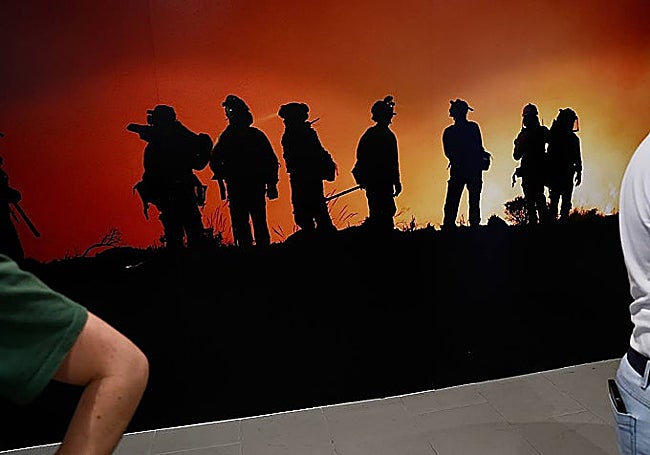
The journalists said they were not in any danger, but they did see the danger – and up close.
In another of the exhibition’s striking photographs, a firefighter can be seen crouching down as 2,500 litres of water pour down on his head from the helicopter. “That’s the position you take to avoid being hit by the water,” Salas said, and one can’t help but ask him: “And how did you protect yourself whilst taking the photo at the same time?” The photojournalist – a man of action and the camera rather than words – grimaces and raises his eyebrows, but Madueño is standing beside him and steps in to explain: “That water discharge was so that the last firefighter we were with could retreat. Ñito was standing a little higher up, but when we got out of there, his boots were charred. I took a photograph of those boots.”
Risking one’s life as an instinct
That image is not about firefighters, but about journalists; and for that reason, it is not included in this compelling exhibition, curated by Amparo García. It highlights not only the epic and gruelling aspects of a profession in which, paradoxically, the protective instinct of its practitioners confronts them with the inevitable need to risk their lives. But those moments captured in the images and the journalists’ accounts are also interwoven with other everyday and deeply human portraits of these heroes. These include physical training on the track at the Cártama base, mental exercise through playing chess between calls to action, those wet uniforms laid out on the bonnet of an off-road vehicle to dry quickly after a downpour, or a moment of relaxation in the pool at headquarters after a gruelling day.
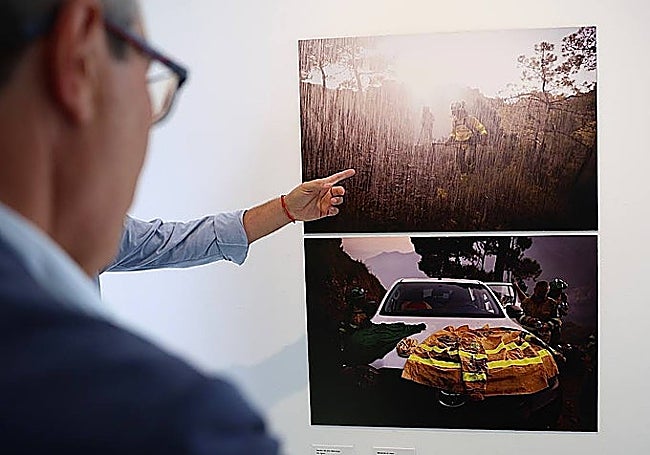
“This exhibition brings us closer to a reality that we often only see from a distance, by showing us those who run towards the fire whilst the rest of us try to get away from it,” explained Francis Salado, President of the Malaga provincial council, in vivid terms, during the presentation of the exhibition. Salado said that the photographers give a "voice" to "ordinary yet, at the same time, extraordinary people".
Indeed, the exhibition concludes with four images of the Brica teams who shared flights and firefighting operations with the journalists. These are pictures taken on the airstrip at the base, in which the forest firefighters pose in uniform, much like the official team photo of a football side at the World Cup currently taking place. And a caption lists them by name: Miguel, Paco, Borja, José Antonio, Francisco P., Javier, Salvador, Oliver, Francisco G., Javier… and so on, right up to 40 everyday heroes.
“The brigades not only took us in and taught us, but also protected us, so we will cherish their friendship forever”
The representative of the Andalusian regional government in Malaga, Patricia Navarro Pérez, took the opportunity during the event to thank the firefighters for their work (which often goes unnoticed), while also highlighting the role of the media for their support and collaboration during these disasters.
She cited reporters Juan José Madueño and Ñito Salas as examples of this commitment, for portraying with such "humanity" this "story, which is not simply one of one fire after another, but of people who face terror every season and every week".
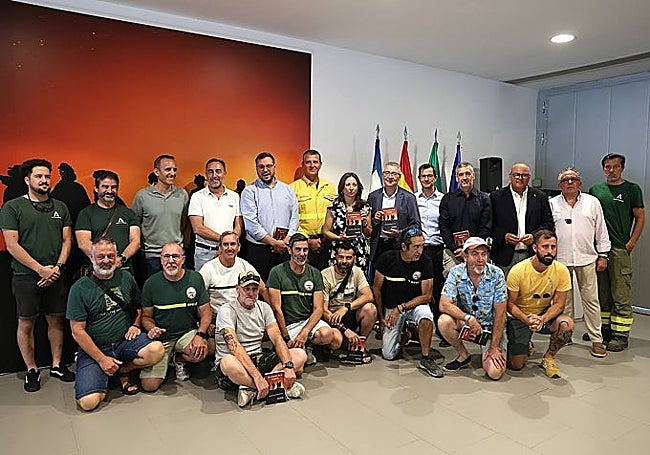
The exhibition and book launch was attended by numerous firefighters and members of Brica, who recalled some of the experiences they shared with Juanjo and Ñito during the fires in Villanueva de la Concepción, Pinos Puente, Víznar, Marbella, Casares, Tarifa and Mijas.
“The brigades not only welcomed us and taught us, but also protected us, so we will cherish their friendship forever,” said Salas, with Madueño echoing his sentiments regarding the bond and camaraderie shared with the firefighters.
Despite the large turnout, two of the units, 701 and 704, were unable to attend the event as they were responding to a fire. “I joked with them that they could come along and walk in smelling of smoke so that people could see that what’s in the book is true,” the co-author concluded.
![[]](http://static.vocstatic.com/voc26/latest/assets/images/favicon/surinenglish/apple-touch-icon-57x57.png)