
Gardening in southern Spain
The rock lotus
Orostachys is a genus of rosette-forming succulents belonging to the Crassulaceae family, closely related to sedums and sempervivums
Denise Bush
Orostachys is a genus of rosette-forming succulents belonging to the Crassulaceae family, closely related to sedums and sempervivums. Native to central and eastern Asia, with species distributed across China, Japan, Korea, Mongolia and Siberia, these plants have evolved to withstand dramatic temperature swings, poor soils and prolonged drought, making them far tougher than their delicate appearance suggests.
Common names are not widely used in English although sometimes it is called ‘dunce cap’, referring to the pointed, conical flower spike. In Japan it is commonly called iwaren-ge meaning ‘rock lotus’.
Orostachys form tight, symmetrical rosettes, typically five to 15cm in diameter, made up of fleshy, pointed or spoon-shaped leaves that are often tipped with a small spine. With around 15 recognised species and numerous cultivated forms, there is considerable variation across the genus; leaf colour ranges from grey-green and silvery to bronze, red-tipped or almost purple. Rosette size and shape can differ markedly between species. They are monocarpic, like Agaves, meaning the individual rosette flowers once and then dies, but not before producing numerous offsets that ensure the colony’s survival.
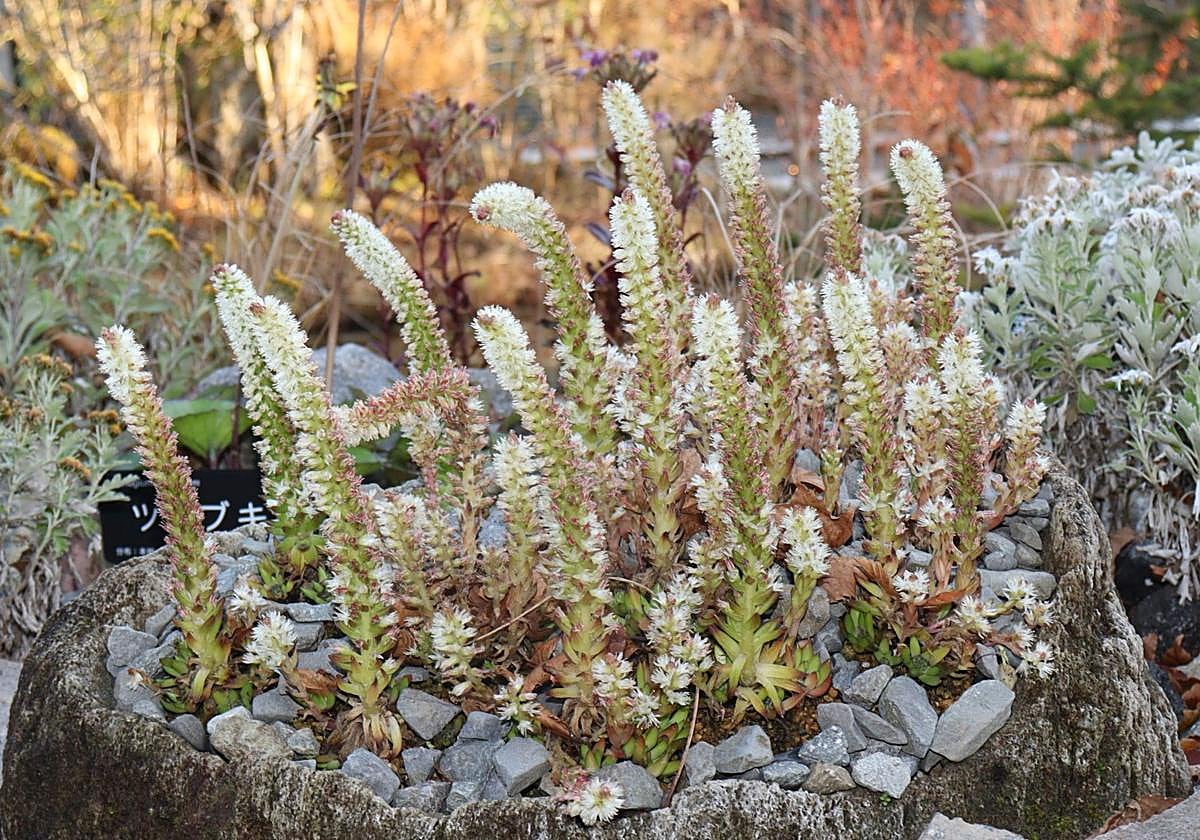
The flower spike, which appears in late summer or autumn, is a dense column of small star-shaped flowers in white, cream or pale pink, rising ten to 30cm above the rosette.
Orostachys is a good choice for Mediterranean gardens, provided that it has free-draining soil. In conditions that mirror the steppe and mountain habitats of their native range, these plants thrive in full sun, tolerate poor and rocky soils and are drought tolerant, once established. The main risk in southern Spain is not heat or drought but excessive winter wet, so raised beds, rockerie or gritty, free-draining compost are a must. Most species are relatively hardy to -15°C or below.
Propagation
Propagation is straightforward. Offsets can be detached and replanted in spring or early summer. Collected seeds germinate easily when surface-sown on gritty compost, although seedlings grow slowly in their first year.
Several species, particularly Orostachys japonicus and O. fimbriata, have a long history in traditional Chinese and Korean medicine, where extracts have been used for their anti-inflammatory, antibacterial and antitumour properties. Modern research is ongoing, with studies identifying flavonoids and other bioactive compounds of potential pharmacological interest.
![[]](http://static.vocstatic.com/voc26/latest/assets/images/favicon/surinenglish/apple-touch-icon-57x57.png)