
Seville
The ‘icy’ summer of 1976 in Andalucía
Fifty years ago, the futuristic and impressive Hielotrón opened in Seville. This huge ice surface under a dome, complete with winding paths and a hockey rink was then one of the first and largest permanent ice rinks in Spain, used by foreign skaters
Alekk M. Saanders
Seville
The ice rink in Seville opened in the spring of 1976. It was named ‘Hielotrón’ (‘hielo’ means ‘ice’ in Spanish), and it revolutionised leisure in the Andalusian capital.
The complex, built near the Montequinto district in Dos Hermanas, was designed by José Miguel de Prada Poole, an architect known as an expert in textile structures.
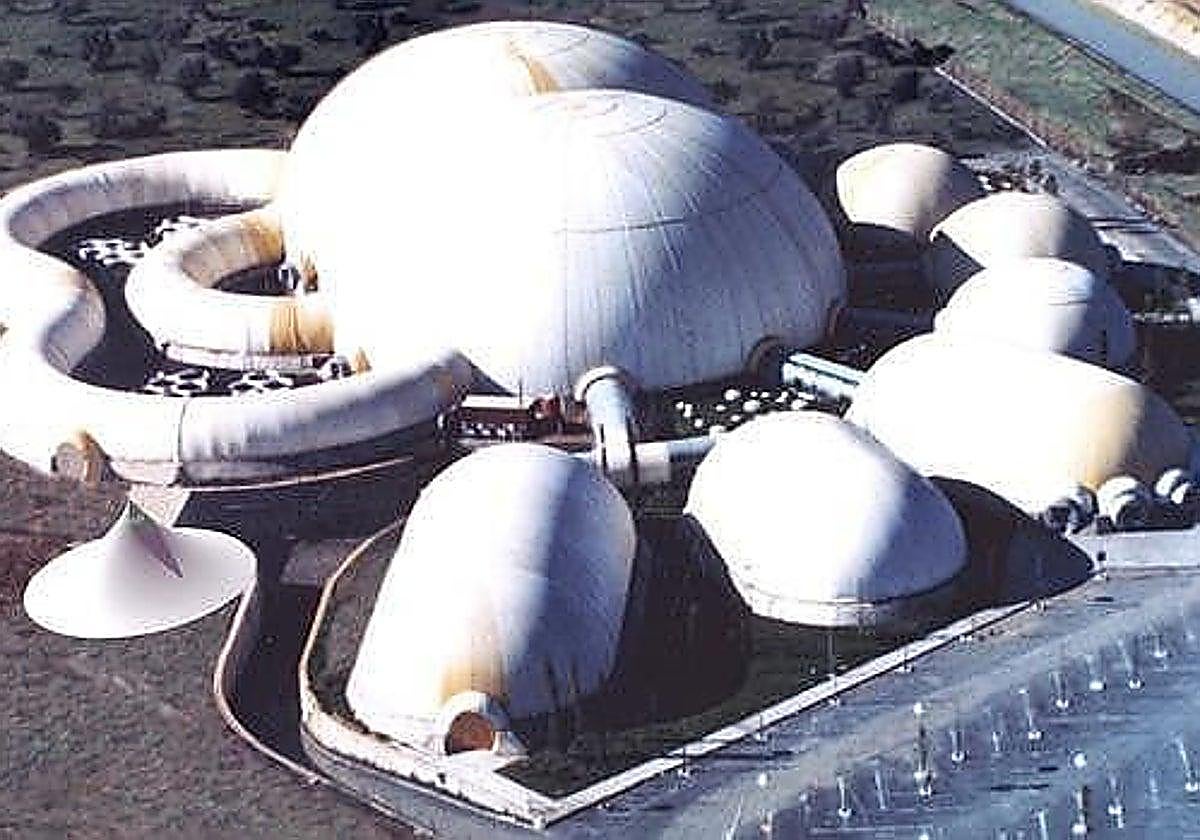
In 1971 the architect designed the Hielotrón, which was immediately dubbed ‘soap bubbles’
In 1971 the architect designed the Hielotrón, which was immediately dubbed ‘soap bubbles’. The structure consisted of synthetic fibre tarpaulins and cables, which were used to raise various roofs. This made it possible to create a variety of areas where visitors could skate along domed structures and footbridges.
Apart from the visual resemblance to soap bubbles, the complex’s buildings were also 'filled' with air. To keep them operational, huge fans forced air into the plastic casing and a system of revolving doors prevented air from escaping.
It is reported that in spite of this, the ice rink boasted low energy consumption. Such an innovative and avant-garde project went on to win the National Architecture Award in 1975 for its revolutionary concept.
'Space rink on ice'
From the very beginning, ‘Hielotron’ was promoted as a ‘space rink on ice’. The opening of this complex led to the establishment of a winter sports club in sunny and hot Andalucía. Club Hielo Sevilla was founded in April 1976.
For two years, its main sports sections were ice hockey and figure skating. In addition, the club also had sections for judo, equestrian sports and karting. There were swimming pools and a mini golf in the complex as well.
CH Sevilla was the first winter sports club in the history of Andalucía to train athletes in ice hockey and figure skating. The ice hockey players took part in official top-level Spanish competitions (including the national league) in both senior and junior categories.
Meanwhile, the figure skaters from various categories and disciplines participated in the 1978 Spanish Championships. Incidentally, some American ice hockey players stationed at the Rota naval base rented the Seville ice rink for training and to hold their ice hockey matches.
American ice hockey players stationed at the Rota naval base rented the Seville ice rink for training and to hold their ice hockey matches
The summer of 1978 was the coolest for local people because of the Hielotrón where everyone was able to enjoy ice. It is reported that a stir was immediately caused among the local population. A shuttle service was organised from the city centre. People from neighbouring towns also came and queued in long lines. What’s more, during its time in operation, the Hielotrón hosted music concerts, children’s shows, and even political rallies.
The summer of 1978 was the coolest for local people because of Hielotrón where everyone was able to enjoy ice in the Seville palace
Gone with the wind
Everything changed overnight. On the night of 23–24 February 1978, a tragic accident occurred. A violent storm, with gusts of up to 67 kilometres per hour, tore the roof off the sports complex. The canvas covering collapsed within ten minutes. Fortunately, no one was injured.
A few weeks later, the Hielotrón reopened mostly thanks to the efforts of the athletes themselves. Eventually, smaller domes were inflated, whilst the main rink where figure skating sessions were held remained open-air. However, this situation was temporary. By warmer April, maintaining the ice outdoors had become difficult and costly. The central dome was never restored.
The company that owned the sports complex eventually closed it down, forcing the ice club to cease operations. In August 2021 (the architect passed away on 11 August 2021) the building was finally demolished after many years of neglect and deterioration, and the site has been reallocated for new urban development.
That said, one can still come across fragments of tarpaulin and the foundations on which this pioneering project was built. It is worth noting that another work by José Miguel de Prada Poole was erected later in Seville. On the Isla de la Cartuja the architect designed the El Palenque, the iconic performance and concert venue for the Expo ’92.
![[]](http://static.vocstatic.com/voc26/latest/assets/images/favicon/surinenglish/apple-touch-icon-57x57.png)