
Science
Malaga ceramicist's 'quantum botijos' explain mysteries of physics at Cern
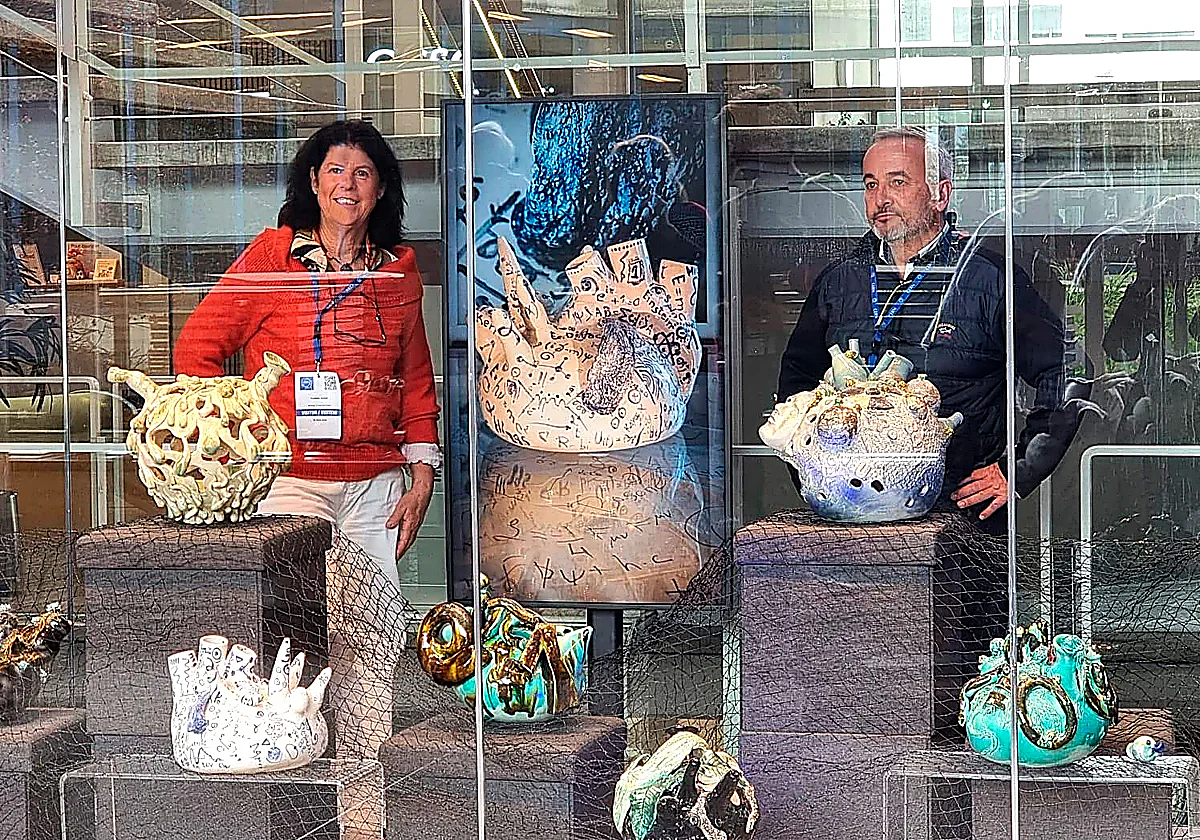
Artist Concha Cuadra, who is also an industrial engineer, uses the typical Spanish drinking vessel to reflect on concepts as complex as the Higgs boson, the Big Bang and Schrödinger's cat
Nuria Triguero
Malaga
Can a simple water jug explain something as complex as the Higgs boson? The traditional Spanish 'botijo' may be traditional, but it is not simple.
Malaga-born ceramicist and industrial engineer Concha Cuadra has chosen Spain's most archetypal drinking vessel to artistically represent the great concepts and mysteries of physics. Her work reflected in The Quantum Botijo exhibition has been on display at the Cern centre in Geneva - the world's leading particle physics research centre - since 30 March. The exhibition ends on 10 April.
Cuadra has presented a total of 20 ceramic pieces, each inspired by a different physical phenomenon and accompanied by a photograph by Santiago Martínez de Septién. Before arriving in Geneva, where scientists from all over the world study the ultimate structure of matter and the universe, the exhibition was on display at Espacio Cero in the University of Malaga.
That installation also included audiovisual pieces by mathematician and expert in computer simulations Jürgen Döllner, which could not be included in the Geneva exhibition. The three artists behind the exhibition combine backgrounds in physics and engineering with an artistic vocation.
Why use the traditional Spanish botijo as a source of inspiration? Cuadra says: "The botijo cools the water through evaporation and energy transfer, which involves the microscopic behaviour of molecules. In quantum mechanics, systems exchange energy in discrete quantities and the jug also manages the flow and dissipation of energy in a controlled manner.
"Furthermore, it maintains a balance between the water inside and the outside temperature, depending on the humidity and heat of the environment, similar to the principle of superposition, where a system can exist in multiple states until it is measured. Finally, the passage of water through the pores of the botijo is reminiscent of the quantum tunnelling effect, in which particles can pass through energy barriers that, on the surface, would seem insurmountable."
The artist states that she does not intend "to explain the Universe, but to open questions, because the complexity of everything that exists is perhaps already hiding in the simplest form of a water jug".
The exhibition is right at the entrance to the Cern auditorium, where the famous discovery of the Higgs boson was announced. Each jug bears the name of a key concept in physics and the universe: 'Big Bang', 'Black Hole', 'Schrödinger's Cat', 'Dirac Equation', 'String Theory'.
-U86637210464ltf-1200x851@Diario%20Sur.jpeg)
-U06420552768VZH-711x841@Diario%20Sur.jpeg)
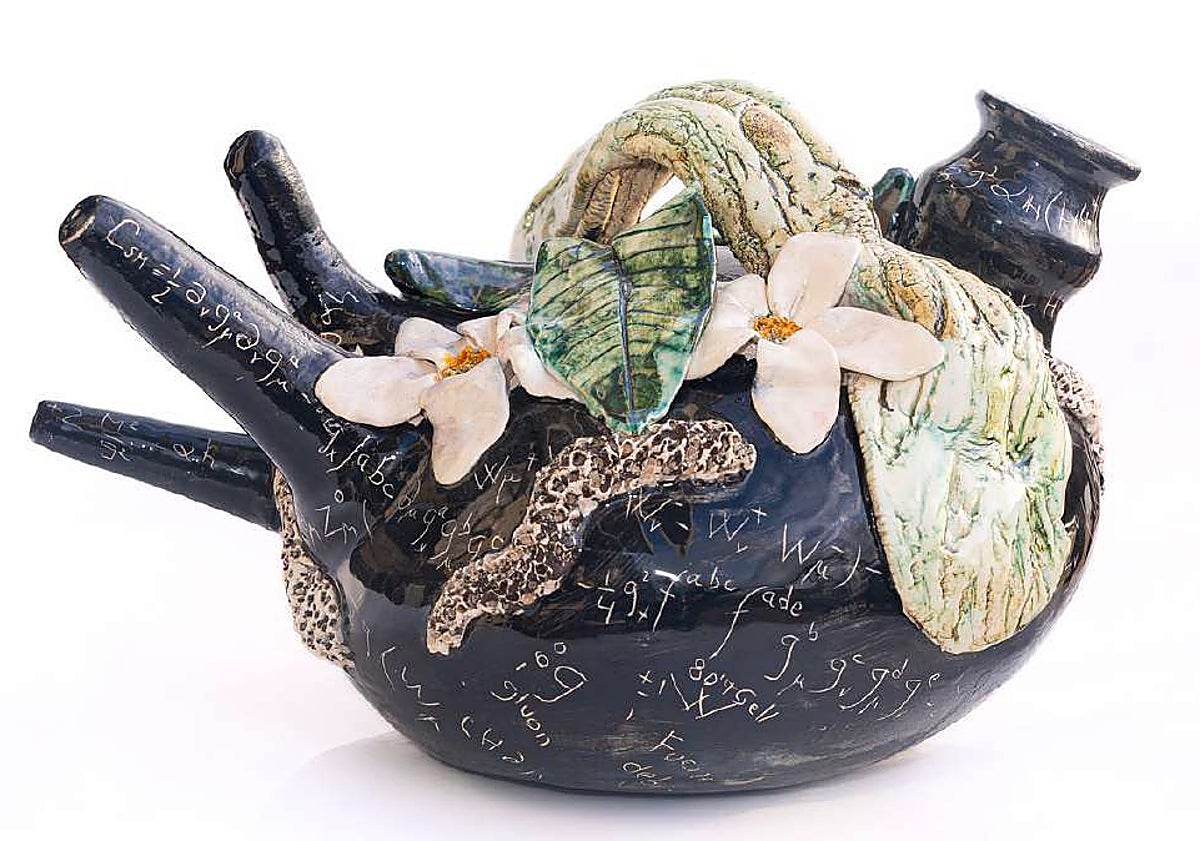
Of course, there is also a 'Higgs Boson'. "The surface of the clay water jug, covered in equations, displays the formulas of the Higgs theory, which mathematically express the existence of this invisible field that permeates the cosmos. Organic forms (flowers, leaves and tree trunks) emerge against this dark background as a symbol of the connection between physics and nature, reminding us that the fundamental laws of the universe are deeply intertwined with the reality that surrounds us.
The jug's multiple spouts, some elongated like test tubes, evoke the experiments conducted at the Large Hadron Collider (LHC), where the Higgs boson was first detected in 2012. The glazed texture, with its interplay of light and reflections, seems to bring the inscribed equations to life, as if the ceramic itself were vibrating with the energy of the subatomic particles," Cuadra says.
A circle that opens and closes in Geneva
For the Malaga-born artist, bringing her exhibition to Cern represents a full circle, since it was precisely there that the seed for 'The Quantum Botijo' was planted. Cuadra visited the laboratory in December 2024 and was "deeply impressed by the magnitude of scientific research and the human effort to understand the Universe".
The images and concepts she absorbed there matured in her mind and ultimately generated "the need to express that experience in a work of art". The result is this collection of works with which the artist reflects on the great questions of contemporary science.
"It was great fun putting together the exhibition, because all the Spaniards who work at Cern kept coming up to us. How could they not be drawn in when they saw the word 'botijo'!" jokes Concha Cuadra, who defines herself as a "ceramicist and conceptual artist". "I fuse traditional pottery with a deep scientific and philosophical exploration," she says.
A family with roots in science
An interest in science and the mysteries of the universe runs deep in Concha Cuadra's family. Her son, Federico Lozano, is currently doing a research stay at Nasa's renowned Jet Propulsion Laboratory (JPL) in California, working on optimising communications for lunar rovers using AI.
He is able to do so thanks to being one of nine young people from Andalucía selected to receive the Fulbright-Junta de Andalucía scholarship last year.
Federico Lozano graduated from the University of Malaga (UMA) with a degree in Telecommunications Engineering Systems and holds two master's degrees: one in Telematics and Telecommunications Networks and the other in Telecommunications Engineering. He is a predoctoral researcher in the field of Telecommunications Engineering, where he focuses on machine learning for improving space communications. He is a member of the SatCom research group, led by Beatriz Soret.
![[]](http://static.vocstatic.com/voc26/latest/assets/images/favicon/surinenglish/apple-touch-icon-57x57.png)