
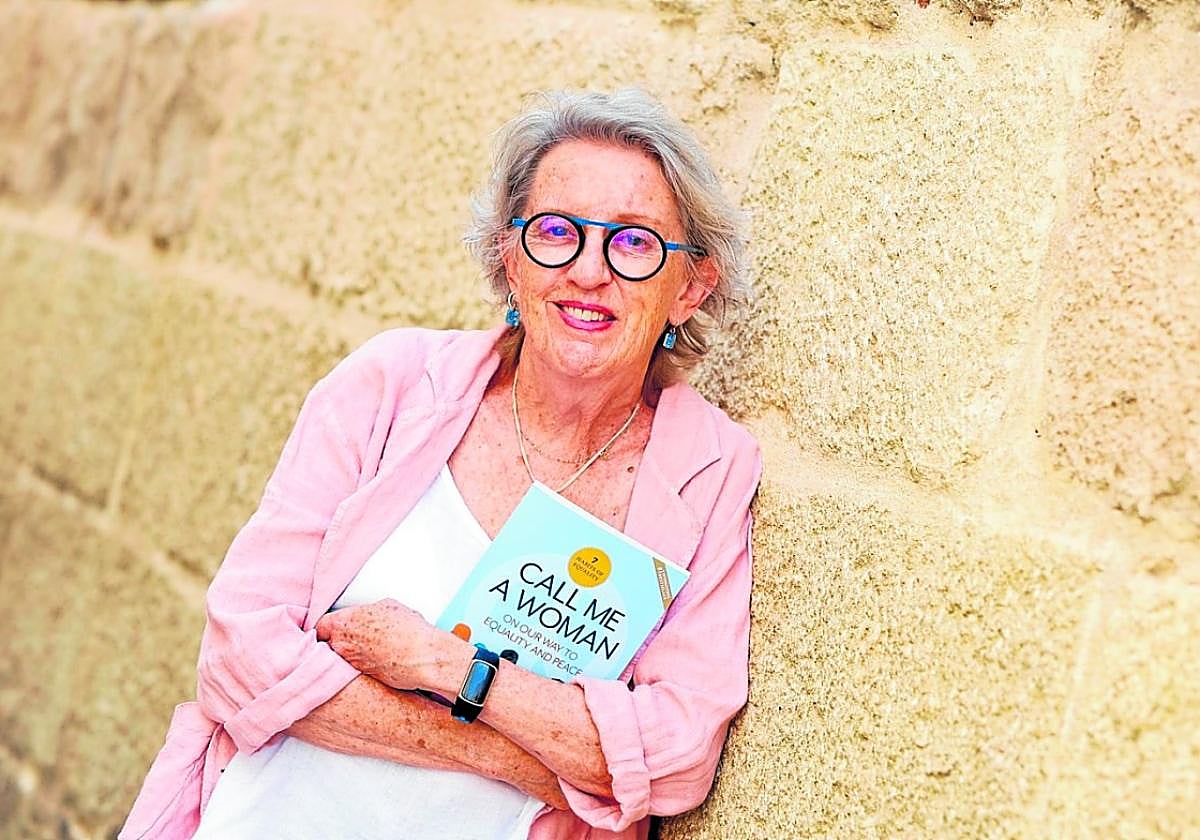
In the frame
From corporate America to the heart of Malaga
Laurie Levin, an American coach and feminist based in the city, talks about how to deal with the current political turmoil
Cristina Vallejo
Malaga
Laurie Levin was a businesswoman in the United States, in Saint Louis, Missouri. She worked for one of the largest market research companies in the country, of which she later became vice-president. Her clients were HP, Pizza Hut and Monsanto, among other multinationals. She likes business, research, data, working in a team for a client... but her last few years were tough: she felt that her career in corporate America had come to an end as well as a kind of cognitive dissonance between her concern for her own health and her veganism and having to work so that chips or biscuits sold better.
“My career in corporate America was wonderful, but there were a lot of things that were not good: the stress, the competitiveness, working between 60 and 80 hours a week. My daughter, my family, were a priority, I never missed a thing, but when my child went to bed, I went back to work,” she recalls. So she changed her work to help people improve their physical and mental health, even within the tense environment of her country, and worldwide.
She lived in the heartland of the US, in a state that Trump won by a landslide. Was it easy for a progressive, feminist woman like her? “I’m used to living with conservative people, naturally,” she says.
.
"Do you want to be happy or do you want to be right? Do you want wellbeing or to be right? It's better to be at peace"
But now, with political polarisation, as well as growing contempt for those who don’t hold the same views, is it still easy for liberals and conservatives to have conversations? Has communication between citizens worsened?
“We are in a bad situation in America, seriously bad. What we need is transformative leadership,” she argues. And she refers to a parable by Martin Luther King on how not to have a conversation: assuming that the other is inferior, or from a place of hatred or condemnation. And she also makes another key point: “Do you want to be happy or do you want to be right, do you want wellbeing or do you want to be right? It is better to be at peace.”
For such transformative leadership to be possible, she says, it has to rely on women, as she recounts in her book Call Me a Woman: “When women are at least 30% of the table, be it at a negotiating table, in parliament, in a company... we are better off, there is greater economic stability, greater happiness and peace. Although things are not inherently like this: women were not born like this; we have built social constructs for ourselves. That is why in my book I say that gender identity has ruined everything.
“We are all responsible for the mess we live in, for the fact that a man’s identity is based on domination and control, first and foremost, over women, who are taught to be inferior. Things have changed, but there is still inequality in the home as to who is going to be the provider, who is going to be the protector. We are all providers, we are all protectors. It should not be a man’s domain.”
Laurie Levin analyses the world and promotes wellness from Malaga, on a voluntary basis, for her friends. Why did she come to the Costa del Sol from the USA? For her daughter. After finishing her studies, her daughter went to Dublin because of Ireland’s historical links with certain parts of the United States, such as Boston.
To be closer to Europe, Laurie Levin moved to the East Coast, to the “blue island” (the colour of the Democrats) that is Charleston. Her daughter got married in Ireland, became pregnant, and within 24 hours of receiving the news, Levin decided to cross the Atlantic.
First she chose the Portuguese Algarve: “I wanted a country that lived by a code of peace, that wasn’t going to get itself into any wars.” But what she didn’t like were the cobblestoned streets of the Portuguese cities, dangerous for a woman who is a keen walker, but has fragile bones. Nor was she enthusiastic about the atmosphere.
So after a month, she came to the Costa del Sol. First, to Mijas. Then to San Pedro Alcántara. And finally here, because she needed to live in a big city.
From where she lives, she has Malaga’s main museums at her fingertips: “It’s really wonderful... the city’s beauty. the celebratory nature of the Spanish people because... I’ve never seen people as celebratory as the Spanish,” she enthuses.
She also notes, laughing, “this city attracts really wonderful people; the people I’ve met, including those who were born and raised here, they are very respectful, very kind and very peaceful.”
"I don't have local friends"
But she has no local Malaga friends. “This is either a problem or... an opportunity. None of the expats I know have any friends who are local. And we are a group of thirty or forty mostly European and Latin American friends who do things together every week... But it’s difficult if you don’t have a command of the language...” she says.
Returning to one of her areas of expertise, women’s rights, does she fear that Trump could endanger gender equality?
“The thing is there is no equality. The US is in a very bad situation, but it has never been good for many people: for women, for people of colour, for trans people, for homosexuals, for indigenous people. There is no country in the world with more opportunities, but they aren’t for everyone. The abolitionists took hundreds of years to free the slaves, the suffragettes began in 1848 to demand women’s suffrage and it wasn’t achieved until 1920. In the US, men and women have never been constitutionally equal,” she says. Recognising equal rights in the US Constitution is one of the aims of Democrats Abroad, a group Levin is active in in Malaga.
She is an unapologetic optimist: she assures us that the threats of regression are only temporary: “We are witnessing the collapse of racist patriarchy. It doesn’t mean it can’t resurge, but it’s just a violent reaction to the progress we have made. Let’s defend it. Let’s celebrate it.”
Though at this ‘impasse’ in the long history of progress the Trump administration makes decisions that impact the world: the severing of all international cooperation; and domestically, militarising several cities. She responds to each ‘but’ with hope: “Look at the polls, most Americans hate what is happening. Trump has only a 38% approval rating. I know that most Americans are not in favour of all this.”
Emotional management
She is trained, moreover, to cope with the news. Even the most horrible. She measures her heart rate, her stress levels, and monitors her thoughts. “I choose my response to each event. It’s not about emotions controlling you, it’s about you controlling them. And now I teach the technique,” she says. The journalist tells her that this is all very easy to say but difficult to apply. She challenges her: “Give me a couple of weeks, you’ll see how you’ll change your mind.”
Does her technique also help her deal with images of the great humanitarian crisis in Gaza when she, a Jew, has relatives who died for being Jewish in 20th-century Europe?
“Along with the illegal deportations done by the US, it is something that has broken my heart and makes me wonder how it is possible for me to live in a world that does this. I am Jewish. I grew up hearing that Israel can do no wrong. But the leader of that country is on the same level as Putin, Trump, Orban and Erdogan, all of the dictators.
“What the people in Gaza and the West Bank are suffering is a genocide. We are only 16 million Jews in the world, but for some reason our small population gets more attention than we deserve because people think we are a threat. And we are not. Unless we have a leader with all that power and the backing of the American military. Netanyahu has created uncertainty for Israel and for Jews around the world for generations. Now there are more people who hate Israel because the state kills innocent children and women,” she says.
![[]](http://static.vocstatic.com/voc26/latest/assets/images/favicon/surinenglish/apple-touch-icon-57x57.png)