
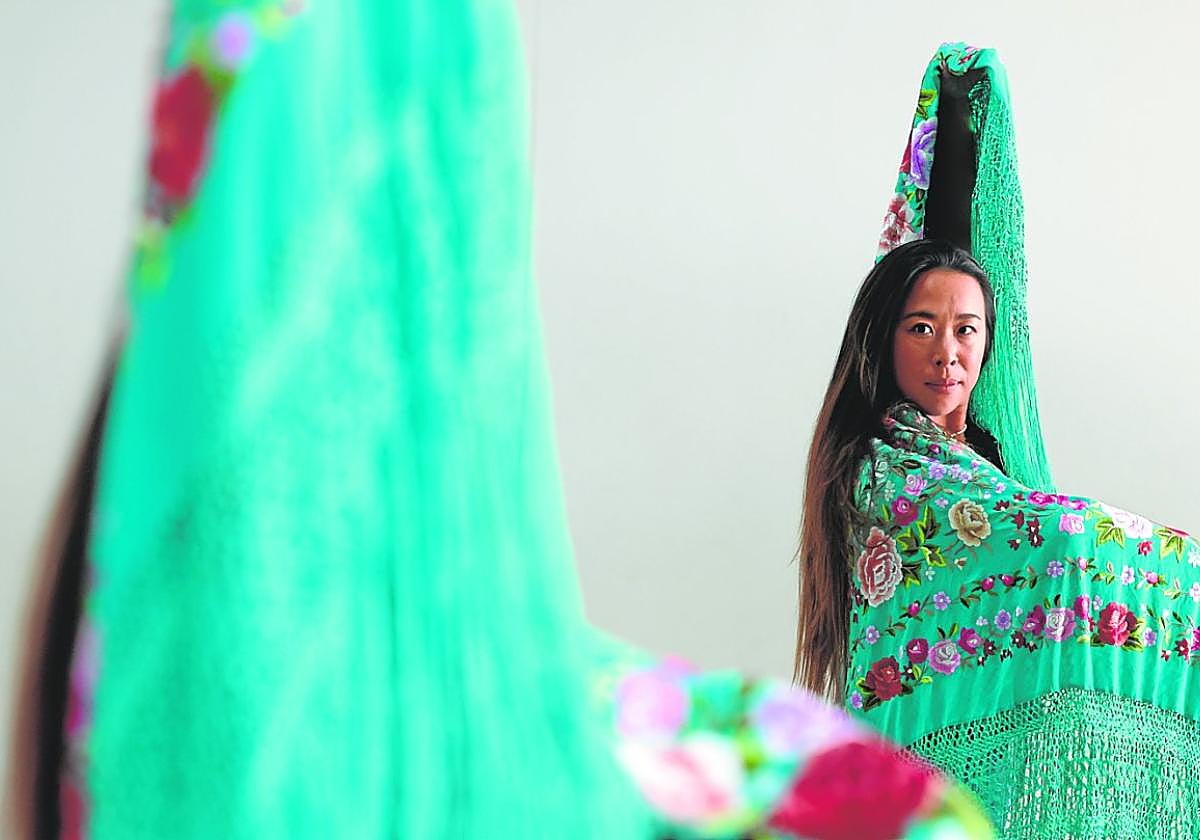
Ayasa Kajiyama: from synchro swimming in Japan to flamenco in Malaga
She gave up professional sport due to injury and started dancing 'sevillanas' and studying Spanish culture. She has now moved to Malaga, where she has created her own niche on the flamenco scene. This weekend she is teaching a special class
Cristina Vallejo
Ayasa Kajiyama is Japanese and came across flamenco almost by chance, when, in her youth, she was looking for a dance form that suited her classical training and that had a connection with the tradition, culture and idiosyncrasies of a people. Now she is amassing awards and giving performances at flamenco venues (tablaos) both in her own country and in Spain. This Saturday she will star in a masterclass at the Marina Aranda flamenco studio in Malaga (info@marinaaranda.es or 616285250).
Back in her home country, Kajiyama formed part of the national synchronised swimming team. She did not make it to the Olympic Games because she suffered a shoulder injury which, along with her discontent with the pressure associated with this professional sport, kept her from competing. She was already familiar with some dance, as classical ballet was compulsory in the training for her sport, but she wasn't really passionate about it. So she started to explore other dance forms, signing up for hip-hop classes, but she comments with a wry smile that her mother laughed at her when she saw her dance because, having been taught to maintain the classic postures imposed by classical ballet, she was unable to let her body relax, so it didn't seem to flow as it should.
She ended up going to a 'sevillanas' dance school in her Tokyo neighbourhood. The teacher also came from classical dance and her technique was more familiar to Kajiyama. She started dancing as a hobby, attending weekly classes, but she then met Benito García, a flamenco dancer (bailaor) from Cordoba, who lived in Japan and ran a school there. So she left her local school to join his.
"It's not just choreography," says the artist, who believes it is essential to get to know the culture and the meaning of the lyrics
That was where she began to sense her true connection with flamenco, because García's teachings were not limited to choreography: "He teaches culture, the essence of the Andalusian woman; you have to know where the movements come from or the reason for the lyrics," said Kajiyama.
Technique and street style
From then on came the prizes for her dancing and the scholarships she won to come to Spain to study flamenco. She had already sensed something about her developing style while still in Japan, but it was in Andalucía that she confirmed that she likes to mix strict technique with natural form, that is, the most academic dance with that of the street.
Over the last few years she has split her life in two between Spain and Japan. If at first she was unaware of the cultural differences between the two, now sometimes she does ask for less intensity from the Spanish and a little more 'express yourself' from her fellow Japanese.
Her home country has the second largest following for flamenco in the world. She has become so immersed in the essence of Spain, Andalucía and Malaga that she speaks the language not only perfectly, but she also uses all the idiosyncrasies typical of this area of southern Spain where she has now settled permanently with her partner, Sergio Aranda, a dancer she had admired long before they met.
She claims that she began to speak Spanish practically overnight after months of total immersion with only Spaniards and zero contact with her compatriots.
Although she now spends seasons in Japan to build her name and her art there too, she equally wants to get herself established in Malaga as part of the tablao circuit. She believes this circuit is on a smaller scale than those in Granada, Seville or Madrid - where she also performs - but she sees strong potential in the province, thanks to the abundance of tourists and local fans.
Her family in Japan had always assumed that she would never have a "normal" life since, from a very young age, she was already on the path towards high-competition sports. But it was actually her father, also a keen traveller and restless in his youth, who encouraged her to travel to Spain when she was starting out in flamenco. He even had to sign an authorisation form for her to be able to board the plane that would bring her to this country for the first time as she was under age.
An established school
Ayasa Kajiyama has prepared this Saturday's masterclass to be fun and participatory. She will dance tangos, a very festive flamenco style, as are bulerías and rumbas. It will therefore be almost a celebration of flamenco dance at the Marina Aranda flamenco school. The studio, on the west side of the city, opened in 2021 when the pandemic was in its last throes. Aranda, a flamenco dancer and singer, had also been giving classes online during lockdown.
She now has eighty students of all ages and levels and from time to time she organises masterclasses with leading figures such as this one. However, she does ask that, in order to spread enthusiasm for flamenco further afield, performances be adapted to both foreign and national tastes.
For example, one key change has occurred in the schedules: the shows no longer start at midnight because fewer people stay out that late. Change yes, but without losing the essence of flamenco.
![[]](http://static.vocstatic.com/voc26/latest/assets/images/favicon/surinenglish/apple-touch-icon-57x57.png)