
Artemis II mission
Orion spacecraft reaches Moon's dark side and completes farthest journey ever made
The Artemis II mission surpassed Apollo 13's record on 7 April by travelling more than 400,000 kilometres away from the Earth
Jon Garay
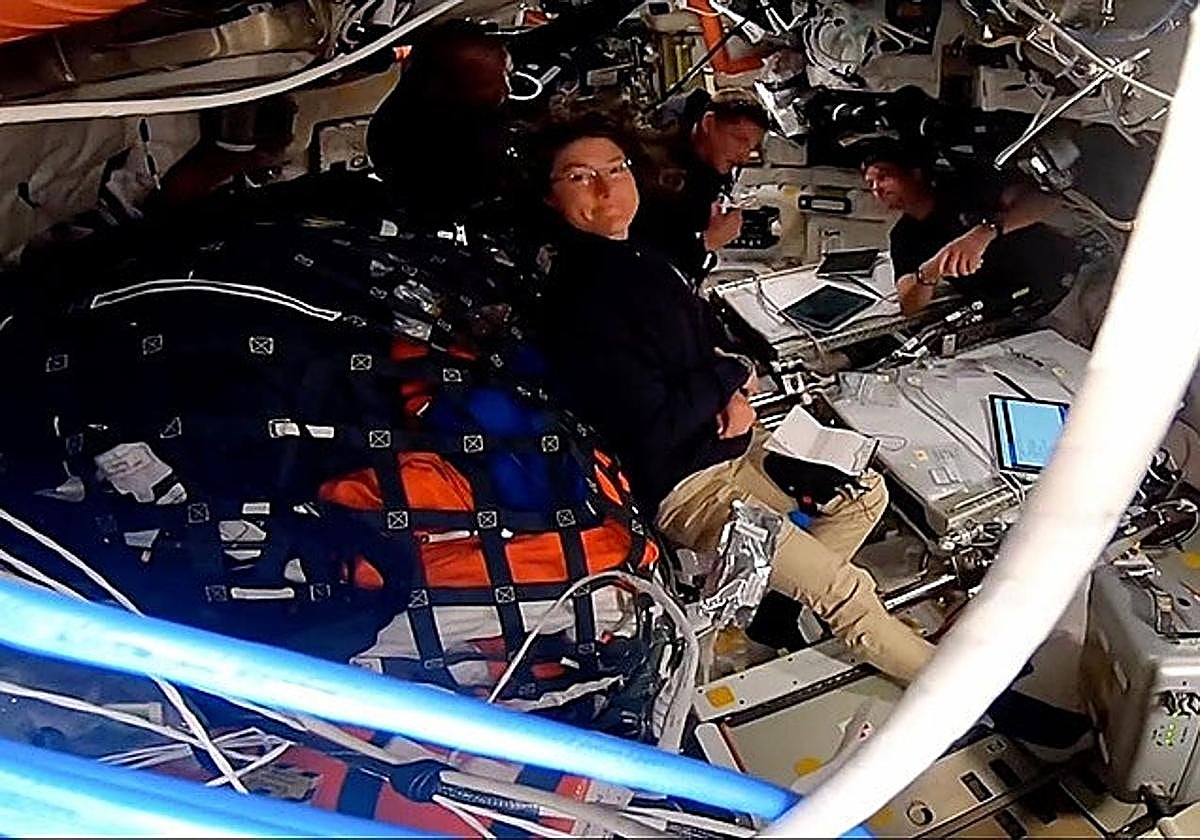
"We'll see you on the other side," astronaut Victor Glover said at 12.44am Spanish time on 7 April, minutes before the Orion spacecraft lost communication with Earth upon reaching the far side of the Moon.
The silence would last for about 40 minutes, the time it would take the spacecraft to appear on the far side of the satellite. At 1.35am, the crew re-established contact with Houston. "Hello Orion. We're ready to bring you home," Houston said. The return trip will take five days.
Orion has officially reached the farthest point away from Earth in human history: 406,772 kilometres. Minutes before that, it positioned itself about 6,530 kilometres from the Moon, just over the 5,800 kilometres that separate Madrid from New York in a straight line.
"We still feel your love from Earth. We love you from the Moon," Glover said.
Related story
It has been 53 years since humanity has been so close to Earth's satellite. In 1972, Apollo 17 landed on the Moon on its return journey. Until now, Apollo 13 held the record for the farthest spaceflight ever undertaken.
The pinnacle of this epic journey came when Reid Wiseman, Jeremy Hansen, Christina Koch and Victor Glover gazed directly at the far side of the Moon, the part of Earth's satellite that remains invisible from our planet. Through the spacecraft windows, they could see it roughly the size of a basketball, according to Nasa - a very different perspective from that of the Apollo 8 mission, when the flight came within just 112 kilometres.
"There's something in your senses that tells you it's not the Moon you're used to," Koch, the first woman to approach the satellite, said in an interview with NBC. In 2028, she will be the first woman to set foot on the Moon.
The flight over the far side of the Moon was scheduled to last six hours. During that time, the astronauts "applied the geological knowledge acquired in the classroom and in environments similar to the Moon" during their two-year training, which included survival techniques, operating the Orion spacecraft and the aforementioned lunar geology sessions.
They took photos of "impact craters, ancient lava flows and surface cracks and ridges formed as the Moon changed over time. They observed differences in colour, brightness and texture, which will provide clues for scientists to understand what the surface is made of and how it formed".
Toward the end of the six-hour flight, the astronauts witnessed a solar eclipse as the Moon passed between the spacecraft and the Sun for 60 minutes. To date, only China has successfully landed on this side of the Moon, which is much more rugged than the side we see from Earth.
iPhone for taking photos
To capture these historic images, the crew is using two Nikon D5 cameras and their personal cell phones. There are also four GoPro cameras mounted on the spacecraft's solar panels. Artemis II marks the first time Nasa has allowed astronauts to bring their cell phones. In all cases, it's the iPhone 17 Pro Max, Apple's most advanced model. "We're giving our crews the tools to capture special moments for their families and share inspiring images and videos with the world," Nasa Administrator Jared Isaacman said.
The most critical moment of this historic journey came when all contact with the crew was lost. For 40 minutes, it was impossible to communicate with the four astronauts. The reason was that the Moon came between Orion and the Deep Space Network (DSN) - a network of long-range antennas located in Madrid, Canberra (Australia) and Goldstone (US) that tracks its trajectory.
During its six-hour journey through deep space, Orion surpassed the record set by Apollo 13, the mission made famous by astronaut Jack Swigert's "Houston, we have a problem" message, alerting space agency engineers that one of the buttons on his spacecraft had begun flashing an alarming red. Last night, Artemis II travelled 406,772 kilometres from Earth, 6,000 kilometres farther than its predecessor.
![[]](http://static.vocstatic.com/voc26/latest/assets/images/favicon/surinenglish/apple-touch-icon-57x57.png)