
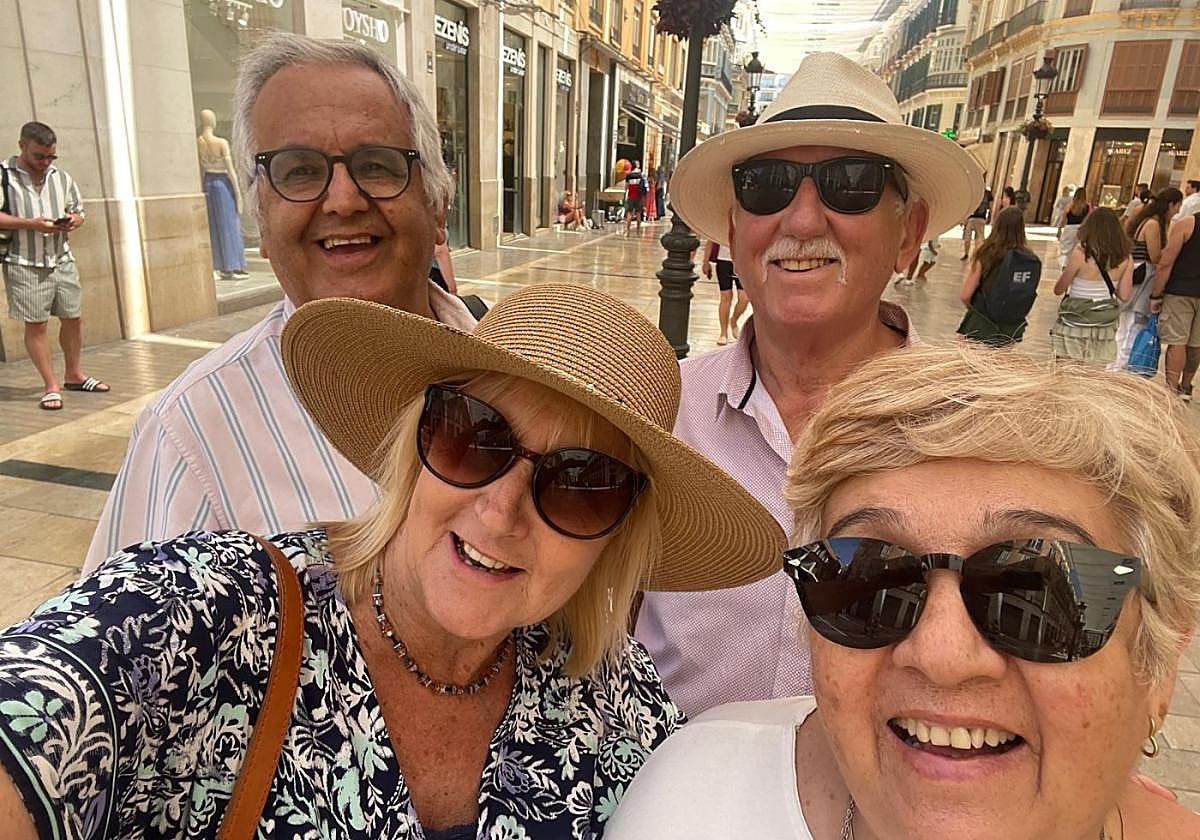
In the frame
Looking back on 25 years of 'The British on the Costa del Sol'
Professor Karen O'Reilly reflects on events that have affected the lives of Britons living in Malaga since she wrote the book, which shaped her PhD, in 2000
Jennie Rhodes
Malaga
In 2000 Professor Karen O'Reilly published her book The British on the Costa del Sol. It was the culmination of several years of research which started in the early 1990s and gave way to her PhD in Anthropology.
Karen and her husband Trevor, who was a key factor in the decision to focus her field of work on this "phenomenon", have been back on the Costa del Sol recently, meeting up with some of the people who featured in the book and others they have met over the years, during the time they lived on the Costa del Sol and on their regular trips. "I think we've been back just about every year," Karen remarks.
She explains that it was Trevor's desire to move to the Costa del Sol which paved the way to her research, although at the time Karen was more focused on her studies and hadn't considered emigrating. It was only when her university professor suggested that she should do research on Brits in Spain that she warmed to the idea.
"At the time the British in Spain were a phenomenon. Back in the UK the stereotype was negative and the media attacked the mainly working classes who were moving there, as well as focusing on it being a place for criminals. There was a different perception of the British in Spain, compared with those in France and Italy for example," Karen recalls.
"When I moved to the Costa del Sol I saw that there were all sorts of people living very nice lives, not at all how the media portrayed it back home," she explains.
Financial crisis
Gloria Uribe, president of Lux Mundi and her husband Leonardo appeared in the original book, as did other well-known names like Charles Betty and Cudeca founder Joan Hunt. While Joan and Charles have since died, Karen and Trevor are still in contact with Gloria and Leonardo and visit them whenever they come to Malaga.
SUR in English was also mentioned in the book as a "solid" part of the English-speaking community and having just celebrated its fortieth anniversary, "shows that there is continuity on the Costa del Sol", Karen points out.
The professor has written about the lives of Britons on the Costa del Sol since the 2000 book and a key paper was published in 2017, following a trip she made in 2015 to see how the 2008/9 financial crisis had affected the British community. In it she reflects that "whilst there is plenty of evidence of a return migration with bars and properties empty or for sale and fewer tourists and English speaking visitors of all types, there are some people, some businesses and some habits and cultural practices that have taken more of a hold and give evidence of longer-term settlement - practices, communities and institutions of solid rather than liquid form."
The quote demonstrates that while there was evidence that some people had been forced to go back to the UK after the crisis, many had stayed on, having built strong connections with their adopted home.
Brexit
The twenty-fifth anniversary of Karen's book was recently the subject of an academic debate recorded for The Sociological Review Foundation, a UK-based charity that aims to educate peopleon the subject of sociology and related disciplines.
The conclusion of the debate, which is available on YouTube, from the academics who took part, all of whom have used Karen's book in their own research on migration, was that there is plenty of scope for a follow-up book.
In 2017 Karen also published her BrexitBritsAbroad research, 'What does Brexit mean for British citizens in the EU27? Talking Brexit with the British in Spain', through Goldsmiths, University of London. The study looked into the immediate impact of the Brexit referendum on Britons living in Spain, before the country officially left the EU in January 2020.
Almost immediately after that, the Covid pandemic started and the two seismic geopolitical events had a major impact on British migrants and indeed second-home owners here.
More research
Karen admits that she is "no longer" on the Costa del Sol enough "to be able to comment" on how much has really changed for the British here. She highlights that there have been seismic geopolitical shifts in terms of Brexit and the Covid pandemic and of course the expansion of the internet in terms of communication and remote working.
"This all shows that people aren't free to make their own choices. There are other factors: in the 1990s people came during the mass tourism boom with cheap flights and accommodation as well as an increase in people's holiday leave and the property boom. Spain joined the EU in 1986 and then came freedom of movement," Karen points out.
Despite having retired from her position as Professor of Sociology at Loughborough University and Research Affiliate of the University of Oxford, she reveals that she is hoping to come back to Spain for an extended period of time in 2026.
The opportunity to reflect on what has happened in the 25 years since the publication of The British on the Costa del Sol and in particular the fallout from Brexit, the Covid pandemic and the expansion of the internet allowing for digital nomads and remote working, has given her plenty of food for thought: "I need to write another paper," Karen concludes.
![[]](http://static.vocstatic.com/voc26/latest/assets/images/favicon/surinenglish/apple-touch-icon-57x57.png)