
Film
The latest adventure of Don Quixote and his squire, Orson Welles
Spain's national film archive and three other European archives are joining forces to reconstruct the film that the great American filmmaker began shooting in 1957 and left unfinished

Madrid
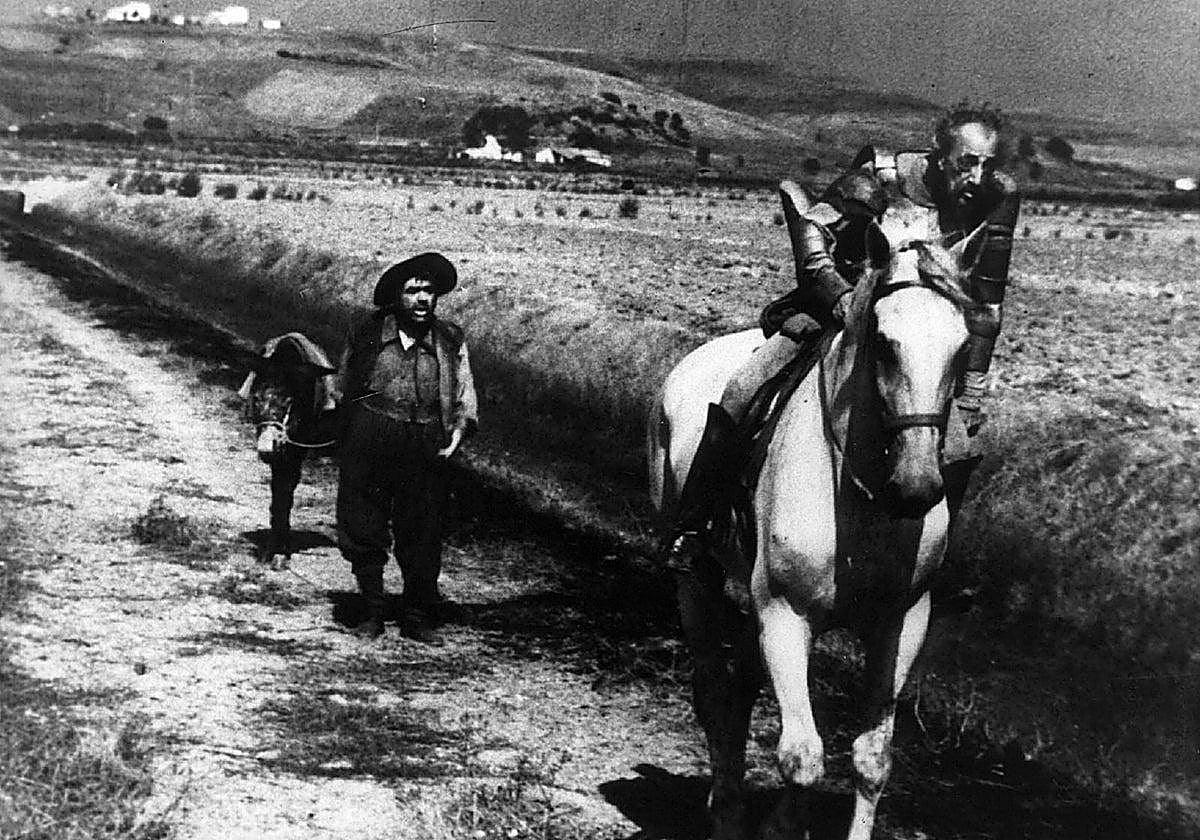
Four European film archives have joined forces to bring to fruition one of the most ill-fated projects in the history of cinema. The Spanish, ... French and Italian film archives, together with the Munich Film Museum (Germany), are set to reconstruct Don Quixote, the unfinished adaptation of Cervantes’ novel that Orson Welles began in 1957 and left unfinished upon his death in 1985.
Oja Kodar, Welles’s partner and artistic collaborator during the final years of his life, has given her consent to this project, which will use the original footage currently held by the Spanish film archive, the Cinémathèque Française, Cinecittà and the Filmmuseum München: 30 hours of scattered footage which, following Welles’s original script, will be edited into a film to be directed by the historian Esteve Riambau, author of four books on Welles and former director of the Filmoteca de Catalunya.
Orson Welles began filming his Don Quixote in the summer of 1957 in Mexico, with Francisco Reiguera, a Spanish exile, as Don Quixote, Akim Tamiroff as Sancho Panza and Patty McCormack as Dulcinea.
The following year, having settled in Rome, Welles continued filming with the same cast and had the reels brought over from Mexico to edit them, but the production of the film began to run into difficulties.
In 1961, he managed to secure funding from RAI for a television series about Spain, 'Viaggio nel paese di Don Chisciotte', which he used as an opportunity to shoot new scenes for his film, just as he did in the following years, while juggling this project with the filming of The Trial (1961) and Chimes at Midnight (1964).
In 1966, Welles - who identified with Don Quixote and was so passionate about this project that he called it ‘il mio bambino’ - cut the scenes featuring Patty McCormack, and in 1969 he dubbed some of the dialogue with his own voice.
In 1972, Reiguera and Tamiroff died, but the director continued to shoot scenes. In 1982, three years before his death, Welles stated that the film was "almost finished", but by that time there were at least three different versions of the film.
Attempt in 1992
The most ambitious attempt to bring Welles’s Don Quixote to the screen took place in 1992, at the Seville Expo, led by director Jesús Franco, who premiered his Don Quixote by Orson Welles using the original footage acquired by the Spanish Film Archive and scenes from ‘Viaggio nel paese di Don Chisciotte’.
However, he was unable to use the 50,000 metres of negative film held by editor Mauro Bonanni at Cinecittà, which was recovered by Oja Kodar in 2017.
Meanwhile, the Cinémathèque Française holds around eighty minutes of 35mm positives that were screened at the 1986 Cannes Film Festival and featured as part of the retrospective which, in late 2025, accompanied the exhibition My Name is Orson Welles.
The Spanish Film Archive, for its part, holds the 50,000 metres of 16mm and 35mm film it acquired in 1991, together with the rights to all existing materials, for cultural and research purposes; and finally, the Filmmuseum holds, in its collection dedicated to Orson Welles, materials relating to the Don Quixote project.
All these materials will soon be brought together in Madrid, according to the Ministry of Culture, and Esteve Riambau will examine them and compare them with the more than a thousand pages of script sequences that have been located, in order to reconstruct the film.
The task will be like piecing together a jigsaw puzzle, combining scenes shot in Mexico, Italy and also in Andalucía, some in black and white and others in colour.
The resulting material, “fully respectful of the director’s vision”, will be screened “at festivals and film archives on a not-for-profit basis”, emphasises Ernest Urtasun’s department.
“We are not going to invent anything or use special effects to fill in the gaps. We don’t work on the basis of hypotheses. The idea is to show the original as far as possible, but it’s like working on a mosaic with missing pieces,” Riambau told The Guardian.
![[]](http://static.vocstatic.com/voc26/latest/assets/images/favicon/surinenglish/apple-touch-icon-57x57.png)