
The vaping trap: 26.3% of Spaniards aged 14 to 18 admit to using vapes in the last month
Despite strict tobacco laws, nicotine addiction is surging, from the 15% of Spanish youths who smoke regularly to the €8 billion annual drain on public health, officials warn that e-cigarettes are reversing decades of decline

Moisés Rodríguez
Valencia
Some 26.3% of Spanish young people aged 14 to 18 have used e-cigarettes in the past 30 days was the devastating figure revealed ... in a survey by the ministry of health.
Experts are warning that these devices can cause potentially serious lung diseases and are more dangerous than conventional tobacco.
The Spanish anti-smoking law came into force at the beginning of 2006. Two decades later, these devices are the gateway through which nicotine hooks teenagers. The major challenge of the regulatory reform, which is already a draft bill in the process of being approved , is to put barriers in place for vapers.
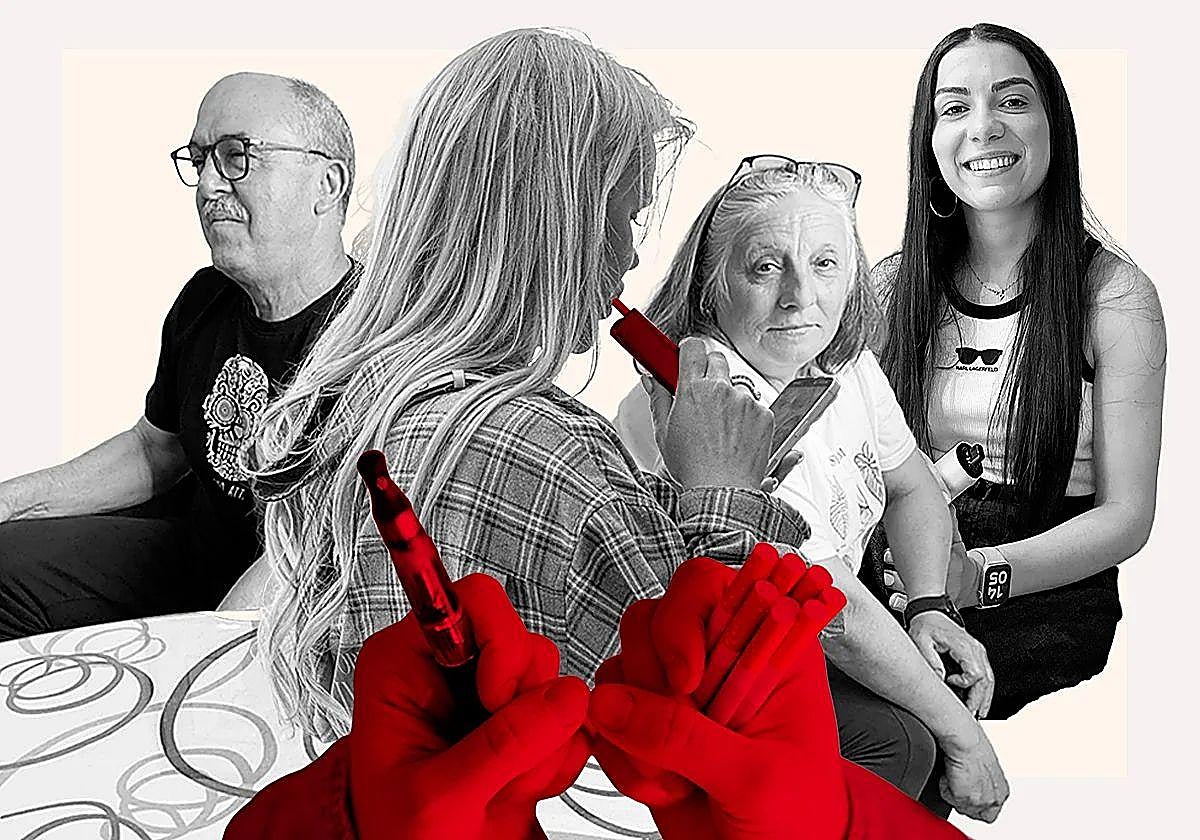
Vega is a young woman from Valencia who, at 21, has been vaping every day for five to six years: "At first it was just a silly thing to do when I went out to party. Most of my friends liked conventional tobacco, but I didn't, so I decided to vape."
The young woman is studying to be a teacher, plays sports and has health workers in her family: "My aunt, my mother... my sister is studying to be a nurse. I'm surrounded, I know it's bad. I try to give it up but I always end up falling. But I intend to quit in the future".
The sweet flavours offered like watermelon or lemon conceal the dangers in attractive packaging that is accessible to anyone. Nowadays, electronic cigarettes can be bought in tobacconists, as well as many other establishments.
For example, three friends, no older than 13, on a typical pre-teen whim decided to take up vaping. They go to one of those shops and, without being asked for any ID, are sold a vape.
There are many more experiences like this, such as a massive concert in Valencia where a group of lads in their early twenties are sharing a single vape; and a lad who can’t stop taking puffs from an electronic device inside a bar whilst watching a football match with his mates. “I only do it when I’m out partying,” he said in defense. But unlike traditional cigarettes, with e-cigarettes we all end up smoking: while conventional tobacco is banned in enclosed spaces, the new devices are not.
These new ways of smoking have sedfgfgfgt alarm bells ringing among anti-smoking organisations, which are urging a reform to the 2006 law. Anecdotal evidence supports their claims, as do the figures, which have tripled since the 2021 survey. A year ago, nearly half of young people aged 14 to 18 (49.5%) had tried these devices at some point in their lives, compared with just 17% in 2014.
“There is a misconception spread by big companies, particularly among young people, that these devices are not harmful to health and are not addictive, but the opposite is true. Consequently, those who are not conventional smokers end up becoming so,” warned Dr Carlos Jiménez, one of the founders of the Smoking Section of SEPAR (Spanish Society of Pulmonology and Thoracic Surgery).
This rise in vaping is also evident among adults, although the increase is not quite as dramatic: between 2022 and 2024, the figure has risen from 2% to 5%. “Vaping is a problem amongst young people. If we look at the young people who use this type of device, up to 70% are not conventional tobacco smokers, but we know that this practice triples the risk of them eventually taking up traditional forms of smoking,” explained Carlos Jiménez.
New technologies as a weapon against the Anti-Smoking Law which, a decade after its adoption, had taken effect. “Conventional cigarettes have lost their glamour, but half of teenagers have experience with electronic devices,” noted Josep Maria Suelves, first vice-president of the nationalcommittee for the prevention of smoking (CNPT).
In 2006, according to Estudes, the average age to begin daily tobacco use was 13.1. According to the 2025 report, this has risen to 14.1. 15.4% of Spanish teenagers are regular smokers. The Anti-Smoking Law has taken effect, yes, but experts believe there is still a long way to go.
The main focus has always been young people, because anyone who starts smoking at school age and becomes addicted finds it very difficult to quit later on. María José Montaner and Juan Manuel Santamaría started smoking as children, at a time when smoking was widely accepted. The heroes in the films always had one lit, and it was seen as a symbol of freedom in the late 20th century.
“We’d been smoking since we were 12 or 13. I remember we used to sneak into a friend’s father’s bar to get cigarettes,” he recalled. “We’d hide in a corner to smoke… but now, looking back, you realise that everyone could see the smoke from a distance,” she added.
This couple were smokers at a time when there were no laws banning tobacco. “You’d go to the doctor and he’d be smoking. I used to work with a lit cigarette,” she recalled. Until one day their daughter came home with some good news and a warning: “That she was pregnant, but that if we didn’t stop smoking, she wouldn’t let us hold the baby. That we’d see him, but we wouldn’t touch him.” And of course, for grandparents, this is a punishment that is not worth it, no matter how addicted they were to tobacco.
“We have two cigarettes left at home as a reminder. We gave it up three years ago,” said María José. They repainted their house in Pobla del Duc, where not even the best bloodhound could find a trace of nicotine today.
Smoke-free areas
This is what experts are calling for in the reform of the anti-smoking act. In addition to regulating new devices, they believe there is still a long way to go in this regard. “There are many health conditions closely linked to smoking, so it was also necessary to take action to protect passive smokers.
Initially, there was very strong opposition from the hospitality sector, but today there are reports highlighting that progress has been made in terms of customer comfort,” said Josep Maria Suelves.
The associations are calling for efforts to create even more smoke-free spaces, particularly in environments shared with vulnerable groups (children and people with medical conditions, especially respiratory ones) and in vehicles, including private ones. They want the colleague with whom one shares a journey to work or a business trip to be prohibited from lighting a cigarette and, of course, from vaping.
“At present, the figures show that smoking kills more than 56,000 people a year in our country, which amounts to over 1,000 a week. And this has not changed much in recent years,” stated Carlos Jiménez.
“There has been a reduction, albeit not a particularly significant one, in cardiovascular diseases. However, there has been a notable increase in lung cancer among women, a result of the boom in tobacco consumption among women from the 1960s or 1970s onwards. Tobacco is a silent killer; the consequences catch up with you when you’re 25 or 30.”
This expert cites statistics from 2023, which show that tobacco generates around 6 billion euros in revenue for the state each year. “It’s a lucrative business for the companies that sell tobacco. According to a study from that same year, tobacco consumption has cost the government 8 billion euros in direct expenditure on related illnesses. If we include the indirect costs, such as sick days and families left without support due to premature deaths, the figure rises to 25 billion,” Carlos Jiménez said.
Anti-smoking organisations are calling to completely ban the glamourisation of nicotine consumption. “The draft bill already covers e-cigarettes and other new formats, but it has not been forceful enough regarding public spaces and advertising. We believe that cigarette packets should be ‘plain’, without any design that might make them attractive,” said
Suelves. “Another necessary measure is to increase the price of tobacco to make it harder for young people to access cigarettes. And to fund methods that have been proven effective for quitting smoking,” explained Jiménez.
Sonia Cebrián is from Valencia; she sits on the board of the CNPT and, from her pharmacy in Pobla del Duc, is doing her bit to combat smoking. Thanks to her, María José and Juan Manuel have given up smoking, using one of the treatments (in tablet form; there is also a spray) that Jimenez described as “effective”.
“We run initiatives in primary schools, secondary schools and at the market. We hold workshops with the younger children and talks with the older ones. ” she said.
It’s a campaign whilst the draft bill takes shape as a reform of the 2006 law, which isn’t obsolete but needs updating: “We need stricter restrictions on smoke-free areas, plain packaging and higher taxes on nicotine.” Cebrián is aware that time is running out and issues a warning: “That draft bill still has to go through several stages and there will surely be opposition… but we need to treat new forms of smoking in the same way as conventional tobacco.”

Sonia Cebrián: "There are young people with irreversible respiratory problems due to vaping".
Cebrián helps those who want to quit smoking, she holds a Master’s degree in Smoking Cessation (PIUFET) from the University of Cantabria and is secretary of the CNPT; she warns that vaping is a ‘silent double killer’.
‘We are seeing cases of new lung conditions that do not occur with conventional tobacco. Ultimately, you’re not inhaling water vapour, but a range of substances at temperatures that affect our bodies,” she explained: “There are many cases among young patients, with numerous respiratory problems, many of them irreversible. There’s the well-known EVALI disease, which is closely linked to the use of e-cigarettes.”
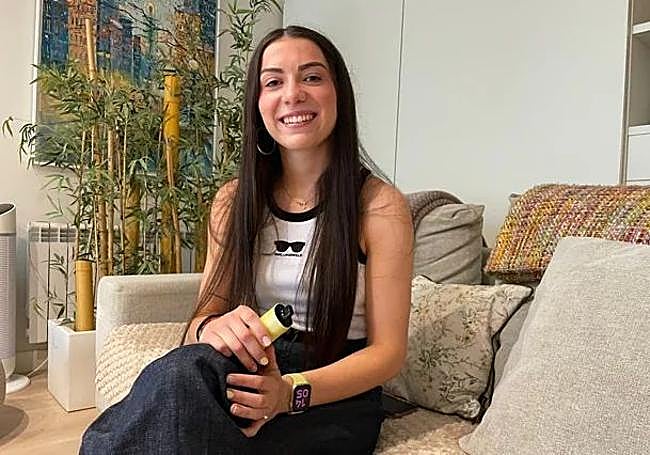
Vega Caballer: "The problem is that nowadays you can find a vape almost anywhere".
“We must be careful, because we’ll all end up ill.” Vega Caballer is studying to become a teacher and has been vaping for five years, but she is aware of how harmful her addiction is and wants to quit: “I work with children and I know I must convey the message that smoking is harmful. My view is that you need to exercise self-control, because you might start something you think is harmless and end up with a serious addiction.”
Vega has experienced this first-hand and, for that reason, considers regulation to be urgent: “The big problem is that nowadays you can find it almost everywhere. I started young, but now you walk down the street and see children vaping; I get the feeling they’re starting earlier and earlier.”
-U35710722553nXg-609x426@Las%20Provincias-kbyB--650x455@Diario%20Sur.jpg)
María José Montaner and Juan Manuel Santamaría: “Given all the information out there, it’s a shame that young people get hooked on smoking”.
María José and Juan Manuel broke their decades-long love affair with tobacco thanks to the love of their grandchildren. It was when their daughter became pregnant and told them she wouldn’t let them hold the baby that they decided to quit smoking.
“Sonia Cebrián really insists that people give up cigarettes. We plucked up the courage and managed it with pill treatment in 25 days,” recalled Juan Manuel. “On 8 June, it will be three years since we stopped smoking,” adds María José.
This couple encourages the younger generation to steer clear of nicotine. “With the information they have today, it’s a shame that they get hooked on smoking. They should take up sport and forget about tobacco, because it’s not worth it at all,” they proclaim.
![[]](http://static.vocstatic.com/voc26/latest/assets/images/favicon/surinenglish/apple-touch-icon-57x57.png)