
Health and wellness
The ten-minute technique to improve your agility
No gym, no weights. An 81-year-old scientist demonstrates the power of training lying down. You'll see results in just two weeks
Julio Arrieta
Is it possible to improve your agility and become more stable without breaking a sweat or lifting a single weight? A new study says yes, and the secret is not in the gym, but in a better place: the floor of your home. A team of researchers led by Yoriko Atomi, an 81-year-old professor emeritus at the University of Tokyo, has found that a programme lasting just ten minutes a day produces noticeable improvements in just two weeks. The key is that it is done in the supine (lying on your back) position, which Atomi herself found to be a breakthrough: "Although I am an expert in exercise adaptation science, this was the first time I considered this posture from a scientific perspective," she explains.
It all started when she herself began to feel discomfort. "Ten years ago, at the age of 70, I started to suffer from lower back pain and osteoarthritis of the knee, which made it difficult for me to walk. Her son Tomoaki, a physiotherapist and member of the Faculty of Health Sciences at Kyorin University in Tokyo, prescribed a series of exercises for her to do lying down. "At first I didn't understand why," she says. After two months, "I was able to move more energetically and comfortably than at any time in the previous ten years," she adds. "I was even able to go back to jogging.
This piqued his curiosity, since although lying down movements are common in physiotherapy and methods such as pilates, there is little experimental evidence of their effectiveness. So he decided to team up academically with his son and daughter-in-law, Aya Atomi (from Tokyo University of Agriculture and Technology), and set to work. The result has just been published in the scientific journal 'PLOS One'.
"We conducted two separate studies to evaluate the short-term effects of a supine exercise programme designed to link trunk stability and coordinated lower limb control. The results showed that this short-term programme can improve postural control, balance and flexibility.
How to move into practice
Why do these exercises lying down? Approximately half of our weight is in our torso, supported by a very small base (our feet). When standing, our body is so busy fighting against gravity that it strains us. When lying down, "in the supine position, the posture is biomechanically stable, which can suppress overactivity of the trunk and leg muscles," says Yoriko.
Let's get down to practice. To perform this routine, all you need is a comfortable surface or mat and 10 minutes of daily consistency. It's good to do all the exercises in one go: "Although each one is done separately, because the body is interconnected, they all form a cycle that involves the whole body," notes Yoriko. "It's important to do them just after getting up, after going to the toilet," when our body has not yet gone into 'standing mode'. This way, we activate it little by little, which is how it works best.
- At what age is it advisable to practice this routine?
- I think that, once a person grows up and is able to walk on their own, they should do this exercise in some form.
But Yoriko, from her own experience "as an 81-year-old who is still actively involved in research", recommends that office workers and people in their 40s and 50s make it their homework "every morning". Even if you are short on time, "just a few minutes is enough, but do it every day as soon as you wake up," he insists. For the rest, especially those who can't do it that often, "it's best to do it two or three times a week".
Abdominal activation
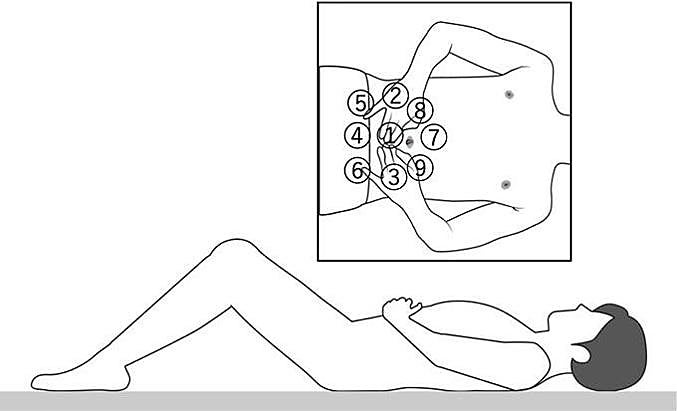
Lying on your back with your knees bent, place your hands on your belly. Imagine that your abdomen is divided into nine areas around the navel, with the first one slightly below the navel and the other eight surrounding it in a circle. Press lightly with your fingertips on one of these areas and contract the muscles in that specific area against the pressure of your fingers for five seconds. Relax and repeat the process in the other eight areas. Look for the contraction just below where you press. Do this cycle three times.
The trunk-leg link
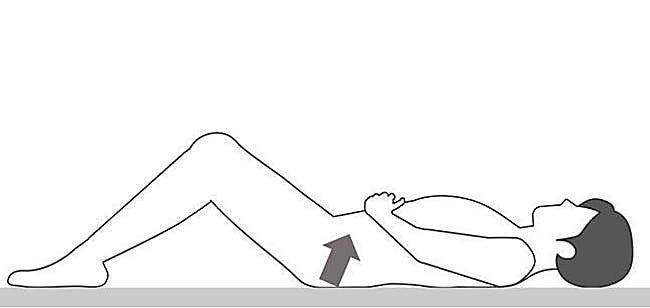
Keeping your knees bent, contract your abdomen and tilt your pelvis backwards, as if you wanted to stick your lower back to the floor. Then lift your hips slightly off the floor - just a few centimetres - and hold the contraction for five seconds. Repeat ten times
Heels and foot coordination
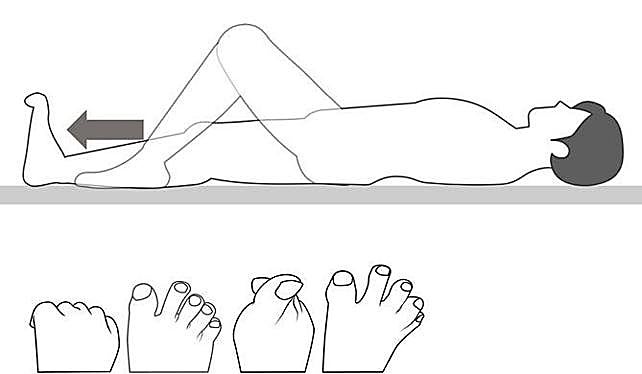
With your legs straight, bend one knee 90 degrees, supporting the sole of your foot. Flex your toes upwards and, keeping your ankle in this position, slide your heel along the floor, slowly stretching your leg until it is completely straight. At the end, push your heel down for five seconds as if you want to lengthen your leg. Repeat three times with each leg. And finally, with your legs straight, try these movements with your toes: close your toes tightly, lift only your big toe and spread all your toes as far apart as possible. Repeat five times.
![[]](http://static.vocstatic.com/voc26/latest/assets/images/favicon/surinenglish/apple-touch-icon-57x57.png)